
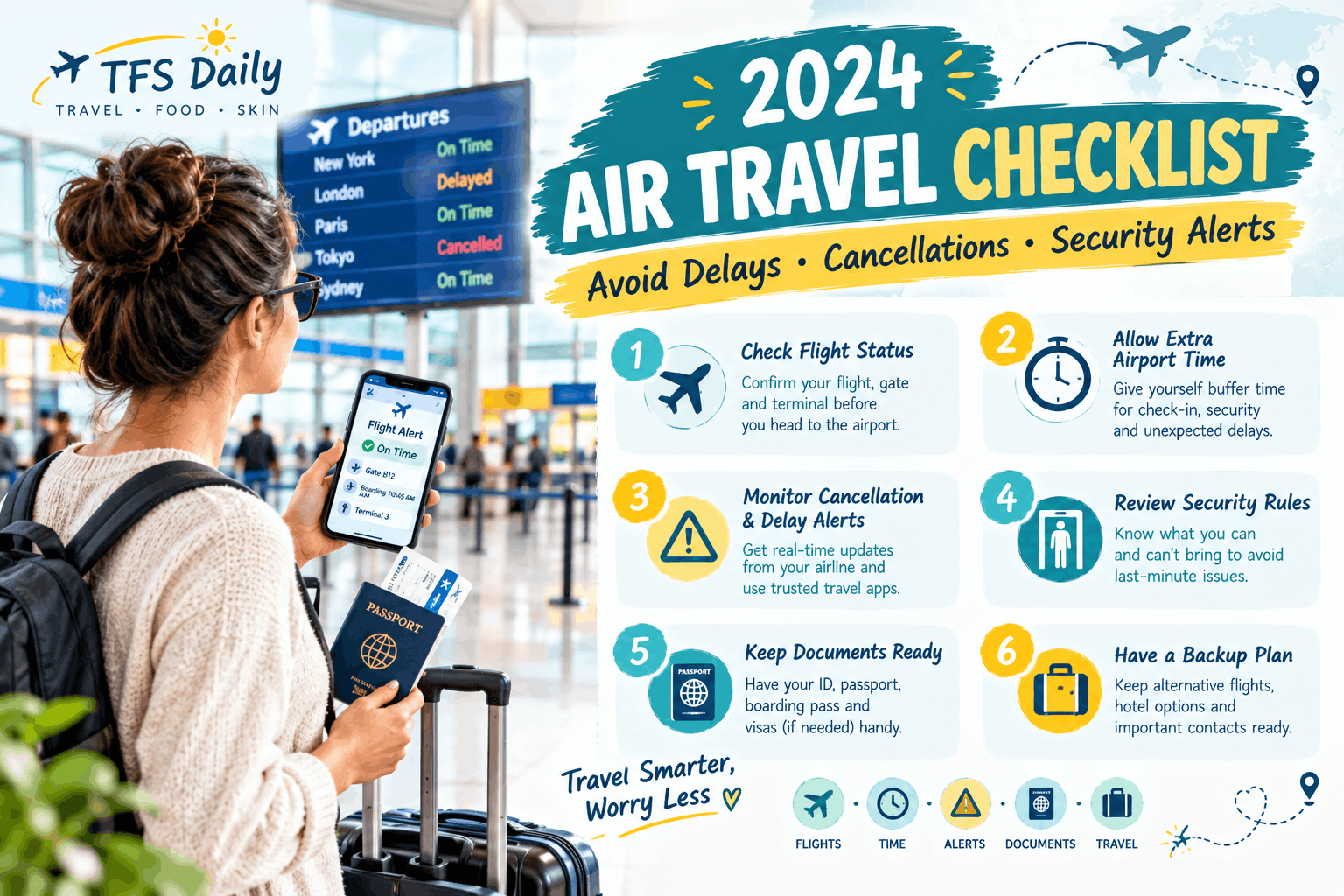
Navigating commercial aviation in 2024 and heading into 2025 requires a drastically different playbook than it did just a few years ago. Between widespread software outages, severe weather disruptions, staffing pinches, and shifting regulatory frameworks from the Department of Transportation (DOT), passengers face an increasingly unpredictable sky. To safeguard your itinerary, you need an actionable, proactive strategy rather than reactive troubleshooting at an overcrowded gate.
This comprehensive air travel checklist 2024 equips U.S. leisure and business travelers with essential tactics to bypass flight disruptions, master updated carrier protocols, manage security advisories, and leverage cutting-edge tools. Whether you are planning a domestic weekend getaway or an international long-haul voyage, following this post-disruption playbook ensures you remain calm, informed, and ahead of the crowds.
Why 2024 Is a Turning Point for Air Travel
The year 2024 marks a structural shift in global aviation. Following record-breaking operational disruptions—marked by widespread IT infrastructure meltdowns, severe convective weather patterns across major U.S. hubs, and air traffic control staffing shortages—airlines and regulatory bodies have overhauled daily operations. The U.S. Department of Transportation introduced mandates enforcing automatic cash refunds for significantly delayed or canceled flights, fundamentally changing how airlines interact with stranded passengers.
At the same time, geopolitical volatility has amplified the frequency of international flight plan alterations. The U.S. Department of State and overseas embassies issue real-time security updates that frequently lead to airspace closures, route diversions, and abrupt schedule changes. According to recent Bureau of Transportation Statistics (BTS) data, approximately 21% of domestic U.S. flights experienced delays exceeding 15 minutes in recent quarters, with operational disruptions cascading quickly through tight aircraft rotation schedules.
Key Takeaway: Flight disruptions are no longer occasional anomalies; they are structural realities of modern travel. Success depends on preparation long before you step foot in the terminal.
The 7 New Rules Airlines Are Enforcing After recent Operational Chaos
In response to passenger backlash and heightened federal oversight, major carriers have updated their contract of carriage conditions and gate operational rules. Understanding these new airline rules 2024 is crucial for avoiding unexpected friction during check-in or boarding.
Rule 1: Mandatory Health Documentation & Origin Screening
Certain international destinations and connecting hubs have updated their biological and health documentation protocols. Airlines now strictly enforce pre-departure health declarations and digital entry forms at check-in counters. Passengers who fail to complete regional health portals prior to boarding are routinely denied travel without recourse.
Rule 2: Revised Baggage Allowances and Strict Sizing
To accelerate boarding times and minimize overhead bin conflicts, legacy and low-cost carriers alike have tightened luggage restrictions. Gate agents now rigorously enforce carry-on dimension limits, forcing oversized bags to be checked at steep gate fees. If you prefer to skip luggage hassles entirely, exploring AI-driven luggage shipping services offers a seamless alternative that bypasses terminal bag drops altogether.
Rule 3: Real-Time Rebooking Policies and Automatic Refunds
Under new DOT guidelines, if your flight is canceled or significantly delayed (defined as 3+ hours for domestic and 6+ hours for international trips), airlines must provide prompt, automatic cash refunds if you decline rebooking. Furthermore, carriers have updated their mobile apps to offer real-time digital rebooking tokens directly to your smartphone, eliminating the need to wait in line at customer service desks.
Rule 4: Enhanced Passenger Identification Protocols
With the enforcement of REAL ID requirements at U.S. airport checkpoints, carriers and TSA screeners are strictly auditing passenger identification. Additionally, international hubs are rapidly rolling out biometric facial recognition at gate boarding turnstiles, requiring passengers to ensure their passport photos match biometric databases accurately.
Rule 5: Narrower Flexible Ticket Change Windows
While basic economy tickets remain largely rigid, main cabin and premium fares now feature altered ticket change windows. Many airlines require flight modifications to be finalized at least 60 to 120 minutes prior to scheduled departure. Failing to cancel or change your ticket before this window results in the complete forfeiture of ticket value.
Rule 6: Priority Boarding for High-Risk and Complex Routes
Routes operating through crowded airspace or high-security international sectors now feature updated boarding sequences. Passengers requiring secondary screening or visa verification must complete gate checks early, or risk having their seats reassigned to standby travelers up to 25 minutes prior to departure.
Rule 7: Mandatory Transparent Delay Notifications
Airlines are now obligated to update flight status logs within 30 minutes of becoming aware of a flight delay or cancellation. These updates must clearly state the reason for the delay (e.g., weather, mechanical, crew availability) within mobile app interfaces, directly impacting consumer eligibility for hotel and meal vouchers.
Understanding U.S. Travel Security Alerts and Their Effect on Flights
Navigating global travel requires tracking active US travel security alerts. Strategic awareness of how embassy alerts impact flight schedules allows you to anticipate re-routings before they happen.
How Embassy Alerts Are Issued
The U.S. Department of State issues travel advisories categorized from Level 1 (Exercise Normal Precautions) to Level 4 (Do Not Travel). Within these levels, local U.S. embassies publish immediate Security Alerts concerning civil unrest, atmospheric hazards, or regional airspace restrictions. When an alert involves commercial aviation infrastructure, airlines immediately initiate safety protocols.
Top 10 Countries with Frequent Travel Security Updates
- Haiti: Severe security risks leading to persistent commercial flight suspensions.
- Israel & Neighboring Regions: Airspace access changes dynamically due to regional conflicts.
- Ukraine: Complete commercial airspace closure remains in effect.
- Sudan: Ongoing security hazards keep commercial routes diverted.
- Ecuador: Localized security alerts impacting flight connections through major hubs.
- Mexico: State-level security advisories impacting regional transit corridors.
- Lebanon: Air carriers frequently alter or suspend flight schedules on short notice.
- Peru: Regional security updates affecting transport corridors around tourist centers.
- Turkey: Regional border updates requiring heightened security checks.
- Kenya: Security advisories affecting domestic transit and regional connection timing.
Typical Airline Responses to Security Alerts
When security alerts trigger operational changes, airlines usually respond in three distinct phases:
- Travel Waivers: Issuing flexible change fee waivers allowing passengers to alter dates or re-route without penalties.
- Rerouting: Adjusting long-haul flight paths around restricted airspace, often adding flight time and technical fuel stops.
- Suspension: Canceling direct service to affected regional airports until security audits satisfy FAA and international standards.
Tools for Monitoring Security Alerts
Stay informed by registering with the Smart Traveler Enrollment Program (STEP), a free service allowing U.S. citizens abroad to receive security updates directly from the nearest embassy. Additionally, subscribing to official State Department RSS feeds and monitoring real-time flight radar services ensures you are alerted to route changes before reaching the airport.
Step-by-Step Checklist to Prevent Disruptions
This master air travel checklist 2024 organizes your travel plan into manageable steps to minimize delay risks.
Phase 1: Pre-Booking Strategy
- Select Direct, Morning Flights: Early morning departures are statistically far less likely to suffer from cascading delay networks.
- Audit Layover Buffer Times: Build in minimum connection times of 2 hours for domestic flights and 3 hours for international connections.
- Evaluate Airline Operational Performance: Review on-time performance records for specific flight numbers using DOT consumer reports.
- Use Smart Search Strategies: Harness advanced flight discovery tools—such as using 4 ChatGPT prompts that actually work—to spot non-stop routing alternatives and budget-friendly backups.
Phase 2: Before Departure (48 to 24 Hours Out)
- Download Airline Native Apps: Enable push notifications for immediate gate changes and delay disclosures.
- Check-in Promptly at the 24-Hour Mark: Early check-in establishes your boarding position and standby priority in overbooking scenarios.
- Confirm Travel Documentation: Ensure your passport has at least six months of validity remaining beyond your intended return date.
- Enroll in STEP: Link your itinerary with the U.S. Department of State.
Phase 3: Day-of Travel Execution
- Monitor Incoming Aircraft: Use flight tracking apps to check where your inbound plane is originating.
- Arrive Early: Plan to arrive at least 2 hours before domestic flights and 3 hours before international departures.
- Pack Essential Medications & Valuables in Carry-On: Never pack critical items in checked bags, regardless of destination.
- Charge Backup Power Banks: Keep personal electronics fully powered to handle unexpected terminal waits.
Phase 4: Backup Plans & Contingency Mapping
- Identify Alternative Neighboring Airports: Know nearby hub options (e.g., JFK vs. EWR; O’Hare vs. Midway).
- Keep Customer Service Numbers Handy: Save carrier international support numbers, which often have shorter hold times during major domestic disruptions.
- Research Secondary Transport: Identify train networks or regional car rental options if your flight segment is canceled.
Choosing the Right Travel Insurance for 2024
A comprehensive flight disruption guide is incomplete without proper financial protection. Relying solely on basic credit card travel coverage often leaves coverage gaps during complex cancellations.
Coverage Types That Matter Most
- Cancel For Any Reason (CFAR): Offers the ultimate flexibility, allowing you to abort travel plans up to 48 hours prior to departure for partial reimbursement.
- Trip Delay Coverage: Reimburses out-of-pocket expenses for meals, lodging, and ground transport during long delays (typically kicking in after 3–6 hours).
- Trip Interruption Insurance: Covers the cost of earned, unused travel arrangements and additional emergency transportation back home.
- Emergency Medical & Evacuation: Vital for international travel, ensuring you are covered if medical emergencies require air transport.
Selecting the Right Policy
Compare policy coverage thresholds carefully across leading providers like Allianz, Travel Guard, and Berkshire Hathaway. Before purchasing, verify that your policy explicitly covers financial default of carriers and severe weather events. To find policy choices tailored to your specific destination, consider using independent travel insurance comparison tools to review side-by-side coverage limits.
Visa-Free Travel in Europe: Which Passports Give You the Edge?
For international travelers and dual citizens, passport strength significantly impacts transit efficiency through international customs control points during schedule changes.
Ranking the Strongest European Passports
According to recent European transit reports and global passport indices, EU passports consistently rank among the world’s most powerful travel documents. Passports from nations such as Spain, Germany, France, Italy, and the Netherlands grant seamless visa-free access to over 190 worldwide destinations.
| Country / Passport | Visa-Free Destinations | Transit Advantage |
|---|---|---|
| Spain / Germany / France | 194 | Priority EU automated border clearance lanes |
| Italy / Japan / Singapore | 193–194 | Instant dual-nationality transit processing |
| United States | 189 | Global Entry eligibility and expedited TSA PreCheck |
Implications for Dual Citizens
If you hold dual citizenship featuring a top-tier U.S. and European passport, strategically utilizing both can greatly simplify chaotic international layovers:
- Use the EU Passport in Europe: Bypass lengthy non-EU immigration lines during tight international connections using automated e-Gates.
- Avoid Regional Visa Hurdles: Eliminate the need for temporary transit visas during unplanned diversions through secondary European airports.
- Leverage Combined Perks: Pair European border convenience with high-end transit strategies like first-class travel upgrades to maximize comfort during unexpected layovers.
Tech Tools & Resources to Stay Ahead of Changes
Modern travel disruption resilience relies on leveraging the right technology stack. Deploying these digital tools puts critical information at your fingertips:
1. Advanced Flight Tracking Apps
- FlightAware & Flightradar24: Monitor live global radar feeds, tail numbers, and real-time inbound aircraft positions long before gate announcements.
- App in the Air / TripIt Pro: Aggregate terminal maps, real-time security line wait times, and connection alerts automatically from your email itineraries.
2. Automated Alert Services & Aggregators
- Google Alerts: Set notifications for specific airport codes or carrier updates if traveling during storm windows.
- Airline Mobile Apps: Enable push notifications, location permissions, and SMS updates for instantaneous gate changes.
3. AI-Driven Itinerary Managers
Emerging artificial intelligence platforms analyze historic flight data and real-time weather vectors to predict potential delay risks hours before carriers officially update board schedules. Using these apps gives you a decisive head start when rebooking ahead of thousands of affected passengers.
FAQ – Quick Answers to Common Concerns
Can I get a refund if my flight is canceled due to a security alert?
Yes. Under U.S. Department of Transportation regulations, if an airline cancels your flight segment for any reason—including regional security alerts, weather, or operational failures—and you choose not to accept their rebooking option, you are entitled to a full cash refund back to your original payment method, rather than mandatory airline vouchers.
Do the new airline rules apply to domestic flights?
Most updated airline guidelines—such as mandatory delay communications within 30 minutes, streamlined digital rebooking tools, and tightened carry-on size enforcement—apply across both domestic U.S. routes and international departures originating in the U.S. However, international long-haul flights may feature different statutory thresholds for cash compensation under international agreements like the Montreal Convention or European Regulation EC 261/2004.
What is the best way to rebook if my connection is missed?
If you miss a connecting flight due to an incoming delay, immediately use your airline’s official mobile app to secure open seats on upcoming departures. Simultaneously, call the carrier’s customer support line or visit a dedicated airside customer service desk. If customer service lines are exceptionally long, contacting the airline’s international support numbers or accessing elite phone lines can connect you with an agent significantly faster.
Final Checklist: Ready for Departure
Air travel in 2024 and 2025 demands proactive management, realistic layover buffers, and robust digital tools. By using this post-disruption air travel checklist 2024, monitoring embassy alerts, and understanding your rights under updated DOT rules, you can tackle unexpected schedule changes with complete confidence. Prepare your backup options ahead of time, keep your tech updated, and enjoy a smoother, stress-free travel experience.



5 thoughts on “2024 Air Travel Checklist: Avoid Delays, Cancellations & Security Alerts”
Comments are closed.