
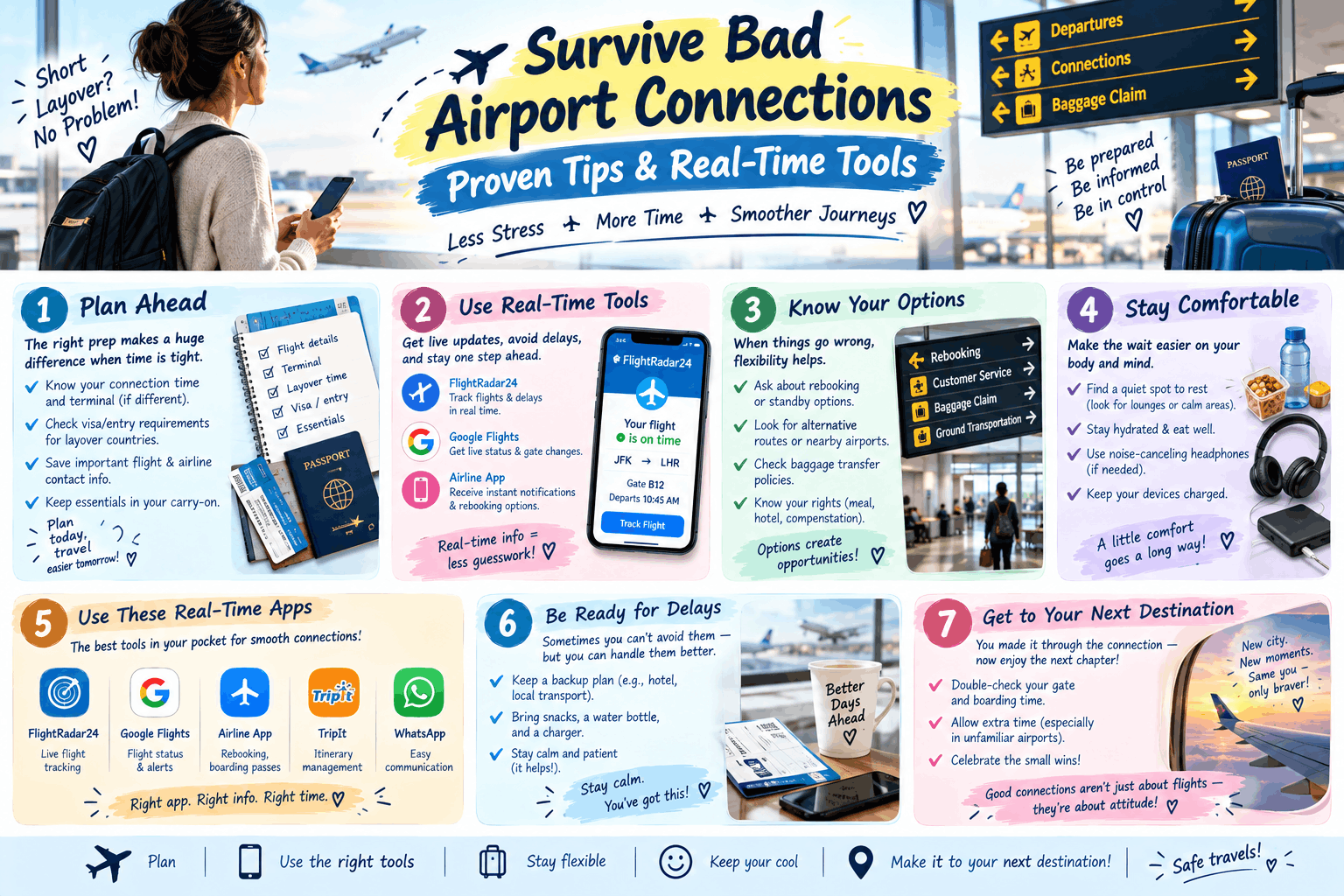
Surviving a connecting flight at an airport notorious for delays, sprawling terminals, or endless security lines requires more than just luck—it demands an active operational strategy. Whether you are dealing with a tight 45-minute window at Chicago O’Hare or navigating miles of concourses in Atlanta, missing a connection can derail business meetings, spoil vacations, and cause unnecessary travel stress. The secret to mastering a bad airport transfer lies in aggressive pre-flight planning, leveraging real-time tracking software, knowing the layout before your boots hit the jetbridge, and acting fast when disruptions occur. By implementing practical connecting flight tips for bad airports, you can turn a potential travel disaster into a smooth, manageable layover.
Why Some Airports Are Nightmare Connections
Not all airports are created equal when it comes to connection reliability. Aviation industry metrics measure transfer stress using several core indicators: Minimum Connection Time (MCT) adherence, average departure and arrival delays, terminal layout complexity, and passenger amenity accessibility. Minimum Connection Time is the legal minimum threshold determined by airport authorities and airlines for a passenger to transfer between flights. However, MCT calculations frequently assume ideal operational conditions—zero tarmac holds, immediate gate availability, light security lines, and swift deplaning.
Recent travel data highlighted by major media outlets, including the Washington Post’s analysis on the worst airports if you have a connecting flight, shows that hubs like Chicago O’Hare (ORD), Newark Liberty (EWR), London Heathrow (LHR), and Charlotte Douglas (CLT) consistently rank as challenging transfer points. Physical bottlenecks—such as single-lane security checkpoints, satellite terminals connected solely by overcrowded shuttle buses, and inadequate staffing at regional-to-mainline gates—transform routine layovers into high-stress obstacle courses. Understanding these structural vulnerabilities is your first line of defense in airport layover survival.
Pre‑Flight Planning: Setting Yourself Up for Success
Your connection survival strategy starts weeks before you step on board. When booking flights through high-risk transfer hubs, ignore the bare minimum connection times calculated by airline engines. While a 40-minute layover at Charlotte (CLT) or Detroit (DTW) might be legally allowed, any minor tarmac delay or gate hold will cause you to miss your next leg.
- Buffer Your Timelines: Aim for a buffer of at least 90 minutes for domestic connections and 2 to 3 hours for international transfers requiring customs re-clearing. If traveling with young children, elderly family members, or mobility assistance, extend domestic buffers to 2 hours minimum.
- Protect Your Booking: Always book your entire journey under a single airline ticket or airline alliance code-share agreement. This ensures that if you miss a leg due to operational delays, the carrier is legally obligated to rebook you on the next available flight at no extra charge and cover overnight accommodation where mandated. Self-transfer itineraries booked across separate non-partner airlines carry zero consumer protections.
- Strategic Seat Selection: Review a comprehensive air travel checklist prior to departure. Selecting a seat near the front of the aircraft in an aisle position can save you 10 to 15 crucial minutes during deplaning, which often makes the difference between catching a flight or standing in a rebooking line.
- Baggage Considerations: If your layover is under 60 minutes at a major bottleneck hub, consider traveling carry-on only. Checked bags frequently fail to make tight transfers even if you physically sprint and manage to board in time.
Real‑Time Tools & Apps to Stay Ahead
When navigating a chaotic airport, information velocity is everything. Traditional terminal flight boards are updated on a delay; by the time a gate change is published on an overhead monitor, hundreds of passengers are already racing toward the new location. Mobile technology gives you the upper hand when learning how to navigate busy airports under pressure.
Flight-Tracking & Navigational Software
Download real-time flight tracking applications such as FlightAware, Flightradar24, or App in the Air. These platforms track incoming aircraft tail numbers, allowing you to see if your connecting plane is delayed hours before the airline officially announces it at the gate. Furthermore, download the official mobile app for every airport on your itinerary. Hub-specific apps for airports like Detroit Metro (DTW), Chicago O’Hare (ORD), or London Heathrow (LHR) feature interactive indoor navigation, step-by-step walking distance calculators, and live TSA wait-time monitors.
Monitoring Weather Waivers
Keep an eye out for news alerts and airline app push notifications regarding weather waivers. As highlighted in Forbes coverage on airline travel waivers, carriers routinely issue proactive rebooking waivers during severe weather events. Enable all push notifications on your airline’s app so you can accept automated flight changes or rebook directly from your phone while other passengers are still stuck in line at the customer service desk.
Airport‑Specific Survival Strategies
Each major connection hub has its own quirks, shortcuts, and systemic traps. Mastering the specific layout and transit systems of the worst airports for connections gives you a massive tactical advantage.
Detroit Metropolitan Airport (DTW)
Detroit’s McNamara Terminal is over a mile long from end to end. If you land at Concourse A and have a connection at the far end, walking can take up to 20 minutes. Instead, use the indoor Express Tram located on the upper level, which stops at three key stations along Concourse A (South Station, Center Station, and North Station). If transferring between the McNamara Terminal (Delta and SkyTeam) and the Evans Terminal (non-SkyTeam carriers), note that you must take a landside shuttle bus and re-enter security screening—factor in at least 45 to 60 extra minutes. DTW offers reliable, free high-speed Wi-Fi throughout both terminals and plenty of quiet seating pockets near the lower gates on Concourse B and C.
Chicago O’Hare International Airport (ORD)
Navigating ORD requires understanding its terminal layout. Terminals 1, 2, and 3 are connected airside via walkways, allowing transfers without re-clearing security. However, Terminal 5 (international arrivals and select departures) requires exiting the secure area and taking the automated Airport Transit System (ATS), commonly known as the ‘People Mover’. If transferring from Terminals 1-3 to Terminal 5, or vice versa, budget at least 60 to 75 minutes for transit and TSA re-screening. For unexpected delays, look for the ‘Quiet Zone’ and urban garden area located in Terminal 3 (near Gate G1), which offers comfortable seating, soft lighting, and charging outlets away from the main concourse noise.
Hartsfield-Jackson Atlanta International Airport (ATL)
As the world’s busiest airport, ATL relies on its subterranean transit system, the Plane Train, which connects Concourses T, A, B, C, D, E, and F. While the Plane Train runs every 2 minutes, concourses can get severely bottlenecked during peak bank hours. If you have a short layover between adjacent concourses (e.g., Concourse A to B), walking through the underground transportation mall is often faster than waiting for a crowded train. The underground walkway between Concourses A and B also features the ‘Flight Paths’ art installation, providing a cooler, quieter environment. For overnight delays or long layovers, ATL’s central atrium features 24-hour grab-and-go options and designated rest zones.
London Heathrow Airport (LHR)
Connecting through Heathrow requires strict attention to terminal numbers. Transfers between Terminal 2, Terminal 3, Terminal 4, and Terminal 5 require designated airside transfer buses, followed by mandatory security re-screening regardless of your origin point. If changing between Terminal 2 and 3, use the underground pedestrian walkway rather than bus transfers. Always keep your boarding pass readily accessible, as Heathrow enforces strict Flight Connections security gates where passengers without confirmed digital or physical boarding passes 35 minutes prior to departure are automatically offloaded.
Newark Liberty International Airport (EWR)
Newark has undergone significant modernization with Terminal A, but transfers between Terminal A, Terminal B, and Terminal C remain complex. United Airlines operates an airside shuttle bus between Terminal A and Terminal C, allowing passengers to bypass landside security. However, if transferring to Terminal B for international carriers, you must exit security and take the AirTrain monorail. Always check whether your connecting gate requires security re-clearing before following general exit signage.
Leveraging Lounges, Amenities, and Paid Services
A bad layover becomes infinitely more manageable when you have a dedicated space to work, recharge, and eat without fighting for airport floor space. You do not need a first-class international ticket to access airport lounges during an extended delay.
- Lounge Access Networks: Services providing a Priority Pass lounge membership offer access to hundreds of independent airport lounges worldwide, providing complimentary food, beverages, high-speed Wi-Fi, and comfortable seating away from the terminal noise.
- Pay-Per-Use Access: If you do not hold a lounge membership, consider purchasing a single-day lounge pass directly through airline mobile apps or third-party booking platforms like LoungePass or Dayuse. Many major airports now offer pay-per-use lounge access or sleep pods (such as Minute Suites at ATL, CLT, and DFW) charged by the hour.
- Day Rooms & Airport Hotels: For layovers exceeding 6 hours, booking a day room at an connected airport hotel—like the Hilton O’Hare, the Westin Detroit Metro Airport, or TWA Hotel at JFK—allows you to shower, nap, and take business calls in total privacy before your next flight.
Handling Delays, Cancellations, and Weather Waivers
When severe weather or mechanical failures disrupt airport operations, mass cancellations occur in waves. Knowing how to act decisively can mean the difference between getting rebooked on the next flight out or spending the night on an airport bench.
“When airlines issue travel waivers, speed is your greatest asset. Do not wait in a 200-person line at the gate; use digital self-service channels and phone agents simultaneously.”
When an airline issues a travel waiver (as documented in Forbes’ analysis on major airline waivers), they temporarily lift change fees and fare differences. This permits passengers traveling through affected hubs to change their routing, select alternate connecting cities, or reschedule their flights for free. If your flight is delayed or canceled while you are at the airport, execute this step-by-step action plan:
- Open Your Airline App Immediately: Most modern airline platforms present automated rebooking options as soon as a cancellation is logged. Accept a viable alternative route before seat inventory sells out.
- Use a Multi-Channel Approach: Join the customer service queue in person, but call the airline’s toll-free line on your phone simultaneously. Pro-tip: Call the carrier’s international support numbers (such as the UK or Canadian desk) if domestic phone queues are backed up with multi-hour wait times.
- Contact Support via Digital Channels: Reach out to airline support via official messaging platforms (such as X/Twitter direct messaging or in-app chat functions), as digital support teams often have faster response rates than phone operators during peak outage events.
- Know Your Passenger Rights: Under US DOT rules, if an airline cancels your flight or causes a significant delay, you are entitled to a full cash refund if you choose not to travel. In Europe (EU261) and the UK (UK261), airline-caused delays over 3 hours mandate standardized monetary compensation ranging from €250 to €600, plus duty of care (meals and hotel accommodation).
If you need detailed guidance on navigating weather-related schedule changes, consult our dedicated guide on how to rebook a flight after weather cancellations.
Health, Comfort, and Productivity Hacks
Long, stressful layovers take a severe toll on your physical and mental well-being. Preventing physical fatigue and managing solo travel burnout requires deliberate effort while navigating busy terminals.
Mobility and Physical Wellbeing
Sitting on an airplane for hours followed by prolonged waiting in a terminal leads to muscle stiffness and poor circulation. Use empty gate areas or designated airport yoga rooms (available at airports like ORD, SFO, and MDW) to perform simple hamstring, calf, and neck stretches. Walking the concourses between flights is also an effective way to maintain energy levels and reduce deep vein thrombosis (DVT) risk.
Hydration and Nutrition Strategies
Pressurized aircraft cabins pull moisture from your body rapidly. Carry an empty insulated water bottle through security and refill it at bottle stations before boarding each leg. Avoid heavy, high-sodium fast food which causes energy crashes; opt for protein-dense snacks like nuts, yogurt, or fresh wraps available at grab-and-go markets located in major concourses.
Quiet Workspaces and Power Access
Standard gate areas suffer from broken or overcrowded power outlets. Look for gate areas with upcoming flights that are hours away or move to secondary concourse levels to find empty charging stations and quiet workspaces. Carrying a high-capacity portable power bank ensures your devices stay charged regardless of terminal outlet availability.
Post‑Connection Follow‑Up
Once you successfully board your final connecting flight, your work is almost complete, but a few post-connection steps ensure a seamless end to your trip.
First, verify your baggage tracking via your airline’s app. Modern carriers scan luggage at each transfer point; checking the app ensures your bags were loaded onto the correct aircraft. If your luggage misses the connection, log a claim at the baggage service office immediately upon arrival before leaving the airport, obtaining a File Reference Number (PIR code).
Second, keep every receipt for meals, local transport, or hotel accommodations incurred due to airline-caused delays. Many premium travel credit cards offer built-in trip delay reimbursement benefits, but claiming these funds requires itemized receipts, original boarding passes, and official documentation of the delay reason from the airline. Finally, consider submitting feedback through official airport or DOT feedback forms if structural issues severely disrupted your travel experience.
Frequently Asked Questions
What is a safe minimum connection time for domestic flights?
While airlines technically permit 30- to 45-minute domestic connections, a safe minimum buffer is 90 minutes. This accounts for tarmac delays, slow deplaning, potential gate changes, and long terminal walks at large hub airports.
What happens if I miss my connection due to an airline delay?
If your delay is caused by the airline (mechanical issues or crew availability) or weather under single-ticket bookings, the airline must rebook you on the next available flight at no additional cost. If the delay forces an overnight stay, ask the gate agent for hotel and meal vouchers.
Can I leave the airport during a long layover?
Yes, but only if you have a layover longer than 5 to 6 hours. Remember that exiting the airport requires passing through TSA security again upon return, so factor in extra travel and screening time.
Do I have to collect my checked luggage during a domestic connection?
No, on single-ticket domestic connections in most countries (including the US), your baggage is automatically transferred to your final destination aircraft. However, on international arrivals entering the US or Canada, you must clear customs, collect your bags, and re-check them at the transfer belt before proceeding to your domestic leg.
Conclusion: Turning a Bad Connection into a Manageable Experience
Connecting flights at notorious hub airports do not have to be stressful nightmares. By building adequate layover buffers into your itinerary, staying armed with real-time tracking apps, understanding hub layouts like Detroit, O’Hare, Atlanta, and Heathrow, and utilizing lounge perks or weather waivers when disruptions hit, you take complete control of your travel day. Keep this checklist saved for your next trip—and master your next airport connection with total confidence. Have your own battle-tested survival tips for tough airports? Share them with the TFS Daily community in the comments below!



One thought on “Survive Bad Airport Connections: Proven Tips & Real-Time Tools”
Comments are closed.