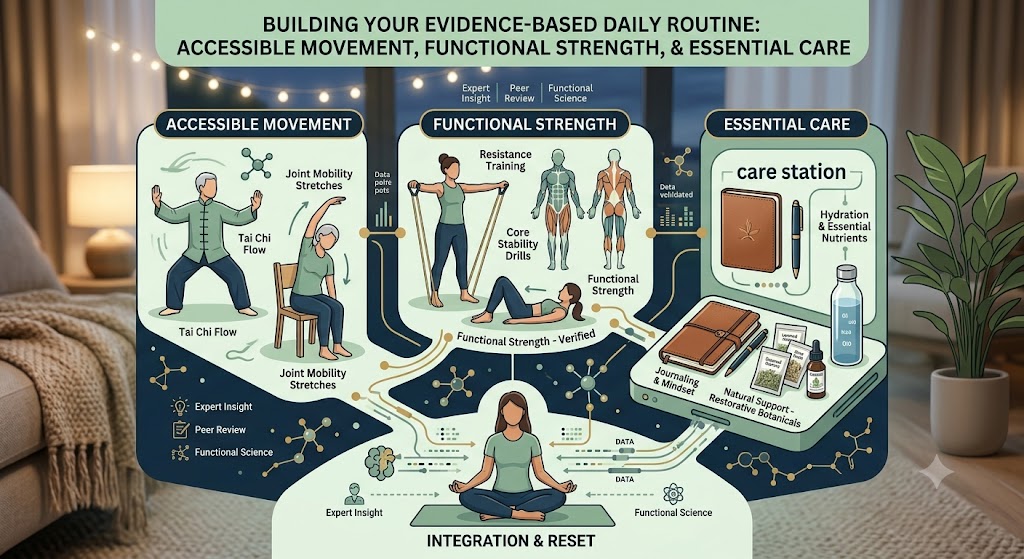
How to Build an Evidence-Based Daily Routine: Accessible Movement, Functional Strength, and Essential Care
The Architecture of Daily Longevity: Why Most Routines Fail
The modern health and wellness landscape suffers from an acute obsession with heroic optimization. Online feeds are saturated with aggressive ninety-minute morning protocols: sub-zero ice baths, hyper-calibrated supplement stacks, infrared light sessions, and exhaustive high-intensity training scheduled before dawn. For the vast majority of working adults, caregivers, and professionals, these regimes are not merely inaccessible—they are physiologically and psychologically unsustainable.
When daily protocols demand extraordinary reserves of willpower, they introduce cognitive friction. According to behavioral science models, human compliance plummets when the perceived effort of executing a habit outweighs the immediate perceived reward or the individual’s baseline energy. The moment professional deadlines surge, parental duties intervene, or poor sleep strikes, hyper-rigid protocols collapse like a house of cards. The individual is left with a sense of personal failure, retreating into total sedentary inertia until the next cycle of unsustainable motivation takes hold.
An evidence-based daily routine strips away the performative noise. Grounded in circadian biology, biomechanics, and behavioral psychology, it is designed around the concept of minimum effective dose (MED) and low-friction sustainability. Rather than asking how much physical and mental stress we can tolerate on our best days, an evidence-based framework asks a far more durable question: What are the foundational biological inputs required to preserve joint integrity, maintain metabolic health, preserve skin barrier function, and regulate the nervous system—even on our most demanding days?
By engineering routines around functional movement patterns, non-exercise physical activity, and fundamental restorative care, we build a physical vessel capable of navigating life’s demands without relying on fleeting bursts of discipline.
Behavioral Mechanics: The Science of Friction and Habit Anchoring
Before examining exercises or physiological protocols, we must address the behavioral machinery that allows any routine to survive long enough to produce biological adaptation. Lasting behavioral change is rarely an outcome of raw willpower; it is an outcome of environmental architecture and cognitive friction reduction.
The B = MAP Equation in Daily Practice
Behavioral scientist Dr. BJ Fogg established that behavior ($B$) occurs only when three elements converge simultaneously: Motivation ($M$), Ability ($A$), and a Prompt ($P$).
- Motivation is erratic, biologically expensive, and sensitive to emotional state, sleep debt, and stress.
- Ability (the ease of doing the task) is actionable and controllable. By reducing the physical and cognitive complexity of a task, you increase ability dramatically.
- Prompts must be anchored to existing physiological or behavioral anchors rather than arbitrary times on a clock.
If your functional strength routine requires packing a gym bag, commuting twenty minutes through traffic, and navigating an intimidating weight room, the friction is extraordinarily high. If motivation dips from an 8/10 to a 2/10 after a grueling workday, the behavior will simply not occur. Conversely, if your movement work is broken down into bodyweight multi-joint movements accessible directly on a carpeted floor in your living room, the friction drops to near zero.
Habit Stacking and Contextual Cues
Routines stick when they leverage neuroplastic pathways that are already myelinated. Rather than declaring, “I will mobilize my thoracic spine at 7:00 AM,” anchor the practice to an involuntary physiological behavior: “After the kettle finishes boiling for my morning water or tea, I will complete three minutes of thoracic rotations and hip openers.” The sensory input of the appliance serves as the neural trigger, eliminating the cognitive burden of deciding when to begin.
Pillar 1: Accessible Movement and the Abolition of Sedentary Decay
There is a critical, medically recognized distinction between exercise and movement. Exercise is a structured, planned period of physical exertion. Movement is the continuous mechanical deformation of human tissue that maintains synovial fluid circulation, drives lymphatic drainage, preserves fascia health, and sustains metabolic flexibility.
Epidemiological research reveals the “active couch potato” phenomenon: an individual can run on a treadmill for forty-five minutes in the morning, yet spend the subsequent ten hours sitting uninterrupted at a desk, effectively classifying their physiological profile as sedentary. Prolonged sitting suppresses lipoprotein lipase (LPL) activity in skeletal muscle tissue, directly hindering the clearance of triglycerides and glucose from the bloodstream regardless of an isolated morning workout.
The Non-Exercise Activity Thermogenesis (NEAT) Paradigm
Non-Exercise Activity Thermogenesis (NEAT) represents the metabolic energy expended for everything we do that is not sleeping, eating, or dedicated sports-like exercise. It ranges from walking across the room to fidgeting, standing, and taking the stairs. NEAT accounts for a substantially higher percentage of daily energy expenditure than a brief thirty-minute gym session, making it a powerful driver of metabolic health and body composition longevity.
| Movement Variable | High-Friction Exercise Model | Evidence-Based NEAT Model |
|---|---|---|
| Time Commitment | 60–90 continuous minutes daily. | 3–5 minute micro-doses dispersed hourly. |
| Biological Impact | Acute cardiovascular/muscular overload; high fatigue. | Continuous glycemic control, synovial lubrication, lymphatic flow. |
| Drop-Out Rate | High (sensitive to schedule disruptions). | Extremely low (seamlessly woven into existing tasks). |
| Equipment Needed | Gym memberships, weights, athletic apparel. | None; accessible in standard clothing anywhere. |
The Joint Hygiene Protocol: Daily Controlled Articular Rotations
Cartilage is an avascular tissue; it lacks a dedicated blood supply. It relies on the mechanical compression and decompression of joint capsules—a process known as imbibition—to draw in nutrient-dense synovial fluid and flush out metabolic waste products. When joints sit stationary in fixed angles (such as standard chair-seated posture: 90 degrees of hip flexion, 90 degrees of knee flexion, internally rotated humerus), large portions of the joint surface are starved of this fluid exchange.
To preserve joint longevity, implement a non-negotiable, five-minute morning “Joint Hygiene” sequence utilizing Controlled Articular Rotations (CARs):
- Cervical Spine: Slow, active rotations taking the neck through maximum comfortable flexion, lateral flexion, rotation, and extension, without shrugging the trapezius or forcing range into pain. (3 repetitions per direction).
- Glenohumeral (Shoulder) Joint: Isolating the arm, tracing the largest possible active circle in space without twisting the torso. This brings the rotator cuff and shoulder capsule through deep internal and external rotation. (3 repetitions per side).
- Thoracic Spine: Crossing arms across the chest, flexing forward, rotating the ribcage, laterally flexing, and extending back. This counteracts the stiffening effects of sustained screen work. (3 repetitions per direction).
- Coxofemoral (Hip) Joint: From a standing balance or quadruped position, drawing the knee to the chest, opening into abduction, rotating the heel upward into internal rotation, and kicking behind into extension. (3 repetitions per leg).
Postprandial Walking: The Glucose Disposal Mechanic
One of the most robust, clinically validated movement interventions is also the simplest: the ten-to-fifteen-minute postprandial walk. Contractile skeletal muscle is capable of clearing postprandial glucose surges independently of insulin signaling through the translocation of GLUT4 glucose transporters to the cell membrane. By simply walking at a conversational pace within thirty minutes of completing a carbohydrate- or protein-rich meal, you significantly bludgeon glycemic spikes, stabilize afternoon energy levels, and reduce arterial stiffness.
Pillar 2: Functional Strength (Training for Musculoskeletal Longevity)
Muscle mass is our metabolic sink and physical armor. Sarcopenia—the age-related loss of skeletal muscle mass and function—alongside dynapenia (loss of muscle strength), begins as early as the third decade of life if unaddressed. Skeletal muscle is not purely an engine for physical labor; it functions as an endocrine organ, secreting anti-inflammatory cytokines called myokines during contraction.
Building functional strength does not necessitate complex weight machines or dangerous heavy lifting. It requires introducing progressive mechanical tension across fundamental, evolutionary human movement patterns.
The Six Primal Movement Patterns
Every strength exercise is an iteration of six foundational biomechanical patterns. A robust, functional daily or alternating-day routine must encompass all six to prevent muscular imbalances and repetitive strain syndromes:
- The Squat (Knee-Dominant Flexion/Extension): Lowering the pelvis down between the heels while keeping the torso tall. Essential for maintaining independence in rising from chairs, stepping over obstacles, and leg drive.
- The Hinge (Hip-Dominant Posterior Chain Recruitment): Pushing the hips backward while maintaining an erect, neutral spine, engaging hamstrings, gluteals, and spinal erectors. Essential for picking objects up off the floor without lumbar spinal flexion.
- The Push (Upper Body Horizontal & Vertical): Pressing load away from the center of mass. Develops the anterior deltoids, pectorals, and triceps, maintaining structural stability in the anterior shoulder girdle.
- The Pull (Upper Body Horizontal & Vertical): Drawing load toward the chest or torso. Strengthens the latissimus dorsi, rhomboids, rear deltoids, and bicep complexes, balancing modern internal rotation postures.
- The Carry (Core Stability & Grip Mechanics): Transporting an asymmetric or symmetric load over distance. Develops transverse abdominis recruitment, quadratus lumborum bracing, and forearm/handgrip strength (a verified clinical biomarker of cardiovascular longevity).
- The Rotation/Anti-Rotation (Transverse Plane Control): Generating or resisting twisting forces through the core. Essential for real-world kinetic stability and spinal health.
The Accessible “Everyday Athlete” Strength Circuit
The following bodyweight and minimal-equipment protocol can be executed three to four days per week in under twenty-five minutes. It requires only an elastic resistance band, an elevated surface (like a chair or sturdy table), and bodyweight.
Phase 1: Squat Pattern — The Tempo Goblet or Box Squat
Execution: Stand with feet shoulder-width apart, toes flared slightly out (15–30 degrees). Lower under control over three full seconds until thighs reach parallel to the floor (or touch the surface of a chair). Pause for one second without unloading weight onto the chair. Drive forcefully through the midfoot and heel to return to standing, fully contracting the glutes at the top.
Prescription: 3 sets of 8 to 12 repetitions. Focus strictly on knee tracking over the second and third toes.
Phase 2: Hinge Pattern — The Single-Leg Romanian Deadlift (Unweighted or Banded)
Execution: Balance on the left leg with a micro-bend in the knee. Keeping the pelvis level and the back neutral, hinge at the hip, sending the right leg straight back behind you as a counterweight. Lower your torso until it is nearly parallel to the floor, feeling the stretch in the left hamstring. Engage the left glute to pull yourself back to vertical.
Prescription: 3 sets of 6 to 8 repetitions per leg. (Hold a light household object or loop a resistance band under the working foot to increase load once stability is mastered).
Phase 3: Push Pattern — The Incline-to-Floor Push-Up Progression
Execution: Position hands slightly wider than shoulder-width. To eliminate compensatory lumbar sagging, scale the movement to an elevated surface (countertop, bench, or chair) rather than dropping to the knees, which alters the pelvic bracing mechanic. Maintain a rigid plank from ankles to crown. Lower the chest until it lightly touches the edge, elbows tracking back at a 45-degree angle. Press the surface away forcefully.
Prescription: 3 sets of 8 to 15 clean repetitions.
Phase 4: Pull Pattern — Banded Rows or Doorframe Face Pulls
Execution: Anchor a resistance band around a secure point or wrap it around both feet in a seated position. Grasping the handles, initiate the movement by retracting the shoulder blades downward and back. Drive the elbows past the ribcage, holding the peak muscular contraction for two full seconds before slowly returning to the starting position over three seconds.
Prescription: 3 sets of 12 to 15 repetitions.
Phase 5: Carry & Anti-Rotation — The Suitcase Carry & Dead Bug
Execution (Carry): Pick up a single moderately heavy weight (a dumbbell, kettlebell, or loaded grocery bag) in one hand. Walk slowly in a straight line for thirty to forty paces without allowing the weight to lean your torso to either side. Maintain level shoulders and a neutral spine.
Execution (Anti-Rotation): Lie flat on your back, knees bent at 90 degrees directly over the hips, arms pointing toward the ceiling. Press your lumbar spine flat into the floor (no arching allowed). Slowly extend the right arm backward and the left leg forward simultaneously until both are hovering inches off the floor. Return and alternate.
Prescription: 3 carries per side; 3 sets of 10 alternating repetitions on the Dead Bug.
Pillar 3: Essential Care (Circadian Biology, Skin Barrier, and Nervous System Downregulation)
A daily routine that only layers on physical output without a symmetrical commitment to input, physiological downshifting, and barrier protection will eventually cause systemic burnout and chronic low-grade neuroinflammation. Essential care is not self-indulgence; it is foundational cellular hygiene.
Medical Disclaimer: The following guidelines reflect general physiological, dermatological, and circadian science principles. They do not constitute personalized medical advice. If you manage chronic endocrine, dermatological, or cardiovascular conditions, consult an accredited medical professional before radically altering sleep timings, supplementation, or topical treatment schedules.
Circadian Calibration: The Retinal Clock Anchor
Every cell in the human body houses a biological clock governed by clock genes. These peripheral cellular clocks are synchronized by a master circadian pacemaker in the brain: the suprachiasmatic nucleus (SCN). The primary environmental input (zeitgeber) that calibrates the SCN is light—specifically the blue-spectrum light inherent to morning sunlight.
Upon waking, viewing direct, outdoor natural light for ten to twenty minutes triggers an evolutionary cascade:
- Intrinsically photosensitive retinal ganglion cells (ipRGCs) detect melanopsin-activating photons and send immediate signals to the SCN.
- The brain triggers a healthy, timely morning cortisol spike that elevates baseline energy, focuses cognitive function, and sets an internal biochemical timer for melatonin release approximately 14 to 16 hours later.
- Looking through a windowpane is insufficient; window glass filters out significant portions of the blue-sky photons, requiring 5 to 10 times longer exposure to achieve the same neural threshold.
Evidence-Based Skin Health: Minimalist Barrier Protection
The consumer beauty and skincare industries have promoted eight- to twelve-step routines that routinely compromise the acid mantle and stratum corneum through over-exfoliation and incompatible ingredient layering. An evidence-based skin strategy focuses on barrier integrity and ultraviolet protection.
| Time of Day | Recommended Intervention | Biological Mechanism |
|---|---|---|
| Morning | Gentle water rinse (or non-stripping cleanser) followed by broad-spectrum SPF 30–50. | Protects cellular DNA from photoaging, UVA-induced collagen breakdown, and UVB-mediated skin damage. Preserves natural sebum produced overnight. |
| Evening | Gentle, pH-balanced (5.5) lipid-replenishing cleanser. | Removes environmental particulate matter (pollution), cellular debris, and chemical sunscreen filters without stripping ceramides. |
| Evening | Barrier-repair moisturizer containing Ceramides, Cholesterol, and Fatty Acids. | Mimics the natural 3:1:1 physiological ratio of stratum corneum lipids to halt transepidermal water loss (TEWL) during sleep. |
Autonomic Downregulation: Toggling the Parasympathetic State
Modern professionals spend extraordinary amounts of time in chronic, sub-clinical sympathetic arousal (fight-or-flight), fueled by unending push notifications, cognitive multitasking, and relational demands. Without a deliberate physiological off-ramp, heart rate variability (HRV) remains suppressed, sleep architecture is degraded, and restorative slow-wave sleep is cut short.
Meditation is an excellent tool, but for individuals in deep sympathetic overdrive, sitting silently can paradoxically provoke more cognitive anxiety. A faster, mechanistically direct intervention is the Physiological Sigh—a breathing pattern discovered by neurobiologists to rapidly lower autonomic arousal:
- Inhale deeply through the nose until the lungs are nearly full.
- Take an immediate, sharp secondary inhale through the nose to fully inflate the lung’s collapsed alveoli.
- Release a long, unforced exhale through the mouth over six to eight seconds.
- Repeat this pattern for 3 to 5 rounds.
This sequence rapidly elevates intra-thoracic pressure, signaling the sinoatrial node of the heart to slow down via vagus nerve motor output, dropping heart rate and downshifting brainwave activity within minutes.
The Complete 24-Hour Integrated Matrix
To assist in translating these independent, evidence-based pillars into a frictionless day, the following sequence illustrates how movement, strength, and biological care weave seamlessly into a standard professional schedule.
Morning Phase: Setting the Biological Clocks
- Waking + 10 Minutes: Step outside. View ambient sunlight for 10–15 minutes while completing your five-minute Joint Hygiene CARs protocol (neck, shoulders, t-spine, hips). Drink 500ml of room-temperature water with a pinch of electrolytes or unrefined salt to restore intravascular volume lost to overnight respiration.
- Waking + 30 Minutes: Minimalist morning skincare: gentle hydration, basic moisturizer, and high-quality broad-spectrum sunscreen.
Midday Phase: Glycemic Anchors & Movement Snacks
- Hourly Desk Break: Stand up. Perform twenty bodyweight air squats, a one-minute doorframe chest opener stretch, or simply walk through your workspace. Duration: 90 seconds.
- Post-Lunch Window: A 10-to-15-minute non-negotiable outdoor postprandial walk. Use this time to take phone calls, listen to research, or embrace silence. This eliminates the afternoon cognitive slump by lowering the glycemic excursion.
Late Afternoon / Early Evening: Functional Load
- Strength Window (3x/week): Execute the 5-movement Accessible Strength Circuit (Squat, Hinge, Push, Pull, Carry/Core). Total time: 20–25 minutes. Keep rest intervals concise (60 seconds) to concurrently stimulate the cardiovascular system.
Night Phase: Nervous System Deceleration
- Two Hours Before Bed: Dim overhead artificial lighting. Shift indoor illumination to eye level or lower (lamps with warm-tinted bulbs) to signal to the pineal gland that the solar cycle has terminated.
- One Hour Before Bed: Execute evening skin hygiene: cleanse pollutants, restore the lipid barrier with a ceramide-rich cream.
- In Bed: 3 minutes of the Physiological Sigh or a short non-sleep deep rest (NSDR) sequence. Dark, cool room (roughly 65–68°F / 18–20°C) to facilitate the core body temperature drop mandatory for entering slow-wave sleep.
Troubleshooting the Protocol: What to Do When Routine Breaks Down
The greatest enemy of an evidence-based routine is all-or-nothing cognitive bias. When an unexpected crisis strikes—such as sudden illness, grueling travel delays, or urgent family matters—individuals often abandon the entirety of their healthy behaviors because they cannot complete them in full.
To make your lifestyle truly anti-fragile, establish an unshakeable “Absolute Baseline” protocol for emergency scenarios. When your day disintegrates completely, discard the strength circuit, discard the walking quotas, and execute only three things:
- Hydration + Sunlight: Look out a window or step outside for 5 minutes; drink clean water.
- Sun Protection: Apply SPF to protect the barrier against cumulative solar radiation.
- Three Deep Physiological Sighs: Consciously communicate safety to your central nervous system before sleep.
By protecting this minimal baseline, the neural architecture of being a person who honors their health remains intact. You eliminate the devastating psychological loop of “falling off the wagon” and having to “start over on Monday.” Continuity always trumps intensity.
Frequently Asked Questions
Is morning sunlight exposure effective on heavily overcast or rainy days?
Yes. Even on thick, overcast days, the ambient lux (a measurement of light intensity) outdoors typically ranges from 1,000 to 10,000 lux. In contrast, standard indoor office lighting rarely exceeds 300 to 500 lux. On grey or rainy mornings, simply extend your outdoor exposure time to 20 to 30 minutes to ensure your retinal ganglion cells absorb the requisite photon density to synchronize the master circadian clock.
Can I complete my functional strength routine every day?
It is not recommended for progressive overload. Skeletal muscle does not grow or adapt during the workout itself; the exercise session serves as the catabolic mechanical stimulus that creates microscopic damage and signaling pathways. Muscle repair, structural remodeling, and connective tissue synthesis occur during the subsequent recovery window, primarily during slow-wave sleep. Training the exact same functional movement patterns every day creates systemic fatigue, increases tendinopathy risk, and stunts strength progression. Aim for 3 to 4 non-consecutive days per week, utilizing off-days for unstructured mobility, long walks, and restorative movement.
Do I really need to wash my face in the morning if I cleansed at night?
From a dermatological perspective, most individuals do not require an active surfactant or foaming cleanser in the morning unless they struggle with severe acne or clinical hyper-seborrhea. Over-cleansing strips natural lipids and compromises the acid mantle. Rinsing thoroughly with lukewarm water is sufficient to clear overnight cellular turnover, perspiration, and residual evening products, preserving the stratum corneum barrier for the day ahead.
How do I reconcile high-intensity cardio with this routine?
High-intensity cardiovascular training (such as Zone 5 sprint intervals or demanding sports) has immense health benefits, but it should be introduced on top of—not instead of—a foundation of accessible daily movement and functional strength. If you wish to incorporate high-intensity cardio, treat it like medicine: prescribe it in small doses (e.g., one to two 20-minute sessions per week) to avoid driving baseline cortisol through the roof, which undermines your nervous system recovery and joint health.