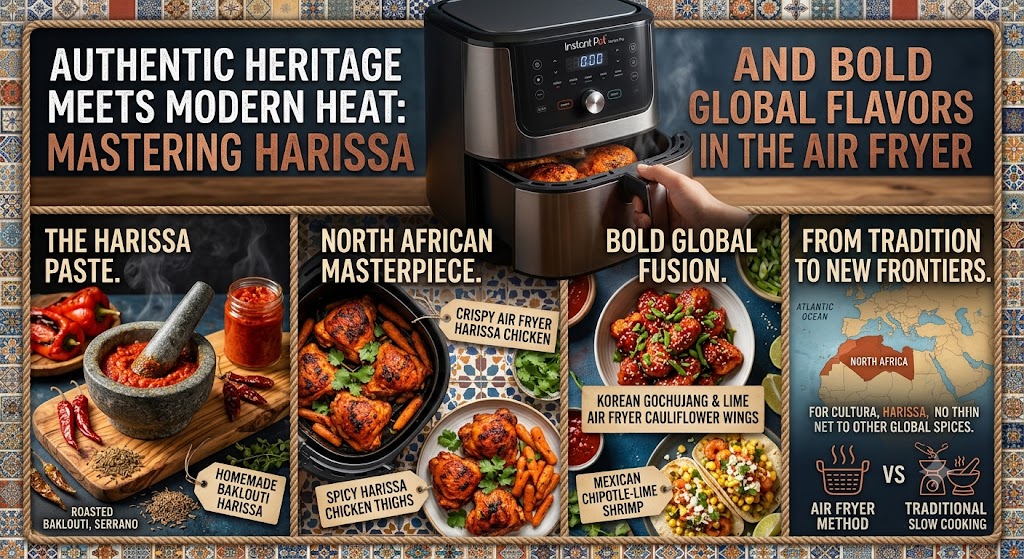
Authentic Heritage Meets Modern Heat: Mastering Harissa and Bold Global Flavors in the Air Fryer
In the culinary world, ancient foodways and contemporary kitchen appliances are frequently framed as ideological adversaries. Purists often argue that complex, slow-simmered, terroir-driven flavors cannot survive the utilitarian whir of modern kitchen electronics. Yet, when you examine the thermal mechanics of authentic culinary traditions—from the searing downdrafts of a Moroccan tagine over glowing embers to the dry, radiant furnace of an Indian tandoor—you realize that our ancestors were always seeking intense, targeted, high-velocity heat.
Few flavor foundations exemplify this intersection better than harissa. Recognized by UNESCO as part of Tunisia’s Intangible Cultural Heritage of Humanity, harissa is far more than a condiment; it is a foundational aromatic paste forged from sun-ripened capsicums, wild-harvested desert spices, pungent alliums, and robust olive oils. It possesses a balance of smoke, earth, acidity, and raw heat that transforms humble proteins and root vegetables into complex culinary expressions.
When this centuries-old paste encounters the high-velocity convective airflow of an air fryer, something remarkable happens. Rather than flattening the nuanced flavors of cumin, coriander, and caraway, the concentrated dry heat accelerates the Maillard reaction, gently blisters chili skins, and caramelizes the natural sugars in garlic and pepper pastes without boiling the ingredients in their own moisture. Mastering this dynamic requires an understanding of how to balance capsaicin, volatile spice oils, and extreme airflow so your food emerges crisped, layered, and smoky rather than scorched, bitter, and dry.
The Anatomy of Authentic Harissa: Beyond the Commercial Tube
To manipulate harissa successfully inside a high-heat convection chamber, you must understand what makes the paste behave the way it does. The generic harissa sold in metallic paste tubes or ambient supermarket jars frequently leans on vinegar, excess citric acid, and low-grade chili mash to achieve shelf stability. While serviceable in quick stews, these commercial formulations often sputter and turn aggressively sour when subjected to direct convection heat.
Authentic North African harissa—specifically from the Cap Bon region of Tunisia, where the condiment reaches its apex—is built on a deliberate calibration of dehydrated and rehydrated chilies, dry-toasted seed spices, fresh garlic, salt, and extra virgin olive oil.
The Chili Profile
Historically, the base relies on varieties like the Baklouti pepper, a long, sweet, moderately hot pepper with thick flesh that offers deep fruitiness alongside sharp pungency. Because fresh Baklouti peppers can be elusive outside of North Africa and specialized agricultural hubs, high-level home cooking requires an informed blend of dried chilies:
- Guajillo chilies: Provide a deep crimson hue, sweet tannic notes, and subtle dried-cranberry brightness with gentle heat.
- Ancho or Pasilla chilies: Impart earthy, raisin-like resonance and essential moisture retention to prevent the paste from scorching under dry convection.
- Chiles de Árbol or dried Serrano: Supply the sharp, clean, capsaicin-forward punch that defines genuine Tunisian heat.
- Aleppo pepper or Urfa biber: Add an oily, cured, subtly smoky backbone that bridges the chili profile with the toasted spices.
The Holy Trinity of Seeds: Caraway, Cumin, and Coriander
While chilies form the body, the spices establish harissa’s culinary signature. Authentic Tunisian harissa is uniquely defined by Carum carvi (caraway). Its distinctive, anise-adjacent, earthy-menthol profile offsets the hot pepper oils and cuts through animal fats. Cumin provides the foundational bass note, while whole coriander seed lends a bright, citrus-tinted floral lift. These seeds must be toasted whole over moderate dry heat until their volatile terpenes bloom, then immediately ground into a textured powder rather than a powdery dust.
Alliums and Olive Oil
Garlic in traditional harissa should be processed raw with sea salt, using mechanical shear (historically a heavy stone mortar or mehrez) to break cellular walls and create a sticky, garlic-chili emulsion. The final element is a high-phenolic, fruity extra virgin olive oil. The oil serves two purposes: it dissolves fat-soluble flavor compounds from the chilies and acts as a protective shield against the heat of the air fryer.
Comparing Harissa Styles for Air Fryer Applications
Not all harissa iterations react identically under convective heat. Use the following guide to choose or formulate the correct harissa profile for your specific cooking technique:
| Harissa Style | Key Ingredients & Profile | Heat Level | Air Fryer Performance | Ideal Applications |
|---|---|---|---|---|
| Artisanal Tunisian Paste | Rehydrated chilies, garlic, caraway, coriander, EVOO, sea salt. Thick, oily, deeply aromatic. | Medium-High to High | Exceptional. Emulsified oils shield chili solids from rapid burning, creating a dark, caramelized glaze. | Bone-in chicken thighs, lamb chops, dense squash, whole roasted root vegetables. |
| Commercial Jarred Paste | Chili paste, water, garlic powder, vinegar, sunflower/soybean oil, modified starch. | Mild to Medium | Variable. High water and acid content cause sputtering and steaming; sugars can scorch rapidly. | Stir-fry conversions, quick thin marinades paired with added honey or fat to buffer heat. |
| Rose Harissa | Standard paste enriched with dried rose petals, rosewater, and occasionally smoked sweet paprika. | Medium | Moderate to High. Floral volatiles can dissipate if cooked at high temps; requires lower cooking temperatures. | Salmon fillets, duck breast, charred halloumi, roasted carrots, delicate brassicas. |
| Dry Harissa Spice Rub | Dehydrated chili flakes, powdered garlic, ground cumin, caraway, coriander, sea salt. | Medium to High | Risky if applied dry. Fine powders will dehydrate and burn within minutes in high-velocity airflow. | Must be combined with oil or melted butter before application; great for crispy chicken wings. |
The Convection Trap: The Physics of Air Frying Bold Chili Pastes
An air fryer is essentially a tabletop convection oven fitted with an oversized heating element and a high-velocity fan. This dynamic creates an aggressive evaporative cooling phase, immediately pulling surface moisture off foods and elevating surface temperatures to trigger rapid dehydration and browning.
While this is ideal for crisping unseasoned chicken skin or parboiled potatoes, it introduces specific challenges when working with complex chili pastes:
1. Capsicum and Garlic Charring vs. Bitterness
The boundary between appealing, rustic char and bitter, unpalatable scorching is razor-thin. Raw garlic contains allicin and simple sugars that carbonize and turn sharply bitter past 350°F (175°C). Similarly, fine particles of dried chili flesh contain low surface moisture; when blasted by 400°F (204°C) air currents, they turn black before the protein underneath has reached safe internal temperatures. The solution: Harissa pastes must be buffered with fats (olive oil, yogurt, or butter) to coat the chili particles, and internal heat zones must be managed systematically using a staged-temperature method.
2. Volatilization of Essential Spices
Volatile aromatic compounds like carvone (caraway) and linalool (coriander) are fragile. If exposed to unbuffered, direct convective heat from the start, these aromatic highs will vaporize into the kitchen exhaust, leaving behind only raw, blunt heat. Adding an acidic component (like preserved lemon juice) or incorporating dairy fats traps these delicate molecules and protects them during the cook cycle.
3. The Moisture Paradox
Wet, watery marinades turn an air fryer into an inefficient mini-steamer. If your harissa has too much un-emulsified liquid or vinegar, you will end up with a soggy surface and a spent heating element covered in evaporated spice residue. The marinade must cling securely as a cohesive paste.
Foundation Recipe: Convection-Proof Artisanal Harissa Paste
This master paste formula is balanced specifically for air fryer use. The oil-to-solid ratio is calibrated to withstand direct, fast-moving air up to 390°F without scorching, while the inclusion of preserved lemon rind balances the rich aromatics with sharp salt-cured acidity.
Equipment & Yield
- Yield: Approximately 1.5 cups (360 ml)
- Prep Time: 25 minutes | Steep Time: 20 minutes
- Equipment: Dry skillet, spice grinder or mortar, high-powered blender or food processor.
Ingredients
- Dried Guajillo Chilies: 6 large (stemmed, seeded, and flattened)
- Dried Ancho Chili: 1 large (stemmed and seeded for depth and moisture)
- Dried Chiles de Árbol: 4 to 6 (adjust based on heat preference)
- Whole Caraway Seeds: 1 tablespoon
- Whole Coriander Seeds: 1 tablespoon
- Whole Cumin Seeds: 1.5 teaspoons
- Fresh Garlic: 6 plump cloves, coarsely chopped
- Preserved Lemon Peel: 1 tablespoon, rinsed thoroughly and minced (pulp discarded)
- Smoked Sea Salt or Kosher Salt: 1.5 teaspoons
- Tomato Paste: 1 generous tablespoon (contributes concentrated glutamates and assists browning)
- High-Phenolic Extra Virgin Olive Oil: ½ cup (120 ml), divided
- Fresh Lemon Juice: 1 tablespoon
Execution
- Rehydrate the Chilies: Place the stemmed, seeded chilies into a heatproof bowl. Cover with boiling water, weigh them down with a small saucer to keep them fully submerged, and allow them to soften for 20 minutes. Drain thoroughly, pressing out excess water with a clean kitchen towel. Retain 2 tablespoons of the chili-soaking liquid.
- Toast the Spices: Place the caraway, coriander, and cumin seeds into a dry skillet over medium-low heat. Swirl constantly for 90 to 120 seconds. Remove immediately when fragrant and the caraway seeds begin to pop. Transfer to a spice grinder or mortar and crush into a coarse, textured powder.
- Process the Aromatics: In a food processor or blender, combine the drained chilies, toasted spice mixture, garlic, preserved lemon peel, salt, tomato paste, and fresh lemon juice. Pulse several times until roughly chopped.
- Emulsify: With the processor running, slowly pour in 6 tablespoons of the extra virgin olive oil and the reserved chili liquid. Blend until the mixture forms a thick, glistening, homogenous paste with fine, visible flecks of spice and chili skin.
- Store: Transfer to a clean glass jar. Pour the remaining 2 tablespoons of olive oil over the surface to form an airtight barrier against oxidation. Sealed and refrigerated, this paste keeps for up to 4 weeks.
Master Class Techniques: Harissa in the Convection Environment
1. Staged-Temperature Cooking (The “Bake Then Blister” Method)
When cooking dense proteins like bone-in chicken thighs or whole root vegetables, avoid running the air fryer at maximum heat the entire time. A high-temperature setting cooks the exterior too quickly, scorching the harissa paste before the center of the food is cooked through.
Instead, employ a staged cook cycle:
- Phase One (Internal Rendering & Cooking): Cook at 330°F–350°F (165°C–175°C) for the first 65–70% of the target time. This lets the hot circulating air gently render fats and cook the meat or vegetable through without burning the exterior seasoning.
- Phase Two (The Crust & Caramelization): Crank the unit to 390°F–400°F (200°C–204°C) for the final 3 to 5 minutes. This rapidly dehydrates the outer layer, caramelizing the harissa paste, crisping skins, and producing deep, blistered color without turning the garlic bitter.
2. Dairy and Fat Buffering
For more delicate proteins like skinless chicken breast, white fish, or paneer, mix your harissa paste into an emulsion of full-fat Greek yogurt, labneh, or softened clarified butter before cooking. The dairy proteins and milk fats insulate the chili pigments and minced garlic, holding moisture against the food and allowing a burn-free, golden-red crust to form.
Signature Recipes: Showcasing Modern Convection Heat
Recipe 1: Blistered Harissa-Glazed Chicken Thighs with Charred Lemon
This recipe demonstrates how fat rendering from dark meat chicken works synergistically with harissa, transforming the paste into a clinging, caramelized glaze.
Ingredients (Serves 4)
- Bone-in, skin-on chicken thighs: 4 large (approx. 2 to 2.5 lbs total)
- Foundation Harissa Paste (from above): 3 tablespoons
- Honey: 1 tablespoon (balances heat and aids Maillard caramelization)
- Ground Smoked Paprika: 1 teaspoon
- Extra Virgin Olive Oil: 1 tablespoon
- Kosher Salt: 1 teaspoon
- Fresh Lemon: 1, sliced into thick rounds
- Fresh Cilantro and Mint: Handful, roughly torn, for garnish
- Cold Labneh or Greek Yogurt: ½ cup, for plating
Method
- Prep the Protein: Pat the chicken thighs completely dry with paper towels. Score the skin lightly in two shallow, parallel cuts without slicing deep into the meat. Season both sides with the kosher salt.
- Prepare the Glaze: Whisk together the harissa paste, honey, smoked paprika, and olive oil in a wide bowl. Coat the thighs evenly with the mixture, working it under the skin edges and into the shallow scores. Let stand at room temperature for 15 minutes.
- Stage One Air Frying: Preheat your air fryer to 340°F (170°C). Arrange the thighs skin-side down in the basket, ensuring they do not touch. Slide the lemon slices into the open spaces. Cook for 14 minutes.
- Flip & Crank Heat: Open the basket. Flip the thighs so they are skin-side up. Discard or turn the lemon slices if already charred. Increase the air fryer temperature to 395°F (200°C).
- Stage Two Blistering: Cook for an additional 5 to 7 minutes until the chicken skin is deeply browned and crisp at the edges, and an instant-read probe inserted into the thickest part reads 175°F (80°C)—the ideal temperature for melting connective tissue in bone-in thighs.
- Service: Spread the cold labneh onto a warm serving platter. Rest the thighs for 4 minutes, then arrange them over the yogurt alongside the charred lemon slices. Scatter fresh mint and cilantro over top and serve immediately.
Recipe 2: Convection-Crisped Harissa & Maple Cauliflower Steaks with Tahini Crema
Cruciferous vegetables are uniquely built for the air fryer. The high-velocity heat dries their tight florets, while the natural sugars in both the vegetable and the harissa-maple marinade brown and crisp quickly.
Ingredients (Serves 2 to 3)
- Large Head of Cauliflower: 1, cut through the core into two 1-inch-thick center steaks (reserve loose florets for another use)
- Foundation Harissa Paste: 2 tablespoons
- Pure Maple Syrup: 1 teaspoon
- Toasted Sesame Oil: 1 teaspoon
- Warm Water: 1 tablespoon
- Sea Salt: ¾ teaspoon
- Raw Tahini: ¼ cup (60 ml)
- Ice Water: 3 tablespoons (to loosen and emulsify tahini)
- Lemon Juice: 1.5 tablespoons
- Pomegranate Seeds: 2 tablespoons (for garnish)
Method
- Prep the Cauliflower: Steam or microwave the cauliflower steaks for 2.5 minutes prior to air frying to pre-hydrate the dense center core. Pat thoroughly dry.
- Combine Baste: In a small bowl, whisk together the harissa, maple syrup, toasted sesame oil, warm water, and ½ teaspoon of sea salt until smooth and fluid. Brush generously over all surfaces of the cauliflower steaks.
- Convection Roasting: Place the steaks flat in the air fryer basket (cook one at a time if your basket is small; do not overlap them). Cook at 375°F (190°C) for 12 minutes, turning gently halfway through using a wide fish spatula. Both sides should reveal blistered, deep auburn edges with tender stems.
- Prepare Tahini Crema: In a separate small bowl, whisk together the tahini, ice water, lemon juice, and remaining ¼ teaspoon salt. The mixture will seize initially, then whip into an ivory, velvet-smooth sauce.
- Plating: Pool the tahini sauce across a shallow plate. Place the sizzling harissa cauliflower steaks across the center, finish with ruby pomegranate seeds, and garnish with a drizzle of your remaining raw extra virgin olive oil.
Global Cross-Pollination: The Convection Flavor Matrix
Once you understand how to harness the air fryer’s rapid convection current to brown oily, spicy pastes without scorching them, you can apply these principles across a broader spectrum of global flavor bases. Bold condiments share common chemical foundations—sugars, amino acids, volatile aromatic oils, and free capsaicinoids—that respond predictably to convective heat.
Here is how harissa compares to, and pairs with, other global staples in an air-frying environment:
- Gochujang (Korean Fermented Chili Paste): Extremely high in natural sugars due to fermented rice and barley malt. It scorches far faster than harissa. In the air fryer, it must be thinned with rice wine, soy sauce, and a generous measure of sesame oil, and kept below 360°F until the final 90 seconds of cooking.
- Berbere (Ethiopian Dry Spice Blend): Dominated by fenugreek, dried ginger, allspice, and korarima. Fenugreek becomes unpalatably bitter when burned. If using berbere in an air fryer, blend it into a rich emulsion of warm niter kibbeh (spiced clarified butter) before applying it to the protein.
- Chermoula (North African Herb-Spice Marinade): Heavy on fresh flat-leaf parsley, fresh cilantro, cumin, and lemon. High airflow will rapidly dehydrate fresh herbs, turning them into dull, tasteless ash. Apply a thin layer before cooking, and brush with a fresh, raw spoonful of chermoula immediately after the food emerges from the air fryer to restore bright, fresh herbal notes.
- Peri-Peri (Portuguese-African Bird’s Eye Pepper Marinade): Characterized by high acidity and citrus oils. It is less prone to burning than sweeter pastes like gochujang, but benefits immensely from the two-stage cooking method to let the citrus sugars brown slowly onto the skin.
Air Fryer Maintenance When Cooking High-Capsaicin Foods
Working with concentrated chili pastes and volatile spices inside a high-output convection appliance requires a few simple workflow precautions:
Aerosolized Capsaicin Control
When you slide open an air fryer that has been running chilies at 390°F, you are exposing yourself to high-velocity, aerosolized capsaicin. Always crack the drawer open one inch while the appliance sits directly under a functioning range exhaust hood. Allow the initial plume of peppery steam to vent upward before pulling the basket fully open to inspect the food.
Parchment vs. Bare Perforated Trays
While perforated parchment paper liners simplify cleanup, they restrict airflow beneath your protein. For recipes like bone-in chicken thighs or whole cauliflower steaks, cook directly on the bare non-stick or stainless crisper basket to ensure hot air flows freely around the food. Save parchment paper for sticky items like glazed salmon or dairy-marinated kebabs that are prone to tearing.
Removing Persistent Spice Residue
Capsaicin, piperine, and carotenoid pigments from chilies are hydrophobic; they bind to the polymer chains of non-stick coatings and resist standard dish soap. If your air fryer retains a persistent hot-pepper scent after cooking, don’t scrub it with abrasives. Instead, wipe the basket with a paper towel dampened with vegetable oil (which dissolves fat-soluble pepper compounds), then wash it with warm water and an active degreasing dish soap.
Frequently Asked Questions
Can I substitute commercial store-bought harissa paste for homemade in these recipes?
Yes, but you will need to adjust the formulation slightly. Commercial pastes (such as DEA or Mina) often have higher acidity and a firmer texture. To adapt them for the air fryer, whisk 3 tablespoons of jarred paste with 1 tablespoon of extra virgin olive oil and ½ teaspoon of honey or maple syrup. This balances the sharp vinegar punch and provides enough protective fat to keep the paste from scorching during high-velocity cooking.
Why did the garlic in my harissa turn bitter in the air fryer?
Garlic burns and develops an acrid, bitter flavor when exposed to dry heat above 350°F (175°C) for extended periods. This usually happens when the air fryer is run at maximum heat from the very start. To prevent it, use our two-stage cooking method (starting around 330°F–340°F and raising the temperature only for the last few minutes) and ensure your garlic is processed smoothly into an oil-rich paste rather than left as dry, exposed chunks on the surface of the food.
Is it safe to air fry with whole spices, or should they always be ground?
Whole spices like caraway, cumin, and coriander will become dangerously dry and fly around the basket in high-velocity airflow, landing on the heating element where they can burn and smoke. While you should toast them whole in a dry skillet on the stovetop to bloom their essential oils, they must be cracked or ground and thoroughly bound into an oil or wet paste before entering the air fryer.
How do I keep chicken breasts moist when using a harissa rub in the air fryer?
Lean proteins like boneless, skinless chicken breasts dry out quickly in convection heat. The most reliable solution is to stir your harissa paste into an equal volume of full-fat Greek yogurt, labneh, or sour cream. The lactic acid tenderizes the meat, while the milk proteins and dairy fats create a protective barrier that insulates the chicken, yielding a tender interior and a savory, blistered crust.
What are the signs that my spice paste has burned rather than caramelized?
Desirable caramelization looks dark mahogany or deep brick-red, feels tacky, and offers a rounded, smoky, slightly sweet flavor. Scorched chili and garlic paste turns charcoal-black, feels dry or crumbly, smells sharply acrid, and leaves a persistent, bitter aftertaste. When in doubt, check your food a few minutes early: color develops much faster during the final high-heat stage of air frying than in a standard oven.