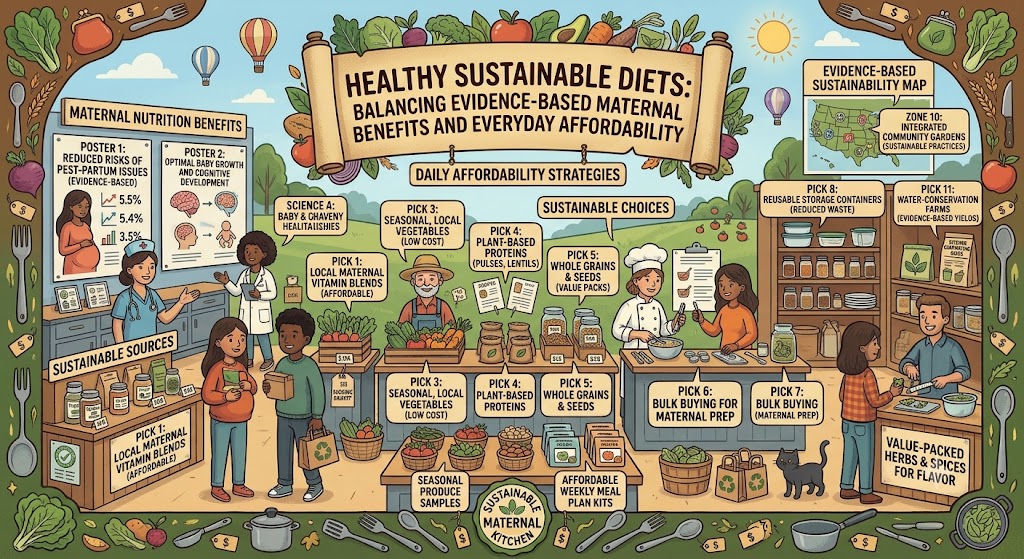
Healthy Sustainable Diets: Balancing Evidence-Based Maternal Benefits and Everyday Affordability
Standing in the fluorescent glare of the grocery aisle, balancing a prenatal vitamin bottle in one hand and a carton of pasture-raised eggs in the other, modern motherhood confronts an immediate, visceral trilemma: biology, ecology, and economics. Expectant and postpartum mothers are constantly bombarded with divergent directives. On one side, public health guidelines stress the non-negotiable biological requirements of a growing fetus—demanding dense stores of bioavailable iron, choline, docosahexaenoic acid (DHA), and zinc. On another side, planetary boundaries urge a shift toward plant-heavy, low-impact eating models. Hovering over both is the relentless arithmetic of the checkout counter, where grocery inflation turns well-intentioned dietary recommendations into financial anxiety.
Too often, conversations around sustainable nutrition treat the human body as an abstract consumer unit. But pregnancy and lactation are periods of rapid cell division, profound blood-volume expansion, neurological construction, and tissue remodeling. A diet that is theoretically optimal for a healthy 35-year-old male executive cannot simply be mapped onto a pregnant body without accounting for metabolic trade-offs. The physiological stakes are extraordinarily high, and maternal depletion syndrome is a very real clinical reality when maternal stores are cannibalized to sustain fetal growth.
The solution is neither an elitist, hyper-expensive organic regimen nor an uncalculated, purely plant-exclusive shift that leaves mothers micronutrient-deficient. Instead, a truly sustainable maternal diet must be resilient across three metrics: it must nourish the biological ecosystem of mother and infant, fit within planetary carbon and land-use limits, and remain accessible to an average household budget. Achieving this requires moving past marketing buzzwords and looking directly at biochemical bioavailability, trophic efficiency, and strategic culinary economics.
The Metabolic Demands of Pregnancy and Lactation: Non-Negotiables
To evaluate any sustainable dietary pattern, we must first establish the physiological baseline. Maternal nutrition is distinct from general adult nutrition in both volume and nutrient density. During gestation, the maternal body creates a transient endocrine organ (the placenta), expands blood plasma volume by nearly 50 percent, increases red blood cell mass, and supports the rapid development of fetal brain and skeletal structures. Lactation demands even greater metabolic output—often requiring 400 to 500 additional calories daily, accompanied by heightened requirements for vitamins A, C, B12, and iodine.
Certain critical nutrients present consistent challenges in conventional sustainable dietary frameworks due to differences in bioavailability between plant and animal food matrices:
- Bioavailable Iron (Heme vs. Non-Heme): Iron requirements jump from 18 mg/day to 27 mg/day during pregnancy to support the maternal-fetal oxygen transport system. While plant sources (legumes, leafy greens) provide non-heme iron, its absorption rate is low (typically 2 to 15 percent) and readily inhibited by phytates, polyphenols, and calcium. Heme iron from animal tissues absorbs at a rate of 15 to 35 percent and is largely unaffected by dietary inhibitors.
- Choline: Often termed the “unsung hero” of the maternal diet, choline is an essential methyl donor critical for fetal brain development, neural tube closure, and lifelong cognitive architecture. The American Medical Association recommends 450 mg/day for pregnancy and 550 mg/day for lactation. More than 90 percent of pregnant individuals fail to meet this threshold. The highest-concentration sources are egg yolks and liver; plant sources like soy and cruciferous vegetables require massive volumetric consumption to deliver equivalent yields.
- Docosahexaenoic Acid (DHA): This omega-3 fatty acid accumulates exponentially in the fetal brain during the third trimester. While the plant-based precursor alpha-linolenic acid (ALA), found in flax and walnuts, can biochemically convert to DHA, human conversion rates are notoriously poor—often below 1 to 5 percent in women of reproductive age. Direct consumption of preformed DHA remains the clinical gold standard.
- Vitamin B12 (Cobalamin): Indispensable for neurological development and DNA synthesis, B12 is synthesized exclusively by microorganisms and absent in unfortified plant foods. Maternal deficiency can lead to irreversible infant neurological impairment, failure to thrive, and elevated maternal homocysteine levels.
- Iodine: Essential for maternal and fetal thyroid hormone synthesis, which governs neurodevelopment. Salt iodization has mitigated severe deficiencies, but changing dietary habits—such as the popularity of non-iodized gourmet sea salts and plant milks that lack iodine fortification—have reintroduced vulnerabilities.
The Planetary Health Dilemma: Deconstructing the “Ideal” Green Diet
In 2019, the EAT-Lancet Commission published its landmark report outlining a “Planetary Health Diet”—a largely plant-based template designed to feed a global population within safe planetary boundaries by minimizing greenhouse gas emissions, nitrogen/phosphorus application, water use, and biodiversity loss. The recommendations advocate for dramatic reductions in red meat and dairy, replacing them with whole grains, legumes, nuts, and unsaturated oils.
While ecologically profound, the generalized application of such models to gestation reveals notable nutritional gaps. Several clinical nutritional scientists have pointed out that strict adherence to low-animal-protein templates can lead to vulnerabilities in iron, zinc, B12, and bioavailable calcium unless heavily fortified or meticulously supplemented. Plants carry protective mechanisms—anti-nutrients such as phytic acid, oxalic acid, and tannins—which naturally bind to minerals and dampen their bioavailability.
“True ecological sustainability cannot be purchased at the cost of human developmental capital. A maternal diet that results in iron-deficiency anemia or subclinical neurological deficits in offspring shifts the ecological burden into long-term healthcare complications.”
The goal is not to dismiss planetary health frameworks, but to refine them. We must identify where the ecological curve and the biological curve intersect without straining the domestic grocery budget. Sustainability is an equation of trophic efficiency: extracting the absolute maximum density of essential, bioavailable micronutrients for the lowest expenditure of environmental resources and household dollars.
Trophic Efficiency: Low-Footprint, High-Yield Maternal Superfoods
The prevailing cultural narrative suggests that ethical, sustainable eating demands either expensive specialty vegan meat alternatives or high-end organic, grass-fed cuts of heritage beef. Both assumptions are financially and ecologically flawed. By evaluating foods through a matrix of nutrient density per gram of carbon equivalent (CO₂e) and cost per milligram of critical nutrient, a set of accessible maternal nutritional anchors emerges.
1. Small Pelagic Fish (Sardines, Anchovies, and Mackerel)
Small oily fish sit low on the marine trophic pyramid. Because they feed on plankton, they do not accumulate the heavy industrial contaminants—like methylmercury, PCBs, and microplastics—that plague long-lived predatory fish such as swordfish, king mackerel, and albacore tuna. Ecologically, purse-seine fisheries for small pelagics produce some of the lowest carbon footprints per kilogram of protein across the entire animal agriculture spectrum.
From a maternal perspective, tinned sardines are a complete nutritional asset. Packed with preformed DHA and EPA, they also deliver whole-food calcium (via soft, edible bones), highly bioavailable heme iron, selenium, and B12. Financially, canned sardines and mackerel cost a fraction of fresh wild-caught salmon fillets, remain shelf-stable for years, and require zero food-waste-generating refrigeration before use.
2. Eggs: The Unmatched Choline Matrix
Pastured, regenerative eggs are often highlighted in lifestyle media, but even conventional supermarket eggs represent an exceptional balance of cost, carbon, and biological utility. Poultry production carries a significantly lower carbon and land-use footprint than ruminant livestock. More importantly, two large eggs deliver roughly 300 mg of choline—well over half of the daily gestational requirement—alongside complete proteins, lutein, zeaxanthin, and easily absorbed vitamin A.
The choline in egg yolks exists predominantly as phosphatidylcholine, a form demonstrated to have superior intestinal absorption and bioavailability compared to synthetic choline bitartrate salts often found in cheaper supplements. For budget-conscious families, integrating eggs into evening meals, rather than reserving them exclusively for breakfast, offers an inexpensive way to replace costly muscle meats without sacrificing neurodevelopmental support.
3. Bivalves (Mussels and Oysters)
Farmed bivalves—mussels, clams, and oysters—are ecological overachievers. They require no fresh water, no arable land, no synthetic fertilizers, and no supplemental feed; they thrive by filter-feeding naturally occurring microalgae, improving coastal water clarity in the process. Their carbon footprint is roughly equivalent to or lower than wild-caught legumes.
Nutritionally, canned or fresh cooked mussels are powerhouses for pregnant and postpartum bodies. A standard 100-gram serving of mussels delivers over 100 percent of the daily requirement for vitamin B12, nearly 40 percent of the recommended intake for iron, and a dense concentration of zinc and selenium. Tinned smoked mussels packed in olive oil or spring water cost pennies per microgram of B12 and iron when contrasted with cuts of beef tenderloin.
4. The Legume Complex: Lentils, Split Peas, and Chickpeas
Plant-based legumes are foundational to low-carbon food systems due to their capacity to fix atmospheric nitrogen directly into the soil, reducing the need for fossil-fuel-derived synthetic fertilizers. Economically, dried lentils and split peas remain the cheapest sources of calories, fiber, and protein on the planet.
The maternal challenge with legumes is their concentration of phytic acid, which impairs non-heme iron and zinc absorption. However, traditional processing methods neutralize these anti-nutrients:
- Soaking: Soaking dried beans in warm water with a dash of an acidic medium (like lemon juice or raw apple cider vinegar) for 12 to 24 hours activates native phytases, breaking down up to 50 percent of the phytic acid.
- Sprouting: Sprouting lentils on a countertop over two to three days further degrades anti-nutrients and increases free folate and vitamin C content.
- Ascorbic Acid Pairing: Consuming legumes alongside a whole-food source of vitamin C (e.g., bell peppers, lemon juice, or tomatoes) reduces non-heme iron from its ferric (Fe³⁺) state to its absorbable ferrous (Fe²⁺) state, multiplying absorption rates up to fourfold.
5. Frozen Brassicas and Field-Grown Greens
Dark leafy greens are rich in folate (vitamin B