
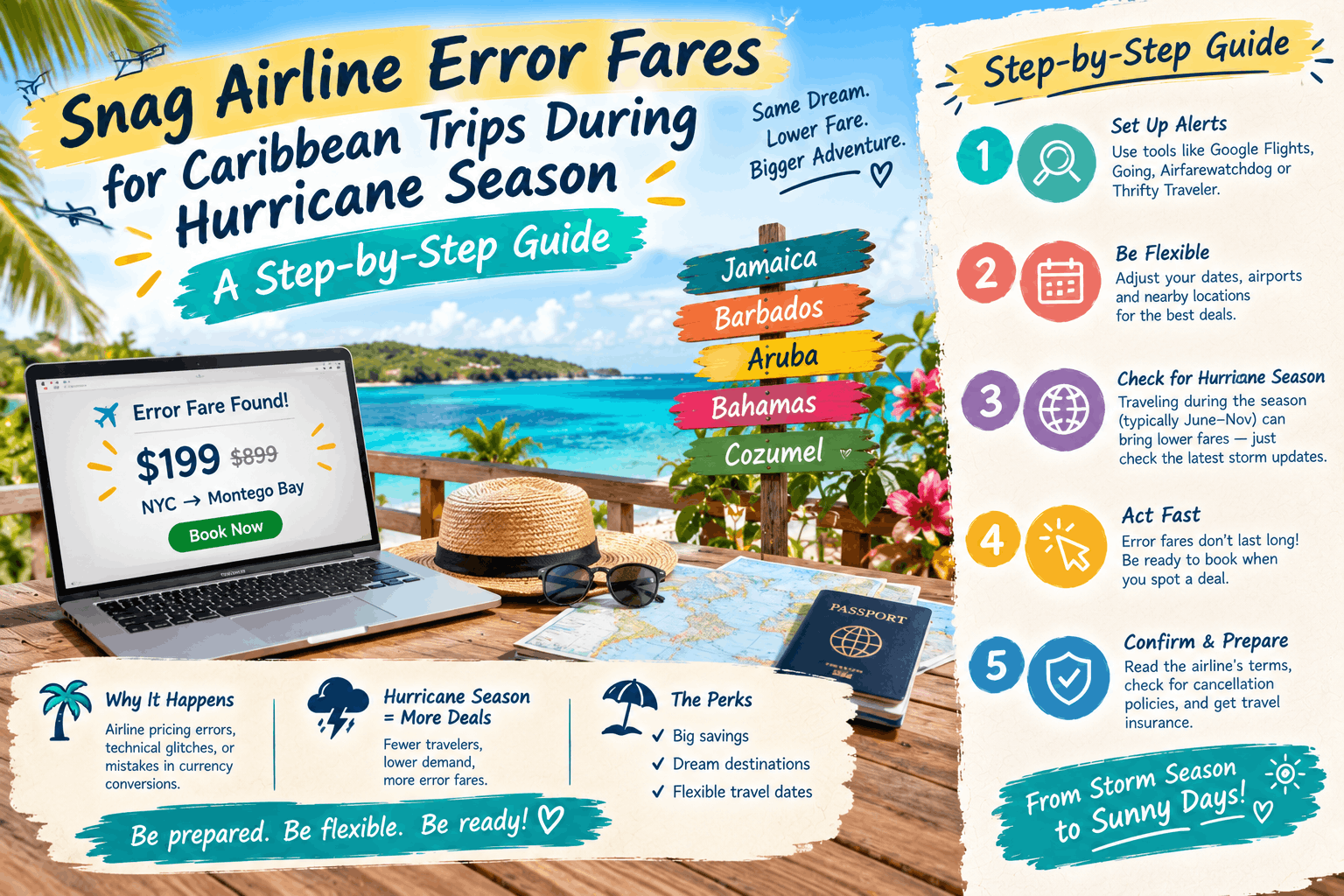
To score dirt-cheap airline error fares for Caribbean travel, you need two things: precise tracking tools and a willingness to leverage the seasonal lull between June 1 and November 30. During hurricane season, airlines constantly tweak their pricing algorithms to fill empty seats, leading to frequent pricing glitches, miscalculated currency conversions, and rapid flash sales. Scoring a $45 round-trip flight to Puerto Rico or a $120 ticket to the Dominican Republic isn’t about luck—it is about knowing where mistakes happen, how to lock them in before airlines patch the system, and how to protect your trip against tropical weather.
Understanding Airline Error Fares and Why Hurricane Season Matters
An error fare (also known as a mistake fare or price glitch) occurs when an airline or Online Travel Agency (OTA) lists a ticket for a fraction of its intended price. These glitches stem from four main technical slip-ups:
- Human Data Entry Mistakes: A worker omits a zero, entering $50 instead of $500 for a long-haul base fare.
- Omitted Fuel Surcharges: Often called a “fuel dump,” where the carrier’s automated ticketing system fails to append mandatory carrier-imposed surcharges.
- Currency Conversion Glitches: Miscalculations that occur when a foreign OTA converts dynamic local currency rates into U.S. Dollars or Euros.
- Algorithmic Collisions: Automated yield management software adjusting prices too aggressively during low-demand windows, causing compounding discounts.
Hurricane season in the Atlantic Basin officially runs from June 1 to November 30, with peak activity occurring between mid-August and late October. During this period, leisure travel demand to the Caribbean plummets as casual vacationers avoid potential storm risks. To maintain route profitability, airlines run aggressive flash sales and modify dynamic pricing protocols far more frequently than they do in peak winter months.
This rapid adjustments phase creates a target-rich environment for flight hackers. When yield management algorithms scramble to fill seats on half-empty planes out of hubs like Miami, Fort Lauderdale, or New York, system glitches multiply. While weather risks exist, the Caribbean covers over 1 million square miles. A storm near the Bahamas rarely impacts Curacao or Aruba, meaning smart travelers can capitalize on region-wide error pricing while steering clear of actual weather disruptions.
Essential Tools & Resources for Spotting Error Fares
Error fares do not linger. Most mispriced routes are patched within two to six hours of public exposure. Relying on manual daily searches will cause you to miss the best deals. To consistently catch these drops, you must automate your monitoring system.
Automated Monitoring Services
Subscription-based deal aggregators deploy Web crawlers to scan Global Distribution Systems (GDS) for sudden price anomalies. Services like Secret Flying, Airfarewatchdog, and Jack’s Flight Club specialize in real-time push notifications. Setting alerts specifically for Caribbean regional codes (such as SJU, PUJ, MBJ, and AUA) ensures you receive instant alerts the moment an anomaly is detected.
Google Flights Calendar and Explore Tweaks
Google Flights remains the fastest manually operated tool for verifying pricing anomalies. To spot off-peak drops, avoid searching specific dates. Instead, set your departure hub, leave the destination wide open, and set your departure timeline to flexible dates within the August–October window. If you master the Google Flights ‘Anywhere’ Hack, you can map out whole island clusters and spot severe pricing deviations across competing carriers in seconds.
Skyscanner Alerts and Hopper Predictions
Skyscanner often indexes third-party OTAs faster than Google Flights, making it an excellent secondary verification engine for regional flight glitches. Combine Skyscanner with Hopper’s price prediction algorithm: Hopper tracks historical tariff patterns to indicate whether a sudden drop is an intentional flash sale or an unannounced error fare likely to be revoked quickly.
VPNs and Regional Currency Manipulation
Airlines regularly adjust fare classes based on the user’s point of sale (POS). Using a Virtual Private Network (VPN) to route your IP address through a foreign country (such as Mexico, Colombia, or the Dominican Republic) can unlock lower base fares listed in regional currencies. Combining localized search parameters with a ChatGPT flight search hack allows you to write custom search prompts to quickly compare international booking engines against domestic rates.
Step‑by‑Step Process to Book a Caribbean Error Fare
Executing an error fare booking requires speed, precision, and strict adherence to specific rules to prevent early cancellation.
Step 1: Set Up Real-Time Alerts for Target Airport Pairs
Configure push notifications on your monitoring apps for major Caribbean gateways. Pay close attention to high-frequency origin airports such as Miami (MIA), Fort Lauderdale (FLL), Orlando (MCO), New York (JFK/EWR), and Atlanta (ATL). Destination filters should include high-volume hubs like San Juan (SJU), Punta Cana (PUJ), Montego Bay (MBJ), and St. Thomas (STT).
Step 2: Verify the Fare’s Legitimacy
Before clicking purchase, verify what type of fare you are viewing. Is it a true mistake fare, or merely a Basic Economy ticket unbundling carry-on luggage and seat selection? Check the routing details:
- Are layovers reasonable (under 4 hours)?
- Is the flight operated by a reputable mainline carrier or a trusted regional partner?
- Does the fare include standard international taxes, or is it missing government-mandated exit fees?
Step 3: Book Quickly Using Speed Tactics
When an error fare goes live, speed is paramount. Book directly through the airline’s website whenever possible, as direct bookings make ticket processing faster. Use a dedicated travel credit card with saved profile data to check out in under two minutes. Use a secondary or dedicated email address to keep purchase receipts separate from your daily inbox traffic.
Step 4: Confirm Reservation and Wait Out the Ticket Issuance Window
Receiving an email confirmation code (PNR) does not mean your ticket is fully issued. You must wait until an e-ticket number (a 13-digit code) is generated. During the first 24 to 72 hours, the airline’s revenue integrity team will review the system glitch. Do not contact the airline during this window under any circumstances. Calling customer service alerts agents to the error, guaranteeing your booking will be flagged and canceled early.
Step 5: Prepare a Flexible Backup Plan
Do not lock in non-refundable hotels, rental cars, or island tours until at least 72 hours have passed and your e-ticket status is firmly confirmed. Always opt for accommodation options that offer free cancellation up to 24 hours prior to check-in.
Safety Nets: Protecting Yourself from Cancellations
Booking cheap Caribbean flights through error fares carries inherent operational risks. Understanding legal regulations and insurance policies will protect your financial investment.
Department of Transportation Rules and Refunds
In the United States, regulations regarding error fares changed in 2015. Under current Department of Transportation (DOT) guidelines, airlines are not legally required to honor mistake fares, provided they can prove an error occurred. However, if an airline voids your ticket, they are legally obligated to provide a full refund of all charges within seven business days. They must also reimburse non-refundable add-ons purchased directly through their site.
Travel Insurance Nuances for Hurricane Season
Navigating Caribbean trips between August and October requires strategic travel insurance. Standard travel insurance policies will not cover trip disruptions caused by a hurricane if you purchase the policy after the storm has been officially named by the National Hurricane Center.
Rule of Thumb: Buy your travel insurance policy immediately after your error fare ticket is confirmed and before any tropical depression in the Atlantic receives an official storm name.
For maximum protection, purchase a Cancel For Any Reason (CFAR) policy add-on. CFAR policies reimburse between 50% and 75% of non-refundable prepaid costs if you decide to pull the plug on the trip due to bad weather forecasts, regardless of whether a formal storm warning has been declared.
24-Hour Hold Options and Flexible Rules
Under U.S. federal law, airlines operating flights to or from the United States must allow you to cancel a booking within 24 hours of purchase for a full refund, provided the flight is scheduled at least seven days out. Some carriers, such as American Airlines, allow travelers to hold a fare price for 24 hours without payment. Utilizing fare holds gives you a risk-free window to check weather patterns and confirm travel availability without placing cash upfront.
Top Caribbean Destinations & Airlines Offering Error-Fare Opportunities
Not all Caribbean routes are created equal. Certain airport corridors experience vastly higher volumes of pricing glitches due to competition between low-cost carriers (LCCs) and legacy airlines.
High-Probability Routes
- Miami (MIA) / Fort Lauderdale (FLL) → San Juan (SJU): High flight frequencies create constant price wars between Spirit, JetBlue, and American Airlines.
- New York (JFK/EWR) → Punta Cana (PUJ): Frequent charter releases and dynamic seat bundling lead to frequent fuel-dump errors.
- Atlanta (ATL) / Charlotte (CLT) → Montego Bay (MBJ): Legacy carrier hubs occasionally glitch when trying to undercut discount regional competitors.
- Orlando (MCO) → St. Thomas (STT): High seasonal volume drops yield flash sale anomalies from August through October.
Airlines Prone to Glitch Fares
Understanding carrier ticketing infrastructure helps identify where price drops occur:
- JetBlue: Known for unexpected flash sales and occasional system-wide code glitches during software upgrades.
- Spirit Airlines: Frequently drops base fares down to $1–$5 during low-demand autumn weeks, leaving only mandatory government taxes.
- Copa Airlines: Often publishes unintended low rates on multi-leg itineraries connecting the U.S. mainland to the Southern Caribbean via Panama City (PTY).
- Avianca: Glitches occur primarily within currency conversion portals on South American base routes touching the Dutch Caribbean (Aruba, Bonaire, Curaçao).
Case Study: Booking a $45 Return Flight to Puerto Rico
To understand how this strategy functions in practice, consider a real-world error fare captured during peak autumn hurricane season.
The Alert and Identification
On September 12, a major flight monitoring system triggered a price drop notification: non-stop round-trip tickets from Miami (MIA) to San Juan (SJU) were listed for $45.20 USD on a major carrier. The standard off-peak rate for this route ranges from $180 to $260.
Analyzing the breakdown revealed that the airline’s booking engine had omitted the return base fare entirely, charging only government taxes and airport facility fees ($15.20 base fare + $30.00 taxes).
Execution and Timeline
- 10:14 AM EST: Deal alert goes live via mobile app push notification.
- 10:17 AM EST: Routing verified on Google Flights; booking initiated directly on the airline’s desktop site.
- 10:21 AM EST: Payment processed; 13-digit e-ticket number issued via automated confirmation system.
- 01:45 PM EST: System error identified by airline IT team; error fare patched back to $210 standard fare.
- Day 3 Post-Booking: E-ticket status remained confirmed; zero cancellation notices issued. Host hotel booked with free cancellation terms.
By moving quickly and avoiding contact with customer support during the 72-hour window, the traveler secured a weeklong Caribbean trip for less than the cost of a tank of gas. Monitoring local weather patterns ensured a storm-free week in San Juan despite traveling in mid-September.
Frequently Asked Questions
Can I be stranded if an error fare is canceled while I am on my trip?
No. Airlines must honor the remaining legs of a ticket once outbound travel has commenced. If an airline decides to cancel an error fare ticket, they will do so within 24 to 72 hours of your initial purchase, long before you board the plane. Once you fly the outbound leg, your return ticket is secure.
Do I need a passport for intra-Caribbean hops booked via error fares?
If you are a U.S. citizen flying to U.S. territories like Puerto Rico or the U.S. Virgin Islands (St. Thomas, St. Croix, St. John), you only need a government-issued REAL ID or driver’s license. For any international island nation (such as the Dominican Republic, Jamaica, or Saint Lucia), a valid passport with at least six months of remaining validity is mandatory.
How many times can I use the same error-fare alert?
Error-fare alerts broadcast deals in real-time to thousands of users simultaneously. You can use an alert to purchase multiple tickets for your travel party in a single transaction, but you must do so before the carrier clears the mispriced seat inventory or fixes the backend glitch.
Conclusion & Quick-Reference Checklist
Finding cheap Caribbean flights using error fares during hurricane season requires combining automated alerts, speedy execution, and smart travel insurance planning. By capitalizing on seasonal low-demand windows and avoiding early booking mistakes, you can visit world-class tropical destinations at a fraction of standard retail prices.
One-Page Error-Fare Hunting Checklist
- Pre-Search Phase: Enable push alerts for Caribbean hubs on Secret Flying, Skyscanner, and Hopper. Ensure credit card profiles and personal details are pre-saved in your browser for instant auto-fill.
- Booking Phase: Act within minutes of an alert breaking. Book directly with the carrier, double-check that you receive a 13-digit e-ticket number, and double-check your dates.
- Post-Booking Phase (0–72 Hours): Do NOT call the airline. Do not book non-refundable hotels or activities. Allow the revenue management team time to clear the error.
- Finalization Phase (Day 4 Onward): Secure flexible accommodations with 24-hour cancellation policies. Purchase a comprehensive travel insurance policy (or CFAR add-on) before any named storms develop in the region.



One thought on “Snag Airline Error Fares for Caribbean Trips During Hurricane Season – A Step‑by‑Step Guide”
Comments are closed.