
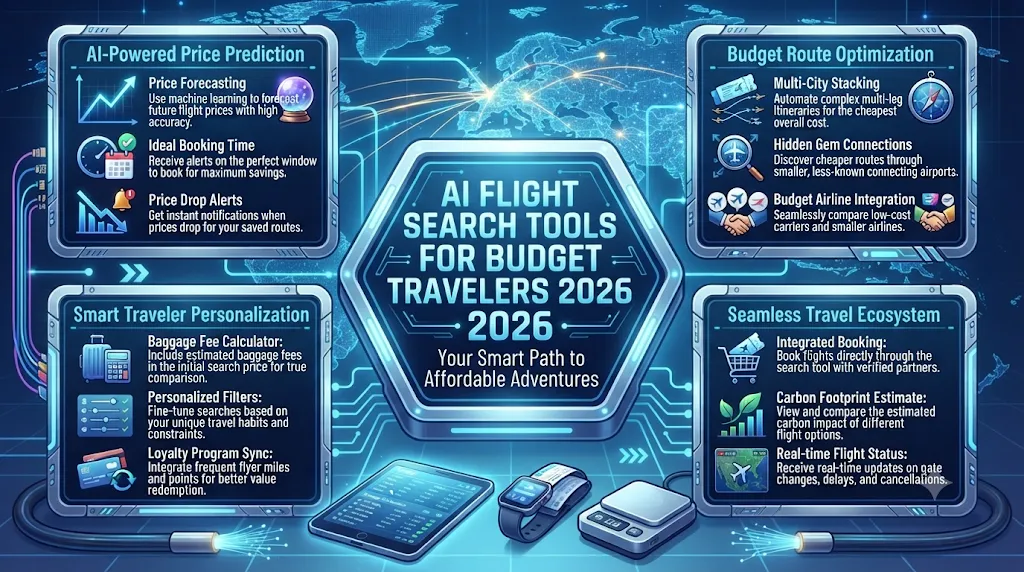
The AI Revolution in Budget Airfare
Every year, budget travelers spend billions on airfare, yet only a fraction discover the best deals. In 2026, AI-driven flight search tools have become the secret weapon that turns the odds in favor of the savvy. These systems sift through millions of fares, predict price swings, and surface hidden savings in seconds, something that manual search could never achieve.
Core AI Flight Search Engines to Watch in 2026
While traditional fare aggregators still dominate the market, the newest entrants harness machine learning to deliver more accurate predictions and deeper insights. Below is a snapshot of the leading AI tools and what sets them apart.
| Tool | Core AI Feature | Cost / Subscription | Pros | Cons |
|---|---|---|---|---|
| Skyscanner AI Optimizer | Dynamic pricing model that recommends optimal booking windows | Free, optional premium analytics for $9.99/month | Wide airline coverage; intuitive calendar view | Limited real-time fare updates for low-cost carriers |
| Google Flights AI Engine | Predictive trend analysis powered by Google Search data | Free | Instant price alerts; seamless Google ecosystem integration | Occasional data lag on ultra-low fares |
| Hopper Predictive Pricing AI | Forecasts price changes up to 365 days ahead | Free core, $4.99/month for premium alerts | Highly accurate for major routes; mobile-first interface | Less coverage of niche destinations |
| Kiwi.com Nomad AI | Generates multi-city itineraries using reinforcement learning | Free | Unique route combinations; flexible dates | Complex UI may overwhelm new users |
| Momondo AI Search Layer | Aggregates fares with AI-driven price comparison engine | Free | Extensive data sources; price drop notifications | Interface less polished than rivals |
Skyscanner AI Optimizer
Skyscanner’s new optimizer uses a neural network trained on historical fare data. It outputs a recommended booking window that maximizes savings. The tool’s calendar view colors days by predicted price, turning a tedious search into a quick visual decision. The free tier covers most airlines, but premium analytics unlock deeper trend charts for frequent flyers.
Google Flights AI Engine
Google Flights has integrated its massive search engine data into a predictive model. It highlights price spikes and dips in real time, and its price alert feature notifies you the moment a fare drops. Because it’s part of the Google ecosystem, it syncs with your Google account for personalized recommendations.
Hopper Predictive Pricing AI
Hopper’s algorithm learns from millions of past bookings. It predicts whether a fare will rise or fall over the next 12 months. The app’s “Best Time to Book” button instantly tells you whether to book now or wait. Hopper also offers a premium plan that sends push notifications on price drops.
Kiwi.com Nomad AI
Kiwi.com’s Nomad AI applies reinforcement learning to propose multi-city itineraries that save money while respecting time constraints. The tool can generate a 7-day roundtrip from New York to Tokyo with a layover in Seoul that cuts the total cost by 20% compared to a single-city search.
Momondo AI Search Layer
Momondo’s AI layer aggregates fares from hundreds of sources. It uses clustering algorithms to detect outliers, those hidden bargains that traditional engines miss. The price drop notification feature lets you sit back and wait for the next discount.
How AI Algorithms Find Hidden Deals
AI does not merely scrape data; it learns patterns. Fare fluctuations follow complex cycles influenced by seasonality, events, and even competitor pricing. Machine learning models capture these nuances, delivering predictions that a human eye would miss. By analyzing millions of historical tickets, the algorithms identify the sweet spot between price, convenience, and availability.
The key to AI’s success is its ability to process variables that would overwhelm a human: currency fluctuations, airport congestion, airline inventory levels, and even social media sentiment about a destination. When combined, these factors produce a multi-dimensional view of airfare economics.
Step-by-Step Framework: 5-Stage AI Flight Hunting Playbook
Below is a concrete, repeatable methodology that turns AI tools into a money‑saving ritual. Each stage is actionable and can be executed in under 10 minutes.
Stage 1: Define Your Travel Parameters
Start with the basics: destination, travel dates, class, and budget ceiling. Enter these into your chosen AI tool. The more precise you are, the sharper the AI’s recommendation.
Stage 2: Run a Baseline Search
Let the AI generate a baseline fare list. Note the average price, the cheapest and most expensive options, and any price anomalies. This snapshot becomes your reference point.
Stage 3: Activate Predictive Alerts
Set alerts for price drops, optimal booking windows, and alternative airports. Most AI tools allow you to specify a threshold (e.g., 10% below current price). When the algorithm detects a dip, you’ll receive an instant notification.
Stage 4: Evaluate Multi-City & Alternate Routes
Use the AI’s route optimizer to explore multi-city itineraries. Even a small detour can shave $50, $100 off the total. Compare the cost of a direct flight against a 2‑stop route that uses a low-cost carrier.
Stage 5: Lock in the Deal with a Smart Purchase
When the price hits your target, book immediately. AI tools often provide a “Buy Now” button that locks the fare for a short period (e.g., 24 hours). This prevents last‑minute price spikes.
Leveraging AI with Price Alerts and Calendar Views
Most AI flight search engines now feature interactive calendars that color-code days by price. Hover over a date to see the exact fare, and click to view detailed options. When you’re flexible, use the “Price Graph” feature to spot low‑price clusters. Combine this with alerts to catch sudden drops.
Some tools, like Hopper, allow you to set “Smart Alerts” that consider your past booking history. If you’ve previously booked a flight for $200, the system will notify you when a similar fare falls below $190. This personalized threshold ensures you never miss a savings opportunity.
Advanced Tactics: AI-Generated Travel Itineraries and Multi-City Hacks
AI is not limited to single‑leg searches. It can orchestrate complex itineraries that blend budget airlines, rail, and even ferries. For example, a trip from London to Barcelona can be split into a cheap flight to Milan, followed by a train to Barcelona. The AI calculates the total cost and travel time, presenting a seamless itinerary.
Multi‑city hacks are especially potent for travelers on tight budgets. Instead of booking separate tickets, the AI can bundle flights into a single ticket with a low-cost carrier that offers free checked bags for multi-city itineraries. The net savings can be 15% or more.
The Role of Machine Learning in Baggage & Ancillary Fees
Ancillary fees, checked bags, seat selection, priority boarding, can erode savings. AI models now factor these costs into their total price calculations. By predicting the likelihood of incurring extra fees, the tool can recommend airlines that offer free baggage on the route, or suggest paying for a seat in advance to avoid a surcharge.
For instance, Skyscanner’s AI now displays a “Total Cost” column that includes estimated ancillary charges based on the airline’s fee structure. This transparency empowers travelers to make truly cost‑effective decisions.
Data Privacy, Transparency, and Ethical Considerations
AI’s power comes with responsibility. Travelers should understand how their data is used. Most reputable tools disclose their data sources in a privacy policy, but it pays to read the fine print. Look for statements about third‑party data sharing, cookie usage, and data retention periods.
Transparency is also key. If an AI tool recommends a particular airline, it should disclose any affiliate relationships. This disclosure ensures that recommendations are based on data, not commissions.
Finally, ethical AI means avoiding bias. Some algorithms may favor high‑spending customers or premium routes. Cross‑check the AI’s suggestions with a manual search to ensure you’re not missing a cheaper alternative.
Practical Takeaways & Checklist for the Savvy Traveler
Below is a quick reference guide you can print or keep in your phone.
- Set Clear Parameters: Destination, dates, budget, and class.
- Choose an AI Tool: Skyscanner for wide coverage, Hopper for price predictions, Kiwi for multi-city.
- Activate Alerts: Price drop, optimal booking window, and alternative airports.
- Explore Alternatives: Alternate airports, nearby cities, and multi‑city routes.
- Factor in Ancillaries: Use AI’s total cost feature to include baggage and seat fees.
- Book Immediately: When the price matches your target, lock in the fare.
- Review Privacy Settings: Ensure data usage aligns with your comfort level.
- Track Your Savings: Log each deal and compare with manual searches.
- Stay Flexible: Adjust dates by a few days to capture lower fares.
- Leverage Loyalty Programs: Use points or miles to offset ancillary costs.
For the extra gear that makes traveling lighter, check out this travel accessory bundle. It includes a lightweight packing cube, a TSA‑approved luggage tag, and a compact travel pillow, all designed to keep your carry‑on organized and comfortable.
FAQ
1. How accurate are AI predictions for airfare?
Accuracy varies by route and time of year. For major hubs, predictions can be within 5% of the actual price. For low‑traffic routes, the margin of error may be higher.
2. Do I need to pay for premium AI features?
Many AI tools offer robust free tiers. Premium features usually provide faster alerts or deeper analytics. Evaluate whether the added cost justifies the potential savings.
3. Can AI help me avoid hidden fees?
Yes. Modern AI models incorporate ancillary fee data into total cost calculations, giving you a clear picture of the final price.
4. Is it safe to share my travel data with these tools?
Reputable providers have strong encryption and comply with GDPR and CCPA. Always review the privacy policy before signing up.
5. How can I use AI to find multi‑city itineraries?
Tools like Kiwi.com’s Nomad AI or Hopper’s multi‑city feature let you input multiple destinations. The AI then optimizes the route for cost and time.
6. Are there any hidden costs with AI flight search engines?
Some platforms may display ads or offer sponsored listings. However, most AI tools provide a clear price breakdown that separates base fare from ancillary fees.
7. Can AI predict price changes for low‑cost carriers?
Low‑cost carriers often have less transparent pricing. AI models still provide useful trends, but the predictions may be less precise than for legacy airlines.
8. How often should I check for price drops?
Set alerts for your preferred routes. Most AI tools notify you within minutes of a price drop, so manual checking is rarely necessary.
9. Do I need an account to use AI flight search tools?
Some tools allow guest searches, but creating an account unlocks features like price alerts and personalized recommendations.
10. Can I combine multiple AI tools for better results?
Yes. Running parallel searches across Skyscanner, Hopper, and Google Flights can uncover discrepancies and ensure you capture the lowest fare.
By mastering AI flight search tools, budget travelers can reclaim hours of research and secure fares that were once only accessible to seasoned pros. Embrace the technology, follow the playbook, and let the algorithm do the heavy lifting.



One thought on “AI Flight Search Tools for Budget Travelers 2026”
Comments are closed.