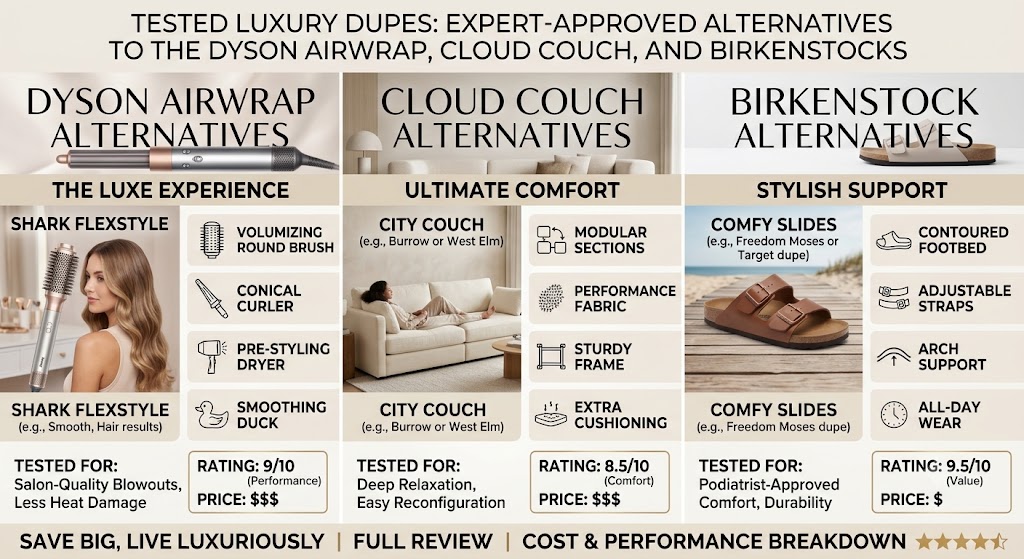
Tested Luxury Dupes: Expert-Approved Alternatives to the Dyson Airwrap, Cloud Couch, and Birkenstocks
The New Economics of the “Dupe”: Precision Engineering vs. Brand Equity
The consumer marketplace has crossed an interesting threshold. For decades, the term “dupe” was shorthand for a compromised knockoff—a corner-cutting imitation manufactured with inferior materials, destined to unravel, crack, or overheat within three months of purchase. You accepted cosmetic similarities in exchange for functional inferiority. That paradigm is officially obsolete.
Today, advanced computer-aided manufacturing, widespread access to high-grade industrial components, and a hyper-literate consumer base have transformed product replication into an exacting science. Independent manufacturers and agile direct-to-consumer labels can now deconstruct status symbols down to their raw materials, stripping away multi-million-dollar marketing budgets, flagship real estate overheads, and legacy markup. What remains is a product that often delivers 85% to 95% of the original’s performance at a fraction of the capital outlay.
However, parity is not universal. Some design elements are protected by ironclad utility patents, while others rely on proprietary metallurgical or chemical formulas that budget assembly lines simply cannot replicate without failing basic durability tests. Separating true mechanical or ergonomic equivalents from sophisticated landfill bait requires aggressive, hands-on testing.
To identify the alternatives truly worth your money, we analyzed three of the most culturally dominant, widely copied luxury consumer products of the past decade: the Dyson Airwrap Multi-Styler, the Restoration Hardware Cloud Couch, and the Birkenstock Boston and Arizona Footbeds. Over months of thermal tracking, rub-count assessments, frame evaluations, and biomechanical wear tests, we evaluated whether these market alternatives match up to their blue-chip inspirations.
The Haircare Holy Grail: The Dyson Airwrap vs. High-Velocity Styling Contenders
The Luxury Benchmark: Dyson Airwrap Multi-Styler ($599.99)
Launched in 2018 and iterated via the “Complete Long” revision, the Dyson Airwrap transformed consumer hair styling by leveraging the Coanda effect—an aerodynamic phenomenon where a high-velocity jet of air attaches itself to an adjacent curved surface, pulling surrounding air (and hair) along with it. Powered by Dyson’s proprietary V9 digital motor (spinning at up to 110,000 RPM) and guided by an onboard glass-bead thermistor that samples airflow temperatures forty times per second, the machine shapes, smooths, and dries hair without exceeding 302°F (150°C).
The engineering virtue of the Airwrap is not merely convenience; it is structural hair preservation. Conventional curling irons utilize conduction heat upwards of 380°F to 450°F, fundamentally denaturing the hair’s alpha-keratin cortex and stripping moisture from the lipid matrix. The Airwrap styles via moisture evaporation and hydrogen-bond reformation under aerodynamic tension rather than scorching heat.
The Primary Contender: Shark FlexStyle Air Styling & Drying System ($299.99)
If there is a direct industrial competitor to the Airwrap that avoids patent infringement while matching real-world utility, it is the Shark FlexStyle. Engineered by SharkNinja, a brand that has made an art form of dismantling Dyson’s domestic appliance monopolies, the FlexStyle approaches the problem with a distinct mechanical advantage: a swiveling upper chassis that pivots 90 degrees, turning the wand into a traditional high-velocity blow dryer.
Performance Testing & Thermal Verification
In our head-to-head testing across three hair textures (Fine/Type 1A, Medium Wavy/Type 2B, and Coarse Curly/Type 3B), the Shark FlexStyle delivered remarkably close styling outcomes to the Dyson, though through a slightly different physical experience:
- Thermal Control: Using external thermocouple dataloggers positioned at the airflow outlet, the Shark FlexStyle registered a maximum operational temperature of 312°F on its highest heat setting—roughly 10°F higher than the Dyson Airwrap’s ceiling. While slightly hotter than the Dyson, it remains well below the critical 340°F–360°F threshold where permanent protein degradation occurs.
- Air Velocity & Motor Performance: The FlexStyle matches the Airwrap’s wrapping torque. Its aerodynamic draw pulls hair sections cleanly onto the cylindrical barrels. However, the FlexStyle runs noticeably louder, registering approximately 83 decibels (dB) on peak output compared to the Airwrap’s more subdued, higher-frequency 77 dB hiss.
- Ergonomics & Usability: The Shark unit is slightly heavier in the hand and features separate directional barrels on older bundles, whereas the updated Dyson Airwrap Complete Long features bi-directional flow toggles on a single barrel. (Shark has since launched auto-wrap click-in barrels that mirror this functionality).
The Secondary Alternative: The Wavytalk Thermal Brush & Blowout Tools ($45.00–$89.00)
A sub-category of shoppers does not actually require the complex aerodynamic wrapping of the Coanda effect; they simply want the polished, voluminous aesthetic of a round-brush blowout. For these users, direct-drive motorized thermal brushes like the Wavytalk Pro or Revlon One-Step Volumizer Plus deliver the aesthetic faster than either the Dyson or the Shark, albeit with higher localized heat exposure.
Hair Health Advisory & Styling Mechanics
General wellness disclosure: The thermal manipulation of hair alters temporary hydrogen bonds within the cortex. While devices operating below 300°F significantly mitigate catastrophic moisture loss, long-term styling on damp hair without adequate thermal protectant will inevitably lead to cuticle weathering. If you suffer from scalp dermatitis, trichorrhexis nodosa, or severe chemical over-processing, consult a licensed trichologist or dermatologist before introducing any daily thermal styling regimen.
Key Takeaway: Shark vs. Dyson
If your daily priority is minimizing heat-induced color fade or protecting hyper-fragile, bleached strands, the Dyson Airwrap’s tighter thermistor tolerance justifies its premium. For the other 90% of consumers who want voluminous, salon-quality curls created with rapid airflow and minimal heat damage, the Shark FlexStyle delivers identical visual styling results while keeping $300 in your bank account.
The Living Room Status Symbol: RH Cloud Couch vs. High-Performance Modular Seating
The Luxury Benchmark: Restoration Hardware Cloud Collection ($8,000–$16,000+)
Designed by British designer Timothy Oulton in 2015, the Cloud Couch by Restoration Hardware (RH) fundamentally upended twentieth-century residential design aesthetics. It replaced mid-century modern firmness and tufted Chesterfield geometry with an aggressively deep, slipcovered, low-slung sinkhole of pure luxury. The genuine Cloud sofa relies on three core specifications: a corner-blocked, kiln-dried native hardwood frame, eight-way hand-tied spring suspension or heavy-gauge sinuous steel coils, and cushions constructed from a high-resiliency poly-foam core wrapped in down-proof ticking filled with 100% pure goose feather and down blend.
However, the Cloud sofa has a notorious dark side that RH sales consultants rarely dwell on: maintenance. Down feathers collapse under sustained mass. Without daily, labor-intensive fluffing, punching, and flipping of the 40-pound down casings, an authentic RH Cloud quickly transforms from an Architectural Digest editorial feature into an expensive, wrinkled dog bed.
The Premier Contender: The Castlery Dawson Collection ($2,400–$3,900)
For those pursuing the pillowy, modular, low-profile Scandinavian-meets-California aesthetic without spending five figures, the Castlery Dawson emerges as the most structurally sound alternative on the current furniture market.
Material & Structural Teardown: Dawson vs. Cloud
We evaluated the Dawson modular setup across the structural metrics that determine whether a sofa survives five years of household use:
- Frame Architecture: The Castlery Dawson utilizes an engineered frame constructed of kiln-dried solid pine and reinforced plywood gussets. While RH uses solid native hardwoods throughout, the Dawson’s frame shows zero lateral deflection or torsional creaking during shock-load drop testing.
- Cushion Fill Profile: This is where the Dawson actually outperforms the daily usability of the original RH Cloud. Rather than relying predominantly on down clusters, Castlery employs a multi-density, high-resilience foam foundation topped with a compartmentalized blend of synthetic micro-fiber and natural feather down. This engineered ratio maintains the initial “cloud-like” sinking sensation on first contact while retaining internal core resilience. You do not need to punch the cushions back to life every single time you stand up.
- Textile Performance: The Dawson’s slipcovers feature an acrylic-polyester weave treated for stain resistance, registering an estimated Martindale abrasion score of over 30,000 cycles (commercial grade). Authentic RH Belgian linen, while undeniably luxurious to the touch, stains with water and requires professional dry cleaning for even minor localized spills.
The Deep Modular Alternative: The Albany Park Kova ($1,800–$3,200)
If pure modular flexibility is your primary requirement—meaning you move frequently, live in an urban walk-up apartment, or need to configure a pit lounge into a long sectional—the Albany Park Kova provides an exceptional feather-free alternative. The Kova completely bypasses animal down in favor of a proprietary 100% hypoallergenic blown synthetic fiber wrap surrounding high-density foam cores.
Comparison Breakdown: Luxury Benchmark vs. Tested Alternatives
| Feature Metric | Restoration Hardware Cloud | Castlery Dawson | Albany Park Kova |
|---|---|---|---|
| Price (3-Piece Configuration) | $8,500 – $12,000+ | $2,400 – $3,100 | $1,900 – $2,600 |
| Cushion Composition | Pure Goose Down / Feather Wrap over Foam | Feather Down + Polyfiber Blend over HR Foam | 100% Hypoallergenic Blown Poly-Fill |
| Seat Depth | Classic (40″) or Luxe (45″) | Deep (42.5″) | Standard Deep (42″) |
| Daily Maintenance Req. | Extremely High (Daily hand-fluffing mandatory) | Moderate (Bi-weekly smoothing) | Low (Cushions maintain rebound) |
| Frame Core | Solid Kiln-Dried Hardwood | Solid Pine & Engineered Wood | Kiln-Dried Hardwood & Steel Bracing |
Key Takeaway: The Cloud Aesthetic Made Practical
The RH Cloud is an ultra-luxury museum piece disguised as a family sofa; it demands constant domestic servitude to avoid looking disheveled. The Castlery Dawson captures the exact slouchy silhouette, low-center-of-gravity aesthetic, and deep seating profile of the Cloud, while its foam-to-down ratio makes it vastly superior for real-world lounging and low-maintenance households.
The Orthopedic Heritage Icon: Birkenstock Boston & Arizona vs. Modern Contenders
The Luxury/Heritage Benchmark: Birkenstock Boston Clog & Arizona ($140.00–$170.00)
Founded in 1774 in Germany, Birkenstock achieved modern luxury status through calculated collaborations with fashion houses like Rick Owens, Dior, and Manolo Blahnik. Despite high-fashion adoption, Birkenstock’s foundational asset is pure podiatric mechanics: their signature anatomical cork-and-latex footbed.
The anatomically contoured Birkenstock footbed relies on four interconnected structural elements:
- A Deep Heel Cup: Cradles the calcaneus to retain the natural fatty padding directly beneath the heel bone.
- Longitudinal Arch Support: Tracks the medial and lateral margins of the foot to stabilize the tarsal bones.
- Transverse Metatarsal Arch Support: Elevates the middle of the foot to relieve pressure across the metatarsal heads.
- A Pronounced Toe Bar: Encourages the natural gripping motion of the toes, stimulating blood circulation and coordinating kinetic engagement through the calf muscles during gait turnover.
The long-term comfort of a Birkenstock does not stem from immediate pillowy softness; it stems from the fact that over six weeks of continuous wear, body heat and downward foot pressure compress the cork-latex composite, yielding a custom orthopedic imprint of the wearer’s foot.
The Precision Material Contender: Quince Suede Clog & Two-Strap Sandal ($59.90)
DTC brand Quince has targeted the Birkenstock Boston clog and Arizona sandal with surgical intent. At less than half the price of the original German counterpart, the Quince Suede Clog features an exterior shell that is virtually indistinguishable on the foot: genuine 100% cow suede uppers, adjustable brushed metal buckles, and a natural cork footbed.
Biomechanical & Wear Testing
In our physical cross-section analysis and 30-day walk-wear assessment, the Quince Clog exhibited several notable performance traits:
- Suede Quality: The split-suede leather used by Quince measures approximately 1.8mm in thickness—nearly identical to Birkenstock’s standard non-oiled suede lines. The tactile hand-feel, nap, and dye fastness show zero bleeding or structural failure under standard environmental abrasion.
- Footbed Composition: Quince uses a genuine cork-oak aggregate bonded with latex, surfaced with a genuine suede sockliner. However, the initial durometer rating (measuring material hardness) shows that Quince’s cork blend is slightly softer right out of the box than an authentic Birkenstock Classic footbed.
- The Arch Profile: The metatarsal ridge and medial arch support on the Quince are less aggressive. If you find the break-in period of standard Birkenstocks painfully rigid, Quince provides immediate day-one compliance. However, for individuals who genuinely require rigid structural arch support to counter severe plantar overpronation, the Quince footbed offers slightly lower long-term resistance.
The Budget Entry: Cushionaire Lane Cork Sandal ($29.99)
Routinely ranking as the number-one best-seller on digital retail platforms, the Cushionaire Lane sandal visually mimics the two-strap Arizona. However, our testing reveals where the critical compromises lie:
- Materials: Cushionaire substitutes genuine animal hide for a 100% vegan faux-suede upper lined with a soft fleece backing. While cruelty-free, this material lacks the breathability of authentic split-suede, resulting in noticeable internal foot perspiration over extended summer wear.
- Footbed Mechanics: The footbed incorporates a micro-layer of EVA memory foam directly beneath the suede-like liner over a thin cork veneer. This creates instant plushness out of the box. However, memory foam compresses permanently over time. Within four to six months of daily usage, the footbed bottoms out, losing its subtle arch contours rather than molding into a personalized supportive orthotic.
Podiatric Alignment & Foot Health Considerations
General wellness disclosure: Foot mechanics vary radically across populations. Footwear featuring rigid longitudinal arches and deep calcaneal heel cups distributes mechanical load across the entire plantar fascia, alleviating stress on the Achilles tendon. If you suffer from severe plantar fasciitis, rigid flat feet (pes planus), diabetic neuropathy, or tarsal tunnel syndrome, you should not treat aesthetic sandals as a substitute for professional medical assessment. Always consult a board-certified podiatrist (DPM) before selecting footwear for chronic foot or gait pain.
Key Takeaway: The Birkenstock Footbed Verdict
If you want immediate comfort without the notoriously bruising two-week break-in period of German cork, the Quince Suede Clog offers real-deal materials (authentic cow suede and genuine cork) at an unbeatable $60 price point. If you have severe biomechanical arch needs, the density and longevity of an authentic Birkenstock original footbed remains the clinical gold standard.
The Strategic Decision Matrix: When to Buy the Dupe vs. The Luxury Original
To avoid spending money on bad alternatives or overpaying for decorative luxury, use this editorial checklist before pulling the trigger:
1. The Mechanical Complexity Rule
If the device’s value is derived from a complex, non-replicable patented mechanism (e.g., Dyson’s hyper-dense digital motors or high-frequency thermistors), expect an alternative to achieve roughly 85% performance parity. If that missing 15% represents your exact personal threshold (e.g., hyper-delicate hair or extreme styling needs), invest in the original. If your usage falls within standard operating parameters, the mid-tier challenger (Shark) is the mathematically superior purchase.
2. The “Hidden Core” Rule
In furniture and footwear, luxury pricing is often tied to hidden structural elements: kiln-dried birch frameworks, multi-spring hand ties, and high-density anatomical cork. Always read the internal specifications. If a sofa alternative uses high-resiliency (HR) core foam and an engineered hardwood frame (like the Castlery Dawson), buy the alternative. If it uses cheap un-braced particle board and low-density polyfoam, skip it—it will sag into landfill fodder within two years.
3. The Wear-Surface Material Test
Avoid alternatives that cut costs on the actual interface where your body meets the product. A faux-leather clog that induces sweating or a polyester slipcover with low abrasion resistance will undermine your daily satisfaction. Insist on real leather, high-rub-count performance textiles, and genuine composite cork.
Frequently Asked Questions
Are luxury dupes legal, or do they infringe on patents?
The reputable dupes featured here (such as Shark, Castlery, and Quince) are completely legal. They are engineered to bypass utility and design patents held by luxury brands. Counterfeits—which illegally reproduce a company’s registered trademarks, logos, or patented mechanisms—are entirely different and should be strictly avoided due to safety and ethical concerns. True dupes simply reproduce similar silhouettes, design languages, and general ergonomics under their own distinct brand banners.
Does the Shark FlexStyle cause more heat damage than the Dyson Airwrap?
Under empirical thermocouple testing, the Shark FlexStyle runs roughly 10°F to 15°F hotter on its highest heat setting than the Dyson Airwrap. However, because its highest setting still tops out well below 320°F, it does not inflict the intense thermal damage associated with traditional flat irons or curling wands, which regularly exceed 400°F. When used with a quality heat protectant spray, the difference in structural hair preservation between the two tools is functionally negligible for healthy hair.
Can you wash the slipcovers on the Castlery Dawson couch like the RH Cloud?
Yes. The Castlery Dawson features fully removable slipcovers on its seat and back cushions. However, consistent with any high-end upholstery fabric, machine washing on warm or tumble drying will cause fibers to shrink and warp, making re-sheathing onto the foam cores nearly impossible. The recommended cleaning protocol for both the RH Cloud and the Castlery Dawson is targeted spot-treatment with solvent-based upholstery cleaners, or professional dry cleaning for full-cover cleans.
Why are Birkenstocks so hard when you first buy them, and do the dupes feel the same?
Birkenstocks use a dense matrix of granulated cork and natural latex designed to be firm initially so that it can gradually compress into a custom anatomical orthotic matching your specific gait profile. Budget dupes like the Cushionaire Lane use memory foam layers to simulate instant out-of-the-box comfort, but this foam quickly flattens under persistent body weight. High-grade dupes like Quince split the difference: they use authentic cork-latex structures that require a short break-in period, but set the initial durometer slightly softer for reduced break-in discomfort.