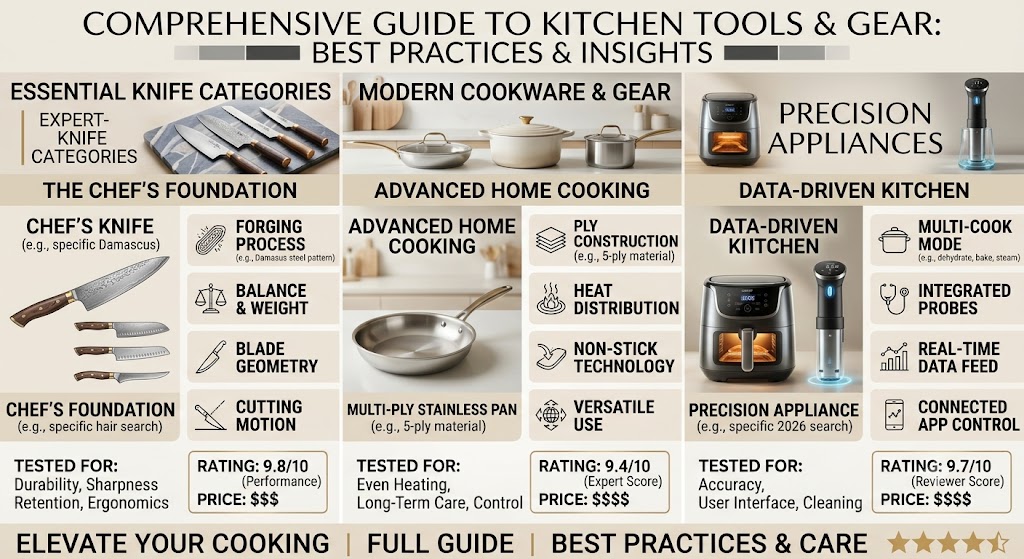
Comprehensive Guide to Kitchen Tools & Gear: Best Practices & Insights
Spend five minutes browsing culinary media, and you will quickly be convinced that executing a restaurant-caliber meal at home requires an overwhelming inventory of specialized equipment. Retail aisles and online storefronts brim with hyper-specific gadgets: avocado slicers, garlic presses, dedicated herb strippers, and digital egg poachers. In reality, walking into any Michelin-starred restaurant reveals a starkly different scene. Professional line cooks execute hundreds of exquisite covers nightly using a minimalist, exceptionally curated kit of durable, versatile workhorse tools.
Cooking with precision, efficiency, and pleasure does not stem from accumulating kitchen gadgets; it comes from mastering the physics of heat transfer, the mechanics of cutting, and the ergonomic rhythm of your workspace. By understanding the metallurgy of your cookware, the edge geometry of your blades, and the utility of industrial prep equipment, you can assemble a kitchen setup that lasts a lifetime while dramatically elevating your culinary output. This guide breaks down the essential science, best practices, and selection criteria for building a high-performance home kitchen.
—
1. The Foundation of Prep: Knives and Cutting Surfaces
Every culinary task begins at the prep station. The biomechanical connection between your hand, your blade, and the cutting board dictates the speed, precision, and physical fatigue of your prep work. Understanding the balance between steel composition and edge geometry allows you to choose tools that stay sharp, resist chipping, and feel like natural extensions of your forearm.
The Anatomy of Blade Steel: Hardness vs. Toughness
Knives are governed by the metallurgy of their steel, which is evaluated primarily through the Rockwell Hardness Scale (HRC). A steel’s chemical composition dictates the trade-off between hardness (edge retention) and toughness (resistance to chipping and catastrophic failure):
- Western / German Knives (56–58 HRC): Typically forged from steels like X50CrMoV15, these blades are softer and tougher. They feature thicker spines, robust bolsters, and wider edge bevels (around 20 degrees per side). They excel at heavy-duty tasks—halving winter squashes, disjointing poultry, and handling bone contact—without chipping. They roll their edge rather than chip when stressed, making them easy to re-align with a simple honing steel.
- Japanese Knives (60–64+ HRC): Forged from high-carbon steels such as VG-10, SG2/R2, or traditional carbon steels like Shirogami (White Paper) and Aogami (Blue Paper). These steels are significantly harder, allowing bladesmiths to grind them to razor-thin profiles and acute edge angles (12–15 degrees per side). They glide through dense root vegetables and tender proteins with zero cellular bruising, but their brittleness means they will chip if twisted, dropped, or used on bones.
The Indispensable Knife Trio
Culinary knife blocks packed with fifteen assorted blades are an inefficient waste of counter space. You can accomplish 95 percent of all culinary tasks with three dedicated blades:
- An 8-inch or 10-inch Chef’s Knife (Gyuto): Your primary extension. An 8-inch knife offers balanced agility for home prep, while a 10-inch blade provides the mechanical leverage needed for large-batch prep work and shredding cabbage.
- A 3.5-inch Paring Knife: Used off the board for in-hand precision tasks—hulling strawberries, trimming artichoke hearts, scoring pastry, and peeling fruit.
- A 9-to-10-inch Serrated Bread Knife: Crucial for slicing through crusty sourdough, delicate sponge cakes, and soft-skinned produce like ripe heirloom tomatoes without flattening the interior crumb or flesh.
Cutting Surfaces: Wood, Rubber, and the Plastic Fallacy
The cutting board is just as vital as the blade. A dulling surface destroys your knife edge within seconds. Glass, marble, bamboo, and ceramic boards should be eliminated entirely; their hardness exceeds that of knife steel, actively rolling and micro-chipping sharp edges.
End-Grain Hardwood (Maple, Walnut, Cherry): The gold standard for home use. In an end-grain board, the wood fibers stand vertically, like the bristles of a brush. When your blade strikes down, the fibers part to absorb the edge and then spring back together after the cut. This preserves sharpness, minimizes visible scoring, and provides natural antimicrobial protection through wood tannins.
High-Performance Rubber (Asahi, Hasegawa): The preferred choice of professional sushi chefs. These synthetic rubber boards offer a soft, cushioned surface that minimizes blade deflection and prolongs sharpness. They are non-porous, highly sanitary, and can be sanitized with chemical solutions that would ruin hardwood.
The Truth About Plastic Boards: While high-density polyethylene (HDPE) boards are ubiquitous in commercial kitchens due to dishwasher sanitization protocols, they develop deep knife gouges over time. These micro-crevices trap bacteria and shed microplastic particles directly into your food during vigorous chopping.
—
2. Cookware Demystified: The Physics of Thermal Transfer
Great cooking hinges on thermal management: heat retention, thermal conductivity, and reactivity. Selecting cookware based on aesthetic appeal or marketing buzzwords often leads to scorched sauces, uneven browning, and ruined pans. Instead, build your pan lineup around the physical properties of culinary metals.
Thermal Properties of Cookware Materials
| Material | Thermal Conductivity (W/m·K) | Heat Retention (Volumetric Heat Capacity) | Reactivity with Acid | Primary Culinary Application |
|---|---|---|---|---|
| Copper | ~390 (Extremely High) | Low | High (Requires Tin/SS lining) | Precision sauces, confectionery, delicate reductions |
| Aluminum | ~220 (High) | Moderate | High (Unless anodized/clad) | Sheet pans, commercial stockpots, clad pan cores |
| Cast Iron | ~50 (Low) | Very High | Moderate (Degrades seasoning) | High-heat searing, baking, shallow frying |
| Carbon Steel | ~54 (Low) | High | Moderate (Degrades seasoning) | Wok cooking, searing, egg and crepe cookery |
| Austenitic Stainless Steel | ~16 (Very Low) | Moderate | Completely Inert | Pan sauces, acidic braises, deglazing, boiling |
Fully Clad Tri-Ply Stainless Steel: The Workhorse
Because stainless steel is a poor conductor of heat but exceptionally durable and completely non-reactive, modern culinary engineering bonds it with conductive metals. A high-quality tri-ply pan features an interior core of pure aluminum or copper sandwiched between two layers of 18/10 stainless steel. This construction extends from the base all the way up the sidewalls.
Clad stainless steel provides rapid, even heat distribution, eliminating hot spots that burn garlic or scorch roux. Because the surface is non-reactive, you can simmer acidic tomatoes, deglaze with dry white wine, and build complex pan sauces (using the fond—the caramelized proteins stuck to the pan surface) without imparting metallic off-flavors or stripping the pan’s finish.
Cast Iron vs. Carbon Steel
Cast iron and carbon steel are close relatives: both are iron alloys that rely on polymerized layers of oil (seasoning) to create a slick, naturally hydrophobic barrier. However, their physical geometry results in distinct kitchen applications:
- Cast Iron: Heavy, thick, and porous. Its massive thermal bulk absorbs a tremendous amount of heat energy. Once hot, dropping a cold, thick-cut ribeye into a cast iron skillet will not crash the pan’s surface temperature. This makes it unmatched for Maillard reaction browning and maintaining steady oil temperatures during frying.
- Carbon Steel: Lighter, thinner, and stamped from sheet metal rather than poured into sand molds. Carbon steel heats up and cools down much faster than cast iron while maintaining exceptional non-stick seasoning capabilities. It is the premier material for French omelet pans, stir-fry woks, and rapid-prep searing where agile pan tossing is required.
The Non-Stick Conundrum
PTFE (Teflon) and ceramic-coated pans have their place, but they are consumable items, not heirloom investments. Even with gentle wooden utensils and strict hand-washing protocols, fluoropolymer coatings break down over 2 to 4 years of daily thermal cycling. Limit non-stick pans to one 8-inch or 10-inch skillet dedicated exclusively to delicate, low-temperature egg cookery, delicate fish fillets, and crepes. Avoid running them under cold water while hot (thermal shock causes warping), and never heat them empty above 450°F (232°C) to prevent toxic vapor release.
—
3. Industrial-Grade Prep Tools: Function Over Form
Home cooks often invest heavily in cookware sets while settling for flimsy prep tools, dull peelers, and warped plastic bowls. Upgrading to commercial-grade prep equipment instantly improves hand comfort, reduces prep times, and keeps your workstation tidy.
Half-Sheet Pans with Wire Racks
Ditch traditional rimless cookie sheets and lightweight baking dishes. The commercial 18-gauge natural aluminum half-sheet pan (18×13 inches) reinforced with an encapsulated steel rim is one of the most versatile tools in modern cooking. It will not warp at 450°F, conducts heat evenly, and holds high volumes of food.
Paired with a stainless steel wire cooling rack, a sheet pan becomes an elevated roasting station for poultry, a dehydrating rack for dry-brining steaks in the refrigerator, and an organized landing zone for mise en place bowls.
The Essential Small Tool Arsenal
- The Fish Spatula (Pelletier): Far more than a seafood tool. Constructed from flexible, thin, slotted spring steel with an offset angle, it effortlessly slides beneath seared smash burgers, lifts fragile fried eggs without puncturing yolks, and doubles as an efficient grease strainer.
- Y-Peelers (Carbon Steel Blade): Ditch bulky, straight swivel peelers. Inexpensive Swiss-style Y-peelers featuring sharp carbon steel blades (like Kuhn Rikon) glide effortlessly around irregularities in butternut squashes, carrots, and potatoes with minimal hand pressure.
- Bench Scraper (Dough Knife): A simple rectangular slab of stainless steel with an ergonomic handle. It is the proper, safe tool for transporting chopped produce from the board to the pan. Using your chef’s knife blade as a shovel drags the razor-sharp apex against the wood, rapidly dulling the cutting edge.
- High-Heat Silicone Spatulas: Look for one-piece, seamless designs rated to at least 500°F (260°C). Seamless construction eliminates deep interior seams where food residues, water, and fungal spores accumulate over time.
- Locking Stainless Steel Tongs: Avoid spring-loaded tongs covered in thick, bulky silicone tips that lack tactile sensitivity. Standard 9-inch and 12-inch scalloped stainless steel tongs act as nimble, heat-proof extensions of your fingers for turning proteins, tossing pasta through emulsified sauces, and plating components.
—
4. Precision Instruments: Taking the Guesswork Out of Cooking
Intuition and sensory cues (smell, touch, sound) are critical culinary skills, but precision instrumentation provides the objective benchmark needed to train those senses reliably. Guessing internal doneness by poke-tests or relying on volumetric baking cups introduces massive variance into your dishes.
Digital Scales: The Demise of Volumetric Measurement
A standard cup of all-purpose flour can weigh anywhere from 110 grams to 160 grams depending entirely on how tightly it was packed, humidity levels, and whether it was sifted. This introduces a 45% margin of error into your recipes. Baking, charcuterie curing, and pickling require absolute mass precision.
Every modern kitchen requires an accurate digital scale that reads down to 1 gram (or 0.1 gram for hydrocolloids and yeast), featuring a swift tare function and an easy-to-read illuminated display. Working by mass simplifies cleanup: set your mixing bowl on the scale, zero the display, and weigh all wet and dry ingredients sequentially directly into a single vessel.
Thermometry: The Instant-Read Thermocouple
Cooking is the application of heat over time to transform proteins, gelatinize starches, and evaporate moisture. Using time as your sole metric is deeply flawed because oven calibration, pan thickness, ambient temperature, and meat thickness vary wildly. Thermometry replaces luck with repeatable science.
Avoid cheap dial thermometers and sluggish thermistor probes that take 10 to 15 seconds to equilibrate. Invest in a thermocouple instant-read thermometer (such as a ThermoWorks Thermapen). Thermocouples yield a verified reading in under two seconds through a micro-thin tip. This speed allows you to map internal thermal gradients in a roasting bird, verify the sugar-crack stage in confectionary work, and monitor frying oil without losing heat through an open oven door.
—
5. Countertop Workhorses: When to Automate
While minimalist hand prep develops culinary technique, certain operations demand extreme mechanical force. High-shear blending, deep pureeing, and planetary kneading simply cannot be replicated by hand.
High-Performance Blenders vs. Standard Blenders
A standard consumer blender (300 to 500 watts) relies on sharp blades to chop ingredients suspended in liquid. A commercial high-performance machine (such as a Vitamix running at 1200 to 1500 watts) uses dull, thick airplane-grade stainless steel blades driven by immense motor torque at speeds surpassing 20,000 RPM. This design pulverizes cell walls through pure kinetic energy and fluid shear.
This power allows you to produce silky veloutés without straining them through a fine-mesh chinois, blend whole grain flours, make nut butters from raw seeds without added oil, and create stable, un-broken hot emulsions (like hollandaise and mayonnaise) in mere seconds.
The Case for the Immersion (Stick) Blender
If storage is at a premium, an immersion blender provides exceptional utility per square inch. It eliminates the dangerous task of pouring boiling, pressurized liquids from a Dutch oven into a tabletop blender carafe. Look for an immersion model with variable speed settings, a detachable stainless steel wand, and at least 300 watts of motor power for smooth, direct-in-the-pot purees.
The Food Processor: Disc Geometry and Torque
Unlike blenders, which create fluid vortexes, food processors are built around high-torque, low-RPM gearboxes paired with large, flat chopping bowls. They excel where blenders stall: shredding firm cheeses, cutting cold butter into flour for flaky pie doughs, slicing vegetables into consistent rounds, and grinding tough proteins for pâtés or homemade sausages.
—
6. Kitchen Ergonomics, Workflow, and Care Protocols
The finest collection of culinary tools remains ineffective if your kitchen workflow is disorganized. Professional cooks organize their operational life around mise en place—everything in its designated place, pre-measured, prepped, and within arm’s reach before the heat is applied.
The Mise en Place Workflow
- Clear the Decks: Never begin prep work in a kitchen that contains dirty dishes, clutter, or drying racks on the countertops. Clear space translates directly to clear focus and safer knife work.
- Station Anchoring: Place a damp paper towel or a non-slip silicone mat directly beneath your cutting board. A board that shifts, slides, or wobbles under downforce is a major safety hazard.
- Trash Bowls and Scrap Trays: Keep an oversized stainless steel bowl directly next to your cutting surface for trimmings, peels, and vegetable scraps. Walking back and forth to the trash can breaks your cooking rhythm and litters the floor with vegetable debris.
Maintenance Regimes That Extend Tool Longevity
High-end kitchen gear can easily last for generations if maintained with basic, deliberate care protocols:
- Zero Dishwasher Policy for Fine Tools: Keep your chef’s knives, carbon steel, cast iron, and wooden cutting boards out of the dishwasher. Harsh powdered detergents contain caustic abrasives that etch knife edges and strip wood finishes. High-temperature steam and turbulent wash cycles swell, warp, and split wood, while cracking riveted knife scales.
- Routine Knife Sharpening: Understand the vital difference between honing and sharpening. Honing with a grooved ceramic or steel rod does not remove metal; it simply straightens a bent, rolled edge. Sharpening removes steel to create a fresh, clean apex. Invest in a dual-grit synthetic water stone (1,000/6,000 grit) and sharpen your blades twice a year. Water stones preserve blade geometry, run cool, and produce mirror-like edges that pull-through knife sharpeners can never match.
- Seasoning Chemistry: When seasoning cast iron or carbon steel, use oils rich in polyunsaturated fatty acids, such as organic flaxseed, grapeseed, or sunflower oil. Apply an impossibly thin coat, wipe it thoroughly until the pan appears dry, and heat it past the oil’s smoke point for one hour. This process chemically bonds a smooth, glassy polymer matrix to the iron surface rather than creating a sticky, gummy layer of burnt grease.
—
7. Key Takeaways: The Pro-Grade Kitchen Checklist
- Prioritize Steel and Edge Geometry: Swap out oversized knife blocks for an 8-inch chef’s knife, a paring knife, and a serrated bread knife suited to your prep style (German for durability, Japanese for laser precision).
- Invest in Thermal Cladding: Build your core cookware lineup around tri-ply stainless steel for all-around pan sauces and acidic dishes, alongside cast iron or carbon steel for high-heat searing and frying.
- Ditch Volume for Mass: Use a digital kitchen scale (grams) to achieve reliable, reproducible baking and pickling results without dirtying multiple measuring cups.
- Control Heat with Instant Thermometry: Stop relying on arbitrary cooking timers. Check doneness with a thermocouple probe thermometer to consistently hit your target textures and temperatures.
- Embrace Commercial Kitchen Standards: Stock up on aluminum half-sheet pans, wire racks, Y-peelers, fish spatulas, and end-grain wood cutting boards for safe, ergonomic, and durable prep work.
—
Frequently Asked Questions
What is the absolute minimum kitchen kit for someone on a strict budget?
If you are building an elite, budget-conscious kit from scratch, purchase: an 8-inch Victorinox Fibrox Chef’s Knife; a large end-grain or edge-grain hardwood board; a 12-inch pre-seasoned cast-iron skillet (such as Lodge); an 18-gauge aluminum half-sheet pan with a wire rack; a digital scale; a flexible fish spatula; and a reliable pocket digital thermometer. This bare-bones setup costs under $150 total and can handle almost any home cooking technique.
How can I tell if my pan is hot enough to cook without food sticking?
For un-coated stainless steel cookware, use the Leidenfrost effect test. Flick a few droplets of water into the dry pan as it preheats over medium heat. If the water sizzles, splits, and evaporates instantly, the pan is not hot enough. When it reaches the correct temperature (around 380°F / 193°C), the water droplets will not evaporate; they will coalesce into a single, bead-like marble that glides across the metal surface. Wipe the water bead out, add your cooking oil, let the oil shimmer, and introduce your protein for clean, non-stick searing.
Can I wash a seasoned cast-iron skillet with modern dish soap?
Yes. The myth that dish soap ruins cast iron dates back to a time when soaps were made with harsh, free lye that stripped away seasoned coatings. Modern liquid dish soaps use mild surfactants that break down free surface grease without breaking down the polymerized, cross-linked oil layer of a properly seasoned pan. Wash your pan gently with hot water, a sponge, and mild dish soap, dry it completely over a low stovetop burner, and rub it with a few drops of neutral oil before storing.
Why do my knives dull so quickly even though I use a honing steel?
A honing steel does not remove dull metal or grind a new edge; it simply realigns a sharp edge that has rolled microscopically to one side. If your blade has blunted from continuous friction, honing will not restore its bite. At that stage, you need to sharpen it using abrasive whetstones or a professional water-cooled grinding wheel. Additionally, check your cutting surface: cutting on bamboo, composite boards, or glass rapidly rounds off a sharp knife edge.
Are ceramic non-stick pans safer and better than traditional PTFE pans?
Ceramic coatings are PTFE-free and handle higher heat without the risk of releasing toxic fluoropolymer fumes. However, their functional non-stick lifespan is typically shorter than high-grade PTFE cookware. The silica-based sol-gel coating in ceramic pans contains microscopic surface peaks that wear down and degrade relatively quickly from normal thermal cycling, often losing their non-stick release properties within 12 to 18 months of regular use.
Why are high-end commercial sheet pans made of aluminum instead of stainless steel?
Pure aluminum conducts heat more than ten times faster than stainless steel. In baking and sheet-pan roasting, you need immediate, even heat transfer from the pan surface to the base of your food to drive off surface moisture, encourage Maillard browning, and prevent soggy bottoms. Stainless steel sheet pans tend to heat unevenly, retain hot spots, and warp aggressively under sudden temperature shifts.