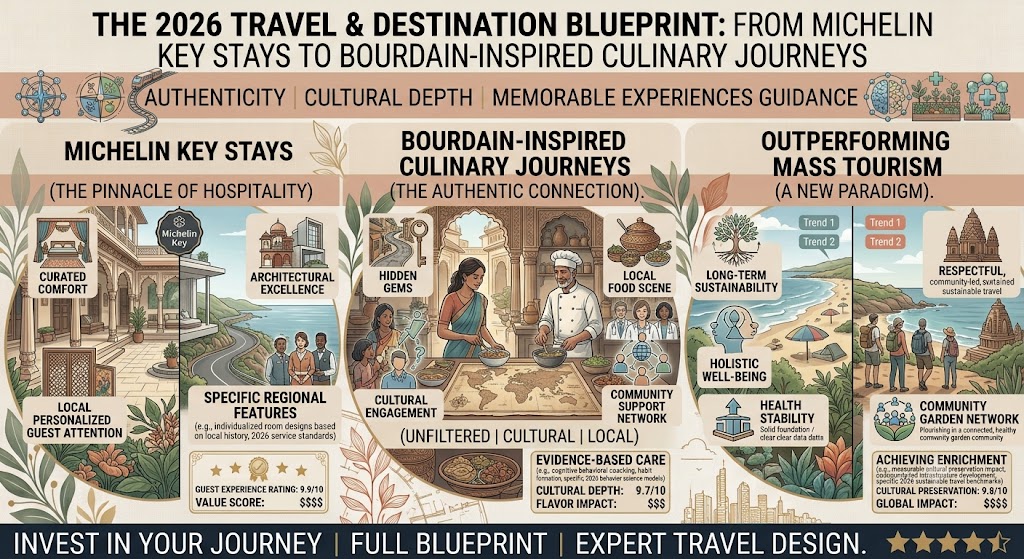
The 2026 Travel & Destination Blueprint: From MICHELIN Key Stays to Bourdain-Inspired Culinary Journeys
We have crossed the threshold of passive sightseeing. In 2026, travel is defined by a deliberate tension: retreating to hotels that represent the pinnacle of architectural and service excellence, then spending the day shoulder-to-shoulder with locals at plastic-table night markets and generational smokehouses.
The Great Decoupling: How Travel Culture Shifted for 2026
For nearly a decade, global travel was governed by algorithmic homogenization. Cafes from Seoul to Mexico City adopted the same poured-concrete floors, oat milk flat whites, and fiddle-leaf figs. High-end hospitality chased standardized five-star checklists, trading local identity for predictable marble bathrooms and scripted concierge greetings. At the same time, food culture became weaponized by viral queues, turning dining into an act of content capture rather than communal nourishment.
The 2026 travel landscape is a decisive rejection of that monoculture. Modern travelers are pursuing what sociologists call “high-contrast exploration.” We no longer travel to exist in a frictionless bubble, nor do we romanticize discomfort for its own sake. Instead, we pair architectural marvels with raw street-level immersion. We spend our mornings studying fermentation traditions alongside third-generation makers in back alleys, and our evenings inside properties evaluated not by generic star counts, but by the soulful rigor of the newly matured MICHELIN Key distinctions.
This blueprint provides the master framework for navigating this evolution. It details how the world’s most discerning travelers are curating routes that honor terroir, architectural integrity, and the enduring human spirit of culinary discovery originally championed by Anthony Bourdain.
The MICHELIN Key Decoded: Navigating the New Benchmark in Stays
When Michelin formally extended its century-old star methodology to global hospitality with the MICHELIN Key, the luxury travel sector experienced a seismic realignment. Historically, hotel classifications relied on superficial amenities: the presence of a 24-hour valet, an Olympic-length swimming pool, or a brand name backed by an international conglomerate. The MICHELIN Key system upended this by anchoring its assessment to five non-negotiable criteria:
- A destination in itself: The hotel contributes substantially to the local cultural context rather than isolating guests from it.
- Excellence in architecture and interior design: A distinct visual point of view that eschews catalog luxury in favor of spatial intelligence and craft.
- Quality and regularity in service: Attentiveness that is intuitive and personal rather than scripted and obsequious.
- Singular personality and character: A discernible soul, often reflecting the vision of an independent hotelier or an uncompromising design atelier.
- Consistency between level of experience and price paid: Demonstrable value at every price tier, whether an eight-room farmhouse or an urban palace.
By 2026, the distinction between One, Two, and Three Keys has crystallized into an indispensable navigational tool for itinerary design:
MICHELIN Key Tier Hierarchy
- One Key (A Very Special Stay): Properties with a strong identity, clear design language, and service that punches far above their weight class. Often independent boutique hotels, restored coastal manors, or design-forward urban outposts.
- Two Keys (An Exceptional Stay): Venues where character and sense of place are profound. These properties feature memorable architecture, deep geographic integration, and hospitality that anticipates guest requirements before they are voiced.
- Three Keys (An Extraordinary Stay): The apex of global hospitality. Wonder-inducing design, peerless comfort, and service so refined it feels invisible. These stays justify an international journey exclusively on their own merits.
The strategic advantage of the Key system is its agnosticism toward scale. A centuries-old ryokan in Ishikawa Prefecture with ten tatami suites carries the same opportunity to achieve Two or Three Keys as a grand Parisian palace hotel overlooking the Seine. It shifts focus from sheer square footage to emotional resonance.
The Bourdain Imperative: Radical Curiosity Without Extraction
To travel in the slipstream of Anthony Bourdain in 2026 does not mean checking off a list of places he filmed fifteen years ago. Those noodle stalls and basement bars have often been transformed by the very exposure he granted them. Rather, channel his philosophical methodology: radical curiosity, intellectual humility, and an unrelenting appetite for the unvarnished truth of a place.
Bourdain understood that food is never just food. It is an expression of border skirmishes, colonial resistance, agricultural adaptations, economic hardship, and communal joy. When you step into a city, the primary objective is to de-center your own expectations and listen to the people feeding you.
Rules for the Modern Bourdain Traveler
- Follow the Shift Workers, Not the Influencers: If you want to understand the culinary baseline of an industrial port or financial center, find where shift workers, taxi drivers, and market porters eat at 5:00 AM or midnight. These venues run on thin margins and high volume; their survival depends on immediate, uncompromising quality.
- Respect the Unwritten Social Contract: When sitting at a wet-market counter in Southeast Asia or an eight-seat izakaya in Osaka, observe before acting. Do not demand substitutions. Do not treat cooks as photo props. Eat what is placed before you, express gratitude in the local dialect, and vacate your seat the moment your meal is complete.
- Track Regional Food Provocation: Seek out ingredients and preparations that challenge your palate: bitter greens, gamey offal, long-cured fats, natural fermentations, and high-heat spices. Travel should expand your sensory tolerance, not validate your domestic habits.
- Prioritize Third Places: Seek out the local tavern, the tea house, the corner pulquería, the seaside oyster shack. These are spaces where commerce takes a backseat to civic exchange. Buy a round, strike up a conversation, and listen far more than you speak.
High-Low Itineraries: The Master Pairings for 2026
The most compelling itineraries combine refined architectural properties with primal, place-defining dining. Here are three field-tested high-low routes designed for 2026.
1. Japan: Beyond the Golden Route (Ishikawa to the Noto Peninsula)
While the Tokyo-Kyoto-Osaka corridor wrestles with unsustainable visitor density, travelers in search of quiet mastery turn northwest to the Hokuriku region. Ishikawa Prefecture offers world-class preserved Edo-period heritage without the theme-park feel.
- The Anchor Stay (Two to Three Keys): Book an immersive stay at an architectural ryokan in Yamashiro Onsen or a master-restored merchant machiya in Kanazawa. Here, the service follows omotenashi in its purest form: garden design that frames the morning mist, hot-spring cedar baths fed by geothermal springs, and private breakfast spreads featuring seasonal sea bream and mountain vegetables.
- The Bourdain-Inspired Ground Game: Head directly into Kanazawa’s Omicho Market at dawn. Bypass the stalls with English laminated signs and look for the counter-only shops serving kaisendon (raw seafood over rice) topped with sweet shrimp and blackthroat seaperch (nodoguro), caught hours earlier in the Sea of Japan. By evening, dive into the Katamachi district’s back-lane oden bars, where daikon radish, beef sinew, and fish cakes have simmered for decades in an umami-rich dashi master stock.
2. Mexico: The Dual Soul of Oaxaca (Central Valleys to the Sierra Sur)
Oaxaca remains Mexico’s culinary heartbeat, but the sophisticated traveler in 2026 moves beyond the immediate perimeter of the Santo Domingo church to understand the region’s agro-ecological diversity.
- The Anchor Stay (One to Two Keys): Select a restored 16th-century convent or an intimate adobe boutique compound designed by contemporary Mexican architects in Oaxaca City’s Jalatlaco or Barrio de la Noria. The aesthetic leans on local limestone, hand-loomed textiles, and courtyards scented with night-blooming jasmine that provide absolute respite from the midday heat.
- The Bourdain-Inspired Ground Game: Hire a local guide to drive south into the Tlacolula Valley on Sunday morning. Inside the sprawling municipal market, navigate the smoky haze of the Pasillo de Humo (Hall of Smoke). Select your strips of thinly sliced tasajo and marinated cecina directly from the butcher, then grill them over glowing coals alongside scallions and avocado leaves. Wash it down with tepache served from an earthen clay barrel, followed by a pilgrimage up the Sierra Sur mountains to drink wild-harvested, clay-pot-distilled mezcal with a maestro palenquero.
3. The Adriatic Borderlands: Friuli-Venezia Giulia & Western Slovenia
The border zone between northeast Italy and western Slovenia represents one of Europe’s most intriguing cultural and culinary confluences: Latin, Slavic, and Germanic influences colliding across dramatic karst limestone landscapes.
- The Anchor Stay (Two Keys): Secure a suite at a restored vineyard estate in the Collio Goriziano or an eco-minimalist alpine retreat tucked into the Soča Valley. These properties feature thoughtful bio-climatic architecture, dry-stone construction, and private wine cellars that house some of the world’s most complex amber (skin-contact) wines.
- The Bourdain-Inspired Ground Game: Spend afternoons seeking out informal osmize—pop-up rustic farmhouses in the Carso plateau marked only by an ivy branch hanging over a wooden gate. Sit at communal trestle tables eating cave-aged sheep cheeses, air-dried prosciutto, hard-boiled eggs, and house-fermented sauerkraut, paired with carafes of sharp, mineral-driven Vitovska. Drive across the Slovenian border into the Vipava Valley for wild-trout fishing and wood-fired mountain stews seasoned with wild juniper and foraged herbs.
The High-Low Matrix: Crafting the Perfect Itinerary Balance
Executing this style of travel requires conscious calibration. Too much luxury creates a sensory vacuum that isolates you from the host culture; too much raw, unscripted exploration without downtime leads to decision fatigue and physical depletion. Use this matrix to structure your balance:
| Travel Dimension | The MICHELIN Key Element (High) | The Bourdain Element (Low) |
|---|---|---|
| Accommodations | Heritage restoration, architectural resonance, deep sleep design, intuitive concierge access. | Secondary basecamps: Family-run guesthouses, rural agriturismi, and community-owned homestays. |
| Culinary Exploration | Hyper-concept multi-course tasting menus analyzing terroir, native seed preservation, and culinary history. | Night-market stalls, roadside rotisseries, dockside fish auctions, and single-dish specialist lunch counters. |
| Transportation | High-speed scenic rail (first-class quiet cars), private electric boat transfers, vetted regional drivers. | Local intercity ferries, public tram systems, rented mountain bicycles, and walking until your shoes give out. |
| Pacing & Rhythm | Dedicated uncommitted mornings for spa hydrotherapy, reading, journaling, and recovery. | Spontaneous late-night wanders, unmapped alley explorations, and following market supply trucks. |
The 2026 Gear, Resilience, and Travel Wellness Protocol
Immersive travel across extreme spectrums—from conditioned five-star suites to humid equatorial markets—places heavy demands on the body. A sharp mind and resilient body are your most essential travel tools.
Circadian Entrainment and Jet Lag Mitigation
Do not forfeit the first three days of an overseas journey to jet lag. Modern chronobiology provides clear tools for resetting your internal biological clock:
- Strategic Light Fasting: Light is the primary zeitgeber (external cue) for your circadian pacemaker. Upon landing, immediately align your light exposure with the destination’s solar cycle. If arriving in the morning, maximize direct outdoor sunlight exposure without sunglasses for twenty minutes to suppress melatonin production and anchor cortisol synthesis.
- Targeted Meal Anchoring: Your peripheral metabolic clocks respond rapidly to food intake. Fasting during the tail end of your flight and eating your first significant meal at the destination’s standard mealtime accelerates metabolic phase-shifting by up to 48 hours.
Skin Barrier Defense Across Variable Microclimates
Commercial aircraft cabins operate at roughly 10% to 20% relative humidity—drier than the Sahara Desert. Exiting an aircraft directly into humid tropical heat or freezing mountain winds destabilizes the stratum corneum, causing inflammation and moisture loss.
- Pre-Flight Hydration Layers: Skip the sheet masks mid-flight, which can evaporate quickly and draw moisture out of the deeper skin layers. Instead, apply low-molecular-weight hyaluronic acid or glycerin to damp skin prior to boarding, locked in with a lipid-rich cream containing physiological ceramides and squalane.
- Environmental Protection: Travel through dense, high-traffic urban centers introduces skin to elevated particulate matter. Incorporate a morning topical antioxidant (such as stabilized vitamin C or ectoin) paired with broad-spectrum mineral SPF 50. This creates a non-reactive physical shield against UV radiation and airborne pollutants.
Health & Wellness Advisory: The physiological protocols outlined above represent general wellness and lifestyle optimization strategies for frequent travelers. They do not constitute formal medical advice. Conditions such as deep vein thrombosis (DVT) risks, severe altitude sickness, gastrointestinal infections, or chronic dermatological conditions require individualized diagnostic evaluation and preventative guidance from a licensed physician or travel health clinic before departure.
Actionable Booking and Logistics Rules for 2026
Executing an elite high-low itinerary requires navigating a tighter booking window and higher demand than ever before. Implement these logistical strategies to secure your access:
- The “Reverse-Calendar” Strategy: Traditional travelers book flights first, hotels second, and reservations last. In 2026, reverse this sequence. Secure your most difficult culinary reservations and boutique Key stays 90 to 180 days in advance (many small, eight-suite properties release inventory on seasonal solstices). Arrange your flights and regional transit only after your core cultural anchors are confirmed.
- Audit Your Digital Sourcing: Remove generic social media algorithms from your destination research. When locating authentic food venues, use local language search terms on local map platforms (e.g., Tabelog in Japan, Dianping in China, or regional food forums in Latin America). Look for venues reviewed almost exclusively in the local language, focusing on reviews that critique cooking technique rather than decor or service speed.
- Leverage Hotel-Level Local Networks: MICHELIN Key properties distinguish themselves through genuine community integration. Contact the hotel concierge or host three weeks prior to arrival. Do not ask for “the best restaurant in town.” Ask: “Where does your head chef take their family to eat traditional comfort food on their day off?” The answer will almost always lead you to an exceptional, unpretentious kitchen.
- Pack for Spatial Agility: If your itinerary swings from a fine-dining dining room to a wet market, pack garments that balance technical utility with classic tailoring. Merinowool crewnecks, dark selvedge denim or tailored trousers, and weather-resistant, unbranded leather walking shoes allow you to enter both environments comfortably and respectfully.
Frequently Asked Questions
How does the MICHELIN Key system differ from traditional Five-Star ratings?
Traditional star systems (such as Forbes or AAA) rely heavily on strict operational checklists: physical room square footage, specific plumbing configurations, and the availability of standardized hotel services. The MICHELIN Key focuses on the emotional and cultural impact of the stay. It evaluates architecture, distinct personal character, hospitality execution, value, and how successfully the hotel reflects its local geography. A minimalist 10-room desert lodge can earn high Key honors, whereas an uninspired 500-room luxury hotel may receive none.
Isn’t it hypocritical to stay in ultra-luxury hotels while seeking street food?
Not at all; it represents a more balanced, sustainable form of engagement. Modern high-low travel rejects the idea that you must confine yourself to a single economic tier. By investing in properties that preserve historic architecture and treat hospitality workers with respect, and pairing that with direct spending at independent, family-run food stalls, you channel capital directly to local operators at both ends of the spectrum, avoiding extractive corporate middlemen.
How can I safely navigate street food without spending my trip sick?
Follow basic food safety hygiene without succumbing to fear. Look for street stalls with high turnover where food is prepared fresh over high heat immediately in front of you. Observe the stall’s water management: do they have a continuous supply of clean water to rinse plates and utensils? Drink only sealed, boiled, or properly filtered water, and avoid pre-cut fruit that has been washed in tap water and left to sit on non-food-grade ice. Most importantly, carry a doctor-prescribed antibiotic and oral rehydration salts so you can address any issues without delay.
What are the biggest mistakes travelers make when attempting “Bourdain-style” travel?
The most common error is treating real communities as backdrops for self-discovery. Travel of this caliber is not about performing bravery or poverty tourism; it is about empathy and active listening. Another frequent mistake is trying to cram too many stops into a single day. Bourdain succeeded because he sat in one chair for hours, letting conversations and meals develop naturally. Slow down, choose one neighborhood per day, and give serendipity room to work.