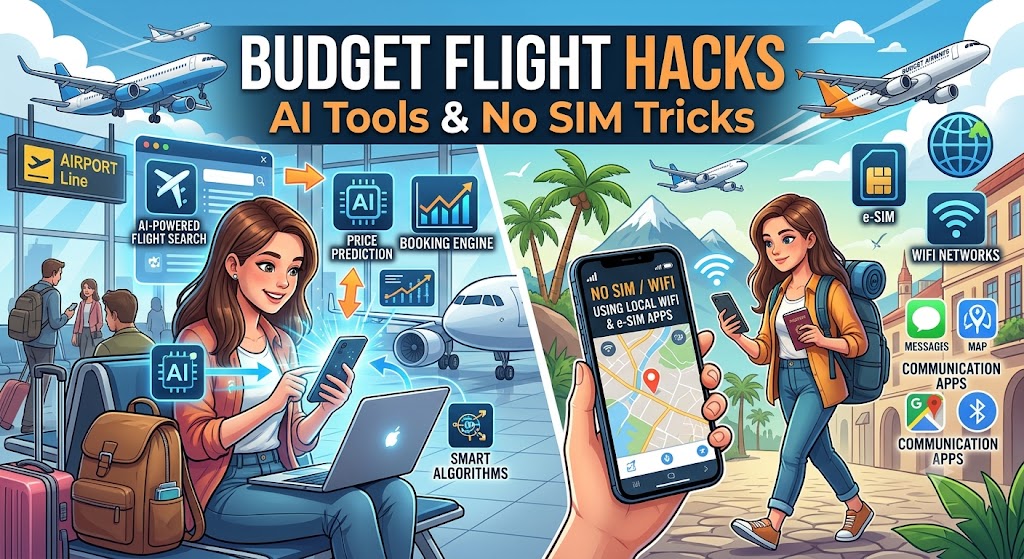
Mastering Flight Hacking in 2026: AI Price Alerts, Hub Routing Secrets & Scam-Proof Booking
The era of clearing your browser cookies on a Tuesday midnight to score a transatlantic flight for $200 is dead. Anyone repeating that advice in 2026 is peddling nostalgia from an aviation landscape that ceased to exist five years ago. Today, global airline pricing is governed by deep-learning revenue management systems operating on continuous pricing engines. Instead of relying on traditional 26-letter booking fare classes (buckets like Y, B, M, or K), legacy and ultra-low-cost carriers alike deploy real-time New Distribution Capability (NDC) feeds that calculate price elasticity in milliseconds.
These algorithmic models evaluate your historical route searches, aggregate macro-demand signals, adjust for spot jet-A fuel contracts, and even cross-reference live regional weather volatility before presenting a fare. If you try to outsmart a continuous pricing neural network using manual searches, you are bringing an abacus to a quantum computing match.
Beating the system now requires equal sophistication. Flight hacking has shifted from folklore to precision engineering: running predictive AI models, mapping multi-ticket itineraries through unindexed shadow hubs, leveraging Fifth Freedom commercial agreements, and insulating yourself from a wave of synthetic travel agency fraud. This guide details the verified protocols required to secure rock-bottom fares across the globe without putting your identity, your capital, or your loyalty accounts at risk.
The 2026 Pricing Machine: How Continuous Pricing Defeated Old Tricks
To break an algorithm, you must first understand its parameters. Until recently, airlines were constrained by the legacy Global Distribution Systems (GDS)—namely Sabre, Amadeus, and Travelport. In that legacy architecture, airlines published fixed tariffs via ATPCO (Airline Tariff Publishing Company). If the cheap “T-class” bucket sold out, the inventory abruptly jumped to the “Q-class” tier, generating noticeable, predictable price steps.
Continuous pricing eliminated these structural steps. By leveraging IATA’s NDC protocol, carriers now generate dynamic price points along a completely smooth mathematical curve. If an airline notices marginal spikes in demand for a London-to-Tokyo route on a Thursday morning, the fare does not climb in rigid $80 increments; it drifts upward penny by penny, dynamic to the minute.
Furthermore, behavioral profiling has become remarkably sophisticated. Even without relying on third-party tracking cookies—largely obsolete in modern browsers—airlines and online travel portals employ device fingerprinting, canvas rendering tests, session latency evaluation, and cross-device graph matching. If their systems determine you are searching for flights from an IP address affiliated with a high-income corporate business park via a high-end mobile device, your quoted baseline fare can subtly diverge from that shown to a user browsing on a five-year-old desktop from an educational subnet.
Key Signals Modern Airline Pricing Engines Track:
- Search Velocity: The total frequency of queries submitted for a specific city-pair within a rolling 60-minute window across all global consumers.
- Device Fingerprinting: Canvas hash, OS build, timezone offset, battery degradation API readings, and peripheral inputs that construct a near-unique hardware ID without cookies.
- Cart Abandonment Patterns: Whether your session halted at the seat selection phase, the baggage upsell screen, or the payment gateway, indicating willingness to buy.
- Synthetic Competitor Scraping: Continuous real-time adjustments counteracting automated data scraping runs launched by rival airline pricing bots.
Weaponizing Autonomous AI Price Alerts & Custom Trackers
Because dynamic pricing runs constantly, human eyes can no longer monitor the market effectively. Finding exceptional value demands autonomous alerting systems calibrated to distinguish true market anomalies from transient $5 dips.
Standard consumer tools like basic Google Flights notifications or generic Kayak alerts remain useful, but they present a critical flaw: latency. By the time a standard consumer platform updates its cache, generates a bulk email digest, and delivers it to your inbox, the underlying algorithmic anomaly has frequently been identified and corrected by the airline’s revenue integrity teams.
Configuring Predictive Scraping Over Reactive Alerts
The modern flight hacker utilizes webhook-driven monitoring pipelines. By leveraging developer APIs or automated browser automation platforms (such as low-code Puppeteer instances or specialized AI travel agents), you can monitor route bands rather than rigid dates.
Instead of tracking “New York (JFK) to Paris (CDG) departing June 12 and returning June 20,” a high-efficiency alert matrix monitors “Any secondary or primary co-terminal in the Northeast US (JFK, EWR, BOS, PHL) to any hub within 500 rail-kilometers of Paris (CDG, ORY, BRU, AMS, FRA) across any 7-to-11-day window between May 20 and July 5.”
When you feed these parameters into an automation framework connected to an instant push channel (like a private Telegram bot, Discord webhook, or direct SMS gateway), you circumvent the consumer notification lag. You receive the alert the moment an ATPCO misfiling or an NDC continuous curve collapses, allowing you to lock in the reservation inside the airline’s 24-hour voiding window before automated patch-scripts fire.
Calibrating Volatility Indexing
Do not set your notification triggers to simple static dollar thresholds (e.g., “Alert me when fare < $600”). Instead, calibrate your agents to look for standard deviation drops. A true anomaly occurs when a fare falls at least 2.5 standard deviations below the 90-day moving average for that specific seasonal route profile. This filters out the constant white noise of standard sales and isolates genuine fare calculation errors, unintended promotional code leaks, and dynamic inventory surpluses.
The Shadow Hub Architecture: Beyond Traditional Layover Booking
If you search for a flight from Chicago to Singapore, traditional flight aggregators query direct itineraries or high-visibility single-stop carrier connections (e.g., Chicago to Singapore via Doha on Qatar Airways, or via Tokyo on ANA). These legacy routings carry high demand and are priced aggressively to capture passenger convenience premiums.
The flight hacker bypasses these trunk lines by adopting the Shadow Hub Architecture. A shadow hub is a high-volume, hyper-efficient secondary or regional transit node that handles massive domestic or low-cost carrier (LCC) traffic, rarely marketed by legacy airline alliances as an international transit gateway.
Deconstructing the Western European Shadow Hubs
Direct flights into major capitals carry some of the world’s steepest aviation taxes and landing fees. London Heathrow’s Air Passenger Duty (APD) and Frankfurt’s steep environmental taxes significantly increase ticket prices. However, continental Europe is stitched together by high-speed rail and aggressive point-to-point carriers.
Instead of booking direct into London or Paris, route your intercontinental long-haul segment into secondary gateways with low airport tariffs—such as Milan Malpensa (MXP), Dublin (DUB), or Madrid-Barajas (MAD). From these entry points, you can deploy a disconnected regional carrier flight or a rail connection to reach your actual destination. A long-haul routing from North America into Dublin often prices out hundreds of dollars lower than an identical journey terminating in London, even after calculating the secondary hop across the Irish Sea.
Asia-Pacific Transit Splitting
In Southeast Asia, long-haul pricing to regional lifestyle capitals like Bali, Phuket, or Da Nang carries heavy tourist surcharges. By splitting your ticket through global megahubs that simultaneously serve as massive domestic LCC bases—specifically Singapore (SIN), Kuala Lumpur (KUL), or Bangkok Suvarnabhumi (BKK)—you can exploit decoupled regional economics.
Booking a transpacific flight into Singapore and independently securing an onward connection via Scoot, AirAsia, or VietJet to your final destination routinely slices 35% to 55% off the unified itinerary cost. However, this strategy requires strict adherence to self-transfer protocols.
The Mechanics of Split-Ticketing and Protected Self-Transfers
When you purchase two separate tickets across unassociated carriers, you exist in the airline ecosystem as two distinct passengers with separate Passenger Name Records (PNRs). If Carrier A experiences a mechanical delay and you miss your outbound flight on Carrier B, Carrier B considers you a standard no-show. Your ticket is forfeited, and your downstream segments will be cancelled.
To safely execute split-ticketing in 2026, you must build resilience into the itinerary:
- The 4-Hour Minimum Buffer: For international self-transfers, never schedule an onward connection under 240 minutes. If you have checked luggage, you must pass through border control, claim your bags from the carousel, change terminals, clear security, and re-check with the onward carrier.
- Dedicated Self-Transfer Travel Insurance: Certain independent policies and niche booking platforms (such as select virtual interlining services) provide missed-connection protection for disparate PNRs. Ensure your policy covers dynamic carrier delays, not merely medical emergencies or outright cancellations.
- Same-Alliance Contingencies: Whenever possible, build split tickets within carriers of the same alliance (Star Alliance, oneworld, SkyTeam). While not contractually mandated to re-accommodate split-ticket passengers, check-in agents frequently possess the manual GDS override capability to check bags through to the final destination if both tickets are clearly displayed during origin check-in.
Unlocking Hidden-Value Fifth Freedom Flights
One of the most overlooked opportunities in commercial aviation stems from international aviation agreements known as the Freedoms of the Air. The most lucrative for travelers is the Fifth Freedom: the right of an airline to carry revenue passengers between two foreign countries as part of an itinerary that begins or ends in the airline’s home nation.
Because the primary revenue engine of these long-haul operations depends on the core long-haul trunk, carriers often struggle to fill the shorter intermediate tag segments. To boost load factors, airlines price these Fifth Freedom legs at drastic discounts, often supplying flagship widebody aircraft and premium amenities on routes dominated by cramped regional planes.
High-Yield Fifth Freedom Routes to Exploit:
- Newark (EWR) to Athens (ATH) on Emirates: A seasonal transatlantic link that provides exceptional baseline economy and business class options directly bypassing European flag-carrier cartels.
- Singapore (SIN) to Bali (DPS) on KLM: Flying a Dutch carrier on an Indonesian regional hopper provides full-service widebody comfort often priced cheaper than regional low-cost carriers once baggage fees are added.
- New York (JFK) to Frankfurt (FRA) on Singapore Airlines: Experience one of the planet’s most refined long-haul products across the Atlantic Ocean, routinely undercutting US and German legacy carriers on the exact same city-pair.
- Madrid (MAD) to Santiago (SCL) via regional South American hops on LATAM: High-yield domestic-style pricing integrated into long-haul intercontinental segments.
The Realities of Skiplagging (Hidden City Ticketing) in 2026
Hidden city ticketing—booking an itinerary from City A to City C with an intentional layover in City B, where you abandon the remainder of the ticket—remains one of the most contentious tactics in the travel industry. It works because hub-and-spoke airline pricing is determined by market demand for the route, not the distance flown or the quantity of fuel burned.
Historically, this was simple: carry on your luggage, get off at the hub, and leave the airport. In 2026, the operational landscape is far more perilous.
The Technological Retaliation Against Hidden City Bookings
Airlines have upgraded their behavioral identification algorithms. If a passenger repeatedly books itineraries and disappears at a connecting hub, the revenue integrity management engine marks the PNR. Carriers now actively leverage:
- Automated Loyalty Clawbacks: If you attach your frequent flyer number to a hidden city itinerary, the carrier’s software will automatically audit your travel history. First offenses routinely result in the immediate forfeiture of accumulated points and status levels. Repeat offenses often trigger total mileage balance cancellations.
- Automated Civil Invoicing: Major carriers, particularly throughout North America and Europe, have established clear terms in their Conditions of Carriage prohibiting the purchase of fares without the intent to complete all segments. Corporate travelers risk having their enterprise travel accounts billed directly for the difference between the hidden-city fare and the point-to-point ticket.
- Biometric Boarding Discrepancies: With facial recognition gates increasingly standard at global transit hubs, gate systems verify departing passengers in real time against the manifest of the connecting flight. If you walk out of the terminal instead of approaching your onward gate, your absence is logged immediately, making same-day, same-carrier return tickets exceptionally risky.
The Golden Rules of Hidden City Booking (If You Must Engage):
- Never Attach a Frequent Flyer Number: Forego mileage accrual entirely to break the direct algorithmic tie to your broader loyalty identity.
- Absolute Carry-On Compliance: If your carry-on bag is gate-checked at the regional departure gate because overhead bins are full, it will be checked through to your final ticketed destination. You will watch your luggage fly to City C while you exit at City B. Carry a single, low-profile bag guaranteed to fit underneath the seat in front of you.
- One-Way Itineraries Only: The moment you miss any intermediate segment on an airline ticket, the reservation engine automatically invalidates and cancels every subsequent segment remaining on that PNR. Never attempt skiplagging on a round-trip ticket.
- Do Not Abuse the Same Route: Executing this strategy once every two years across different carrier alliances represents negligible statistical risk. Executing it monthly on a primary hub will trigger security review and passenger bans.
Scam-Proofing Your Bookings: The Synthetic OTA Landscape
As flight pricing dynamics have grown more complex, the threat landscape has expanded exponentially. The emergence of automated large-language-model coding frameworks has unleashed an unprecedented volume of synthetic Online Travel Agencies (OTAs). These rogue portals mirror legitimate metasearch results, offering impossibly cheap fares designed specifically to harvest credit card data, extract predatory hidden processing markups, or drop passengers into customer service black holes.
Deconstructing the “Bait-and-Switch NDC” Scam
A prevalent scam involves aggregators displaying fares that no longer exist. You search for an intercontinental ticket, discover a rate 30% below any legitimate carrier, and input your personal identifying information alongside your payment details. The rogue platform processes a temporary pre-authorization, then sends an automated message stating: “The requested fare class has sold out; our concierge team is holding your seat, please pay an additional $185 to finalize ticketing.”
In reality, the agency never possessed the seat at the advertised rate. They intentionally run search engines designed to harvest demand, locking you into an non-refundable customer relationship while using high-pressure tactics to force secondary payments.
The Rogue Ticketing Verification Checklist
Before submitting payment information to an unfamiliar aggregator or third-party seller discovered via price comparison tools, run through this operational defense checklist:
- Verify IATA/ARC Accreditation: Authentic travel agencies operating legally possess an active International Air Transport Association (IATA) number or an Airlines Reporting Corporation (ARC) accreditation. Search the provider’s site for these credentials, and verify them via official registry lookups. If this information is missing, terminate the session.
- Analyze the Merchant Category Code (MCC): High-risk platforms occasionally run charges through unrelated, unregulated international MCCs (such as digital utility services or general merchandise retail) to evade payment network chargeback protocols. Use a credit card with real-time push verification showing the merchant name and processing category.
- Demand the Instant Airline PNR: An authentic booking generates an alphanumeric 6-character PNR directly within the airline’s reservation system (e.g., Sabre, Amadeus) almost immediately, not merely an internal agency booking reference. If your confirmation does not provide a direct carrier PNR verifiable on the operating airline’s official website within 60 minutes, file an immediate payment dispute.
- Deploy Virtual Credit Cards (VCCs): When transacting with non-primary booking sites, never deploy your physical primary debit or credit card number. Use dynamic tokenized virtual cards (available via major fintech and banking platforms) set with a hard spending cap precisely equal to the quoted ticket price and configured to auto-terminate post-transaction.
Strategic Comparison: Flight Hacking Methodologies
Not all flight hacking techniques carry the same balance of effort, financial yield, and travel risk. Use the comparative matrix below to select the appropriate vector for your operational needs.
| Strategy | Typical Savings | Technical Complexity | Risk Level | Primary Operational Pitfall |
|---|---|---|---|---|
| Shadow Hub Decoupling | 25% – 50% | Moderate | Low | Missed connections on separate PNRs during operational delays. |
| Fifth Freedom Booking | 20% – 40% | Low | Very Low | Limited route availability; requires flexible positioning. |
| AI Webhook Alert Sniping | 30% – 70% | High | Low | Airlines voiding mistake fares within the 24-hour review window. |
| Dynamic Currency Arbitrage | 5% – 15% | Moderate | Low | Foreign transaction fees eating into paper arbitrage margins. |
| Hidden City (Skiplagging) | 30% – 60% | Low | High | Gate-checked luggage, loyalty account bans, canceled returns. |
The 2026 Flight Hacker’s Step-by-Step Booking Protocol
To consistently secure top-tier value without exposing yourself to travel disruption, follow this chronological workflow every time you plan an international flight.
Phase 1: Macro-Scouting and Broad-Band Scouting
Do not begin by selecting specific dates. Open an unconstrained multi-city aggregator to map broad seasonal baseline costs across your target continents. Locate which major secondary hubs currently exhibit suppressed pricing trends. Identify whether any Fifth Freedom routes intersect your trajectory.
Phase 2: Shadow Network Construction
Map your journey as two separate components: The Long-Haul Core and The Regional Tag. Seek the lowest possible intercontinental bridge between major hub regions. Once that bridge is locked, search local point-to-point rail links, regional low-cost carriers, or regional bus lines to traverse the final 200 to 500 miles. Build at least four hours of transit buffer into any self-transferred segment.
Phase 3: Automated Price Tracking Integration
Once you isolate the 2 to 3 acceptable route architectures, establish your autonomous trackers. Set your alerting webhooks to trigger exclusively on standard deviation price movements rather than nominal discounts. Prepare your booking accounts, travel documents, and payment methods in advance so you can act immediately when a downward anomaly occurs.
Phase 4: The 12% Rule for Direct Carrier Conversion
When you locate your target flight at an exceptional rate via a third-party aggregator or OTA, cross-reference the cost directly on the operating carrier’s website. If the direct airline price is within 10% to 12% of the OTA rate, book direct every single time.
That 10% to 12% margin serves as your ultimate travel insurance. When flights are delayed, canceled, or disrupted, airlines prioritize passengers who purchased tickets directly through their own channels. Passengers holding third-party tickets booked via cut-rate OTAs are consistently pushed to the back of the queue, instructed to manage changes through their booking agent, and excluded from self-service re-accommodation tools in the airline’s app.
Phase 5: Post-Purchase Validation
The instant your booking completes, take three immediate actions:
- Log into the operating airline’s official portal using the provided 6-character PNR. Confirm that the status is listed as “Ticketed” or “Confirmed” and that an actual 13-digit ticket number (e.g., 016 for United, 006 for Delta, 176 for Emirates) has been issued.
- Select your seats immediately. In the modern NDC framework, an unselected seat on an anomalous fare increases your vulnerability to involuntary bumping if the flight is overbooked.
- Set a calendar alert for 23 hours post-purchase. In jurisdictions like the United States, regulations require full refunds within 24 hours for bookings made at least seven days prior to departure. Use this final day to monitor if competing carriers drop their rates to match the anomaly you captured.
Frequently Asked Questions
Does searching for flights repeatedly from the same device really increase the price?
Yes, but not through the simplistic cookie-tracking mechanisms of the past. Modern airlines utilize continuous pricing engines that track regional search velocity across thousands of users simultaneously. If a route experiences a sudden surge in search volume, the system automatically shifts inventory up the dynamic pricing curve. Furthermore, sophisticated device and network fingerprinting can identify high-intent return visitors, occasionally holding lower inventory tiers back while displaying higher-tier baseline rates.
Is hidden city ticketing illegal in 2026?
Hidden city ticketing is not illegal under criminal law in most global jurisdictions; you cannot be arrested for getting off an airplane early. However, it represents an explicit violation of the contractual Conditions of Carriage you agree to when purchasing a ticket. While you break no laws, airlines possess the contractual right to terminate your frequent flyer account, confiscate accrued status and miles, cancel remaining flights on that itinerary, and in rare instances, pursue civil claims for the fare difference.
What is the safest way to protect myself from fake or rogue online travel agencies?
The most effective strategy is verifying that any agency possesses valid IATA or ARC credentials and paying exclusively with a virtual credit card (VCC) set with a single-use spend cap. Additionally, insist on an immediate 13-digit airline e-ticket number issued directly on the airline’s native reservation system. If an OTA cannot supply an airline-verifiable PNR within one hour of purchase, initiate an immediate dispute through your financial institution.
How do Fifth Freedom flights differ from standard international codeshares?
A codeshare is simply an agreement where an airline sells seats on a partner airline’s aircraft using its own flight number. A Fifth Freedom flight is an operational reality: an airline flies its own metal (its own aircraft, pilots, and cabin crew) between two entirely foreign countries before continuing to or returning from its home country. This yields premium long-haul aircraft configurations and service standards on unusual short-haul or mid-range global routes, frequently at highly competitive fares.
Can I check luggage when utilizing split-ticket itineraries?
You can check luggage, but you assume significant operational risk unless you have substantial layover times (minimum 4 to 5 hours for international connections). Because your tickets are split across two separate PNRs, your bags will rarely be transferred automatically between unaffiliated carriers. You must pass through immigration, claim your bags, change terminals, clear security, and re-check your luggage with the onward airline before their strict check-in closure cutoff times.