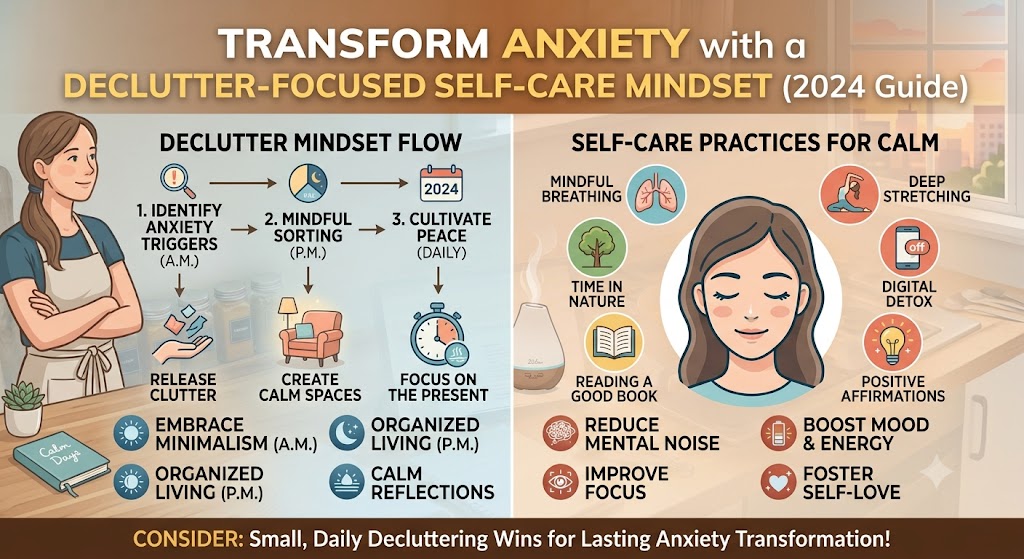
Anxiety often feels like a storm that never ends, but the space you live in can either amplify the turbulence or become a quiet harbor. By shifting to a self‑care mindset that prioritizes decluttering and short, intentional power pauses, you can rewire your stress response, lower cortisol, and reclaim mental clarity—all without leaving home. This guide walks you through the science, the step‑by‑step plan, and the tools you need to turn a messy room into a calming sanctuary.
Why Your Environment Fuels Anxiety
Brief neuroscience of clutter and stress
Neuroscientists explain that visual overload triggers the amygdala, the brain region that flags danger. When the eye scans a chaotic room, the brain receives a constant stream of unrelated stimuli, forcing the prefrontal cortex to work harder to filter information. This extra cognitive load keeps the sympathetic nervous system on high alert, which translates to higher heart rate and lingering anxiety.
Statistics linking messy spaces to heightened cortisol
Research published in Environment and Behavior found that participants who worked in cluttered offices exhibited a 12% increase in cortisol levels compared with those in tidy spaces. A 2023 survey by Verywell Mind reported that 68% of respondents felt “more stressed” after a day spent in a disorganized environment.
Real‑world examples from recent studies
Verywell Mind highlighted a study where college students who organized their dorm rooms saw a 30‑minute reduction in daily rumination time. Similar findings emerged from a UK home‑environment study that linked minimalism to improved sleep quality and lower anxiety scores.
Adopting a Self‑Care Mindset: Foundations for Change
Defining ‘self‑care mindset’ vs. occasional habits
A self‑care mindset is a durable belief system that treats daily choices as intentional acts of well‑being, not occasional indulgences. It means viewing each declutter session or pause as a strategic move toward mental health, rather than a one‑off chore.
Three core beliefs to internalize
- Control: You can influence how your surroundings affect you.
- Compassion: Mistakes are part of growth; be gentle with yourself.
- Consistency: Small, repeated actions build lasting neural pathways.
Mini‑exercise: mindset affirmation worksheet
Print a simple worksheet with three rows: What I control, How I’ll be compassionate, One consistent action today. Fill it each morning to reinforce the mindset before you begin any cleaning or pause practice.
The Decluttering Blueprint for Anxiety Relief
Step‑by‑step 7‑day declutter plan (room‑by‑room)
- Day 1 – Entryway: Remove shoes, coats, and mail you don’t need. Keep a single basket for daily essentials.
- Day 2 – Kitchen Counter: Clear all appliances except the coffee maker. Store utensils in a drawer organizer.
- Day 3 – Living Room Surfaces: Toss magazines, empty mugs, and stray cords. Add a decorative tray for remote controls.
- Day 4 – Bedroom Nightstand: Keep only a lamp, a book, and a glass of water.
- Day 5 – Closet: Apply the ‘joy vs. stress’ matrix (see below) to each garment.
- Day 6 – Home Office: Archive old paperwork, delete unnecessary files, and use cable clips.
- Day 7 – Bathroom Shelves: Consolidate toiletries, discard expired products, and use a single tray for daily items.
Prioritizing items: the ‘joy vs. stress’ matrix
Draw a simple 2×2 grid. The top‑right quadrant (high joy, low stress) stays. The bottom‑left (low joy, high stress) goes. Items in the top‑left (high joy, high stress) may stay if you can reorganize them; bottom‑right (low joy, low stress) can be stored elsewhere or donated.
Quick‑clean hacks for busy schedules
- Set a timer for 5 minutes and tackle one surface.
- Use a “one‑in, one‑out” rule: for every new item, remove an old one.
- Keep a microfiber cloth in each room for instant wipe‑downs.
Maintaining a clutter‑free zone long‑term
Schedule a 10‑minute “reset” at the end of each day. During this time, return misplaced items to their homes and note any recurring problem areas in a journal.
Power Pauses: The 3‑Minute Reset That Rewires Stress Responses
What a power pause is (origin & science)
The power pause originated in high‑performance sports, where athletes use brief, focused breathing to reset heart rate. Studies in the Journal of Occupational Health Psychology show that a 3‑minute diaphragmatic breathing session reduces perceived stress by 27% and improves attention.
Guided 3‑minute breathing & grounding routine
1. Sit upright, feet flat.
2. Inhale through the nose for 4 seconds, expanding the belly.
3. Hold for 2 seconds.
4. Exhale slowly through the mouth for 6 seconds.
5. Repeat for three minutes while gently pressing your thumb to your index finger to anchor the practice.
Integrating pauses into work, home, and transition moments
Place a pause timer app on your phone. Trigger it when you finish a meeting, after a stressful email, or before stepping into a clutter‑prone room. The brief reset signals the brain that the threat has passed, allowing the parasympathetic system to take over.
Combining Declutter & Power Pauses into a Daily Self‑Care Routine
Sample 20‑minute morning routine
- 5 minutes: Quick entryway tidy (put shoes away, clear mail).
- 3 minutes: Power pause breathing.
- 7 minutes: Targeted declutter of a single surface (e.g., kitchen counter).
- 5 minutes: Review mindset worksheet and set a micro‑goal for the day.
Evening wind‑down checklist
- Turn off all screens 30 minutes before bed.
- Spend 5 minutes clearing the bedroom nightstand.
- Do a 3‑minute power pause focusing on gratitude.
- Write one sentence in your stress journal about the day’s biggest win.
Printable habit tracker template
Download a free PDF that includes columns for “Declutter Zone,” “Power Pause,” and “Mood Rating (1‑5).” Tracking progress visually reinforces consistency and provides data for future adjustments.
Tools, Apps, and Resources to Support Your Journey
- Minimalist cleaning product kits – recommended tool that uses non‑toxic ingredients and reusable containers.
- Meditation & pause timer apps such as Insight Timer – set custom 3‑minute sessions.
- Free printable PDFs (worksheet, habit tracker) available on the TFS Daily resource page.
- Community forums where members share before/after photos and accountability partners.
FAQ & Common Pitfalls
What if I feel overwhelmed by the process?
Start with micro‑tasks: a single drawer or a 5‑minute timer. Celebrate each tiny win; the brain rewards completion with dopamine, which counteracts anxiety.
How to handle sentimental items without guilt?
Take a photo of the item, then place it in a “memory box” limited to 10 pieces. If the box fills, review and let go of the least‑valued pieces. This approach respects emotion while keeping physical clutter low.
When to seek professional help?
If anxiety persists despite environmental changes, consider therapy. Cognitive‑behavioral therapy (CBT) combined with a decluttered space often yields faster results than either method alone.
Conclusion: Measuring Progress & Celebrating Wins
Use simple metrics: a daily stress journal rating, before‑and‑after photos of a room, and the habit tracker’s consistency percentage. Review these weekly to see tangible improvement. By reinforcing the self‑care mindset, you transform your home into a proactive ally against anxiety, proving that a few minutes of intentional cleaning and breathing can create lasting calm.
Ready to start? Begin with today’s entryway, set your first power pause, and watch the ripple effect on your mind.