
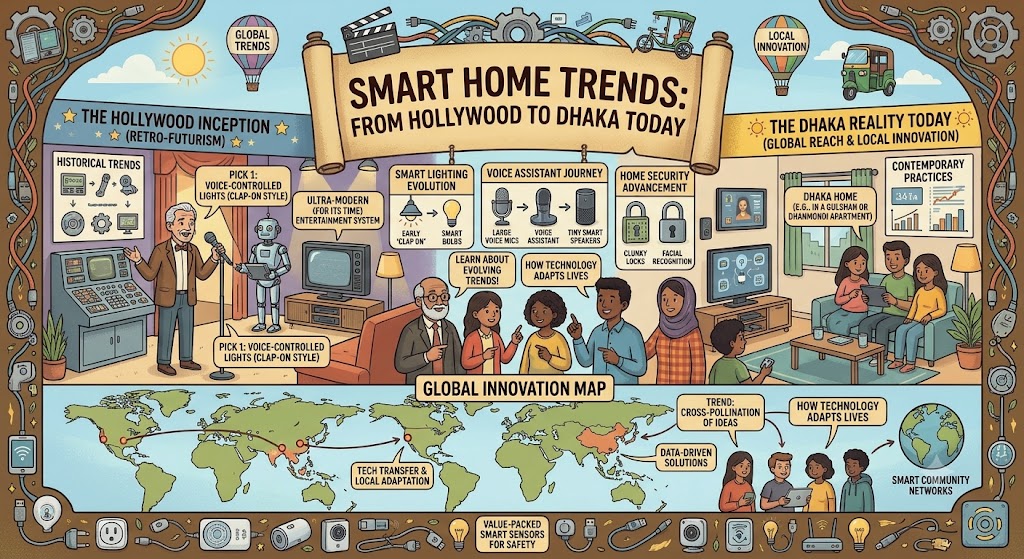
Smart Home Trends: From Hollywood to Dhaka Today
For decades, the idea of a house that thinks, talks, and anticipates our needs has lived in the realm of science fiction. Yet, the same dream that once fueled the futuristic sets of Blade Runner and The Jetsons is now a tangible reality for millions worldwide. This article traces the journey from Hollywood fantasies to the bustling streets of Dhaka, revealing how technology, culture, and sustainability converge to shape the homes of tomorrow.
Hollywood’s Blueprint: The Genesis of Smart Living
In the 1960s, The Jetsons introduced audiences to a family living in a floating, gadget-laden world. While the show was purely entertainment, it planted the seeds for what would become the modern smart home ecosystem. Consequently, the 1990s saw the first real-world attempts at home automation, with companies like Control4 and Crestron pioneering integrated control systems.
Moreover, the rise of the internet in the early 2000s accelerated this evolution. As broadband speeds improved, so did the feasibility of connecting household devices. Therefore, the 2008 launch of the Amazon Echo marked a pivotal moment, turning voice assistants from novelty into everyday utility.
However, Hollywood’s influence extended beyond technology; it also shaped consumer expectations. For instance, the seamless, almost magical interactions depicted on screen fostered an appetite for intuitive interfaces. Consequently, designers began prioritizing user experience, ensuring that smart devices were not just functional but also delightful.
In addition, the cultural impact of these portrayals cannot be overstated. As audiences grew accustomed to on-demand entertainment and instant gratification, they demanded the same level of convenience in their homes. Therefore, the market for smart home solutions expanded at an unprecedented rate, paving the way for the next generation of devices.
From Wired to Wireless: Technological Milestones
One of the most significant breakthroughs came with the adoption of Wi-Fi and Zigbee protocols. By standardizing communication, manufacturers could create interoperable ecosystems, allowing lights, thermostats, and security cameras to work in concert. Consequently, the user experience became more cohesive, reducing the friction that previously deterred many from adopting smart technologies.
Additionally, the integration of artificial intelligence (AI) has revolutionized how homes respond to occupants. Machine learning algorithms now predict patterns-such as when you typically wake up or how you adjust lighting-and adjust settings automatically. Therefore, energy efficiency and comfort are achieved simultaneously, offering tangible savings for homeowners.
Meanwhile, the proliferation of edge computing has addressed latency concerns. Rather than sending every command to the cloud, devices now process data locally, ensuring faster responses and enhanced privacy. Consequently, smart homes feel more immediate, mirroring the instant reactions seen in cinematic portrayals.
Moreover, the advent of 5G promises to further shrink the gap between expectation and reality. With ultra-low latency and massive bandwidth, future devices will support richer interactions, such as real-time video streaming from security cameras or immersive augmented reality experiences within the living space.
Key Takeaway: Connectivity is the backbone of smart living, and its evolution has turned speculative dreams into everyday conveniences.
Smart Homes in Dhaka: A Cultural and Economic Lens
Dhaka’s rapid urbanization has created a unique environment for smart home adoption. As the city grapples with congestion, pollution, and power instability, technology offers pragmatic solutions. Consequently, residents are turning to smart appliances to manage energy consumption and improve indoor air quality.
Furthermore, the local market has responded with affordable, localized solutions. For example, the kitchen appliances available on Amazon India provide energy-efficient options that cater to the region’s power fluctuations. Thus, homeowners can maintain culinary efficiency without compromising on performance.
In contrast, traditional home designs in Dhaka often feature open courtyards and high ceilings, which can be leveraged for passive cooling. Smart HVAC systems now integrate with these architectural features, optimizing temperature control while minimizing energy usage. Therefore, the synergy between design and technology is particularly pronounced here.
Meanwhile, the rise of e-commerce platforms has democratized access to smart devices. A quick search on Amazon India for home decor essentials reveals a plethora of smart lighting and décor options that enhance both aesthetics and functionality. Consequently, the boundary between style and smartness continues to blur.
Key Takeaway: In Dhaka, smart homes are not just luxury items-they are practical tools that address environmental and economic challenges.
Sustainability at the Core: Green Smart Living
Environmental consciousness has become a driving force behind many smart home innovations. For instance, smart thermostats now incorporate geofencing, learning when residents are away to reduce unnecessary heating or cooling. Therefore, households can significantly cut carbon footprints without sacrificing comfort.
Additionally, solar integration is gaining traction. Solar panels coupled with smart inverters allow homeowners to monitor production in real time, ensuring that excess energy is stored or fed back into the grid. Consequently, the push towards renewable energy aligns seamlessly with smart home ecosystems.
Meanwhile, water conservation has also benefited from automation. Smart leak detectors and flow-control valves alert residents to potential issues before they become costly problems. Thus, the combination of technology and sustainability creates a resilient living environment.
Moreover, the use of eco-friendly materials in smart devices-such as recycled plastics and biodegradable components-further reduces environmental impact. Therefore, the industry is moving toward a circular economy model, where devices are designed for longevity and easy recycling.
Key Takeaway: Sustainability is no longer optional; it is integral to the next generation of smart homes.
Security and Privacy: Protecting the Digital Household
As homes become increasingly connected, the risk of cyber intrusion rises. Consequently, manufacturers are embedding robust encryption protocols and regular firmware updates to safeguard sensitive data. Therefore, users can trust that their personal information remains protected.
Moreover, biometric authentication-such as facial recognition or fingerprint scanners-has become commonplace. These systems not only enhance security but also streamline access, eliminating the need for keys or passwords. In addition, many smart locks now support temporary access codes, ideal for guests or service personnel.
However, privacy concerns persist. Some users worry about the data collected by voice assistants and smart cameras. To address this, many vendors offer opt-in settings and local data processing options, ensuring that personal information stays within the household. Consequently, the balance between convenience and privacy is continually being refined.
In contrast, the regulatory landscape is evolving. Governments worldwide are introducing stricter data protection laws, which compel companies to be transparent about data usage. Therefore, compliance is becoming a competitive advantage, fostering trust among consumers.
Key Takeaway: Security and privacy are foundational pillars that must evolve alongside technological advancements.
The Future Frontier: What Lies Ahead?
Looking forward, the integration of Internet of Things (IoT) with blockchain promises unparalleled transparency and security. For instance, blockchain can verify the provenance of smart devices, ensuring authenticity and preventing counterfeit products.
Furthermore, the concept of “smart neighborhoods” is emerging, where entire communities share data to optimize resources like water, electricity, and waste management. Consequently, cities can become more resilient, adapting quickly to changing conditions.
Meanwhile, the rise of generative AI will allow homes to design personalized environments on the fly. Imagine a living room that rearranges its furniture layout based on your mood or a kitchen that suggests recipes based on available ingredients. Therefore, the line between physical space and digital experience will blur even further.
Moreover, as the global population ages, smart homes will play a pivotal role in enabling independent living. Features such as health monitoring, fall detection, and medication reminders will become standard, ensuring safety and peace of mind for seniors.
Key Takeaway: The future of smart homes lies at the intersection of technology, sustainability, and human well-being.
Frequently Asked Questions
1. What is the most essential smart device for a new homeowner?
While preferences vary, a smart thermostat is often the best starting point. It balances comfort with energy savings and can integrate with other systems like lighting and security.
2. Are smart homes secure?
Security depends on the manufacturer and how you configure settings. Opt for devices that support end-to-end encryption, regular updates, and robust authentication methods.
3. How can I keep my smart home affordable?
Begin with high-impact devices such as smart bulbs, switches, and a thermostat. Gradually expand your ecosystem, ensuring each addition aligns with your lifestyle and budget.
4. What are the environmental benefits of a smart home?
Smart devices optimize energy usage, reduce waste, and can integrate renewable sources like solar panels, leading to lower carbon footprints.
5. Where can I find reliable smart home products?
Amazon India offers a wide range of vetted smart home gadgets. For instance, check out wellness and fitness accessories that complement a holistic smart lifestyle.
6. How do I ensure my smart home respects my privacy?
Use devices that allow local data processing, enable opt-out for data sharing, and regularly review permissions to maintain control over your information.
7. Will smart homes replace traditional appliances?
Smart versions of traditional appliances are designed to enhance functionality, not replace them entirely. However, over time, the line will blur as more features become standard.
8. Can I install smart home devices myself?
Many devices are plug-and-play, but for complex integrations, professional installation ensures optimal performance and security.
9. How do smart homes contribute to safety?
Features like smoke detectors, carbon monoxide sensors, and automated lock systems provide real-time alerts and prevent accidents.
10. What is the future of smart home technology?
Expect deeper AI integration, blockchain security, and community-wide IoT networks that collectively create smarter, more resilient living environments.
In conclusion, the journey from Hollywood’s imagination to Dhaka’s streets illustrates how smart homes have transcended fantasy to become practical solutions for modern living. By embracing connectivity, sustainability, and security, homeowners worldwide can craft spaces that are not only intelligent but also resilient and deeply attuned to their needs. As technology continues to evolve, the smart home will remain at the forefront of shaping our daily experiences, proving that the future of living is indeed bright, connected, and remarkably human.


One thought on “Smart Home Trends: From Hollywood to Dhaka Today”
Comments are closed.