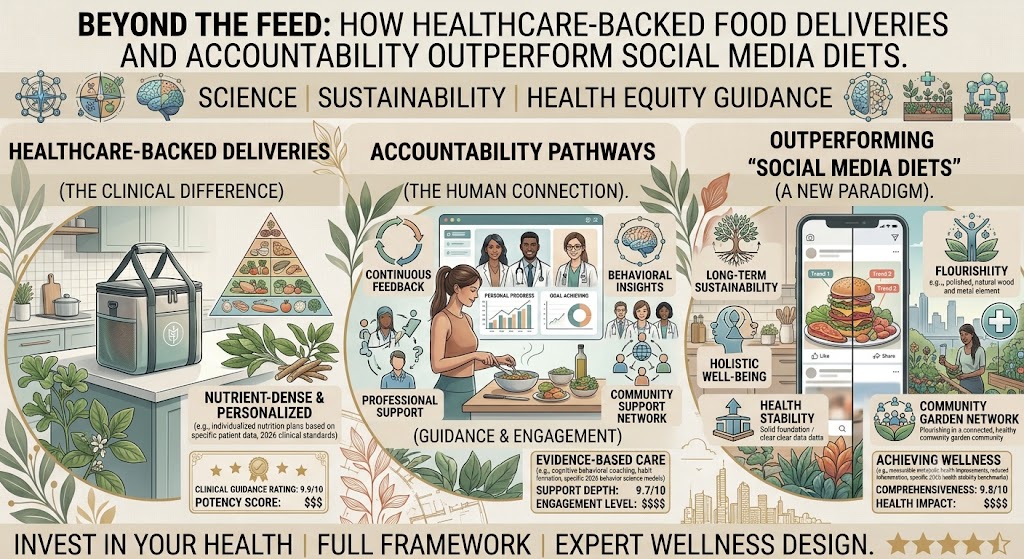
Beyond the Feed: How Healthcare-Backed Food Deliveries and Accountability Outperform Social Media Diets
Every morning, millions of individuals wake up, unlock their smartphones, and surrender their metabolic destiny to an algorithm. Within thirty seconds of scrolling, they encounter an avalanche of irreconcilable nutritional dogma: an influencer drinking raw dairy and claiming carbohydrates are toxic; a biohacker advocating for twenty-hour intermittent dry fasts paired with black coffee; a wellness creator promoting a powdered green elixir as the ultimate cure for systemic inflammation. These micro-targeted videos are visually captivating, emotionally compelling, and meticulously engineered to harvest attention.
They are also, by and large, failing our biology.
Despite the democratization of wellness advice across platforms like TikTok, Instagram, and YouTube, modern metabolic health metrics continue to degrade. Chronic lifestyle-driven diseases—including type 2 diabetes, non-alcoholic fatty liver disease (now metabolic dysfunction-associated steatohepatitis or MASH), cardiovascular conditions, and autoimmune flare-ups—are climbing at alarming rates. The disconnect is profound: never before has the public consumed more nutritional content, yet never before has the public experienced such profound metabolic dysfunction.
The fundamental breakdown does not stem from an information deficit; it stems from an infrastructure deficit. True metabolic transformation cannot occur in the ephemeral, deregulated space of social media feeds. Instead, a quiet clinical revolution is demonstrating that sustainable health outcomes demand two unglamorous, non-algorithmic components: clinically validated, healthcare-backed food delivery systems and objective, human-centered professional accountability. To understand why this combination consistently outperforms the viral diet of the week, we must examine the physiological, psychological, and logistical mechanics of how humans actually adopt and maintain dietary change.
The Epistemic Rot of Social Media Diets
To grasp why viral diets underperform, one must first analyze the incentives governing the platforms where they circulate. The primary directive of any algorithmic feed is not the optimization of your vascular endothelial function, gut microbiome diversity, or fasting insulin levels. Its sole directive is engagement. Engagement is disproportionately fueled by extremity, novelty, and aesthetic spectacle.
The Algorithmic Bias Toward Extremity
Moderate, evidence-based nutritional principles are terrible for social media growth. A nuanced post detailing that long-term cardiovascular health hinges on a high-fiber, minimally processed diet tailored to an individual’s personal lipid profile and renal status will never compete with a video claiming that eating exclusively ribeye steaks cured someone’s depression overnight. The algorithms favor binary narratives: good foods versus bad foods, miraculous cures versus toxic poisons. This creates an epistemic environment where nuance is suffocated, and radical interventions are promoted as universal panaceas.
Surrogate Endpoints and the Aesthetics Deception
Social media diets rely almost exclusively on visual surrogate endpoints: single-digit body fat, vascularity, filtered skin, and curated energy. Consumers routinely conflate an influencer’s visible rectus abdominis muscles with pristine biological health. This assumption is deeply flawed. Extreme caloric restriction, dehydration protocols, undisclosed performance-enhancing compounds, and genetic predispositions frequently mask severe underlying hormonal disruptions, dyslipidemia, elevated apolipoprotein B (ApoB), and bone mineral density loss.
When everyday individuals attempt to mimic these “What I Eat in a Day” routines, they apply a non-contextual, uncalibrated protocol to their unique physiology. The resulting mismatch frequently triggers the familiar cycle of initial water-weight loss, rapid metabolic adaptation, insatiable hunger, bingeing, psychological shame, and eventual weight regain—all with an added layer of self-blame.
Key Takeaway: The Social Feed Trap
- Algorithms optimize for virality and emotional arousal, not physiological equilibrium or biochemical individuality.
- Aesthetic markers shown on camera are unreliable indicators of metabolic, endocrine, or cardiovascular wellness.
- One-size-fits-all nutritional advice distributed to millions fundamentally ignores personal baseline biomarkers, comorbidities, and genetic variances.
The Infrastructure of Adherence: Why Delivery Trumps Inspiration
Dietary adherence is not a character trait; it is an environmental byproduct. Behavioral economics and cognitive psychology have demonstrated that human decision-making degrades under cognitive load, stress, and fatigue. The modern food environment—dominated by hyper-palatable, energy-dense, and nutrient-poor ultra-processed foods—is designed to exploit these moments of cognitive depletion.
Social media diets offer motivation, but motivation is a fleeting neurochemical state governed by dopamine. When motivation inevitably wanes at 7:30 PM on a rainy Tuesday, the individual is left staring into an empty refrigerator, forced to navigate the friction of meal planning, grocery shopping, ingredient prep, cooking, and cleanup. This friction is precisely where adherence collapses.
From Meal Kits to Medically Tailored Meals (MTMs)
Commercial consumer meal kits addressed part of this equation by delivering ingredients or prepared meals to the doorstep. However, commercial offerings are fundamentally market-driven: they optimize for customer retention through palatability, which often means masking poor nutritional density with excessive sodium, refined seed oils, added sugars, and elevated saturated fats.
In contrast, healthcare-backed food delivery systems—frequently categorized under the clinical umbrella of “Food is Medicine” (FIM), including Medically Tailored Meals (MTMs) and Medically Tailored Groceries (MTGs)—operate under entirely different constraints. These interventions are:
- Formulated to Clinical Guidelines: Meals are designed to meet rigorous, evidence-based criteria established by medical advisory boards, specializing in conditions like chronic kidney disease (CKD), heart failure, type 2 diabetes, and oncology recovery.
- Macronutrient and Micronutrient Precision: Sodium-to-potassium ratios, soluble versus insoluble fiber content, glycemic load, saturated-to-unsaturated fatty acid distributions, and bioavailable micronutrients are calculated with pharmaceutical-grade scrutiny.
- Friction Elimination: By placing fully prepared, clinically calibrated nutrition directly into the patient’s immediate physical environment, these systems radically alter the individual’s choice architecture. The default choice—the easiest, lowest-friction option—becomes the clinically optimal choice.
A landmark study published in JAMA Internal Medicine revealed that participation in a Medically Tailored Meal program was associated with significantly fewer hospitalizations and lower overall healthcare costs compared to a control group of non-participating individuals facing similar medical challenges. You cannot replicate those clinical outcomes with an influencer’s grocery haul video.
The Accountability Factor: Human Feedback vs. Parasocial Engagement
Nutrition science is dynamic, non-linear, and deeply personal. It does not exist in a vacuum separated from sleep, psychological stress, work schedules, relationship dynamics, and baseline metabolic health. One of the central flaws of social media dieting is its fundamentally one-directional nature: the creator broadcasts, and the audience passively consumes.
This creates a phenomenon known as parasocial accountability. An individual believes that by following an account, commenting on their posts, or purchasing their branded supplement stack, they are engaged in an active health transformation. In reality, the creator has no knowledge of the follower’s existence, no visibility into their biochemical markers, and zero legal or ethical responsibility for their clinical trajectory.
The Clinical Dietitian-Patient Nexus
Healthcare-backed delivery programs are increasingly integrated with genuine, bidirectional human accountability, typically anchored by Registered Dietitians (RDs) or clinical health coaches. This changes the structural dynamic of dietary change in several critical ways:
1. Dynamic Metabolic Calibration
The human body is an adaptive organism. When caloric intake or carbohydrate availability changes, thyroid hormone output, leptin, ghrelin, and non-exercise activity thermogenesis (NEAT) shift concurrently. A static social media plan cannot adjust when a patient’s weight loss stalls or when their low-density lipoprotein (LDL) spikes dangerously in response to a ketogenic intervention. Clinical accountability provides regular, structured checkpoints to interpret physiological feedback and titrate nutritional protocols in real time.
2. Objective Biomarker Tracking vs. Vanity Metrics
Social media diets measure success through the lens of subjective feelings and bathroom scale metrics. Healthcare-backed programs prioritize deep, objective diagnostics:
- Glycated Hemoglobin (HbA1c): Evaluating long-term glycemic control rather than transient fasting blood glucose spikes.
- Comprehensive Lipid Panels: Measuring ApoB, LDL particle numbers (LDL-P), and high-sensitivity C-reactive protein (hs-CRP) rather than just total cholesterol.
- Kidney & Liver Function: Monitoring glomerular filtration rates (eGFR), AST, ALT, and microalbuminuria to ensure nutritional therapies do not overload vital organs.
3. Psychological De-escalation and Behavioral Iteration
When an individual deviates from an extreme social media diet, they often experience what behavioral psychologists term the “what-the-hell effect”—a cognitive distortion where a minor dietary lapse leads to complete behavioral surrender. A registered clinician contextualizes lapses, prevents catastrophic thinking, identifies psychological or environmental triggers, and constructs actionable behavioral boundaries for the next scenario. This shifts the internal narrative from moral failure to scientific experimentation.
Direct Comparison: Algorithmic Diets vs. Healthcare-Backed Interventions
To fully grasp the divergence between these two approaches, we can evaluate how they operate across core structural parameters:
| Parameter | Social Media Diet Trends | Healthcare-Backed Delivery & Accountability |
|---|---|---|
| Validation Standard | Anecdotal claims, cherry-picked abstracts, aesthetic virality. | Randomized controlled trials (RCTs), clinical guidelines, peer-reviewed data. |
| Personalization Depth | Zero. Universal dictates broadcast to broad demographics. | High. Formulated around specific diagnoses, labs, allergies, and lifestyles. |
| Adherence Support | Pure willpower and motivational content; high cognitive and prep friction. | Nutritional infrastructure delivered direct-to-door; zero culinary prep friction. |
| Feedback Mechanism | One-way broadcast; validation via vanity metrics (scale, mirror). | Two-way clinical dialogue; verified via metabolic labs, CGMs, and health checks. |
| Sustainability Profile | Low. High attrition, metabolic adaptation, cyclical weight rebound. | High. Teaches lifestyle scaffolding; adapts dynamically as biometrics evolve. |
The Cost-Benefit Reality: Reallocating the Wellness Budget
A frequent pushback against clinically integrated food delivery and personalized accountability is financial cost. Without question, subscribing to a medically aligned meal delivery service and retaining a Registered Dietitian represents a visible monthly expense. However, viewing this through a narrow lens ignores the hidden, decentralized costs of the social media diet ecosystem.
Consider the typical spending pattern of a consumer trapped in the algorithmic wellness cycle:
- Unregulated Dietary Supplements: Nootropics, fat burners, adaptogenic mushroom blends, and detox teas costing anywhere from $150 to $400 per month.
- Food Waste: Hundreds of dollars spent on exotic ingredients, niche flours, and fresh produce purchased during a burst of enthusiasm, only to decay in the produce drawer when cognitive fatigue sets in.
- Commercial Meal Replacement Shakes and Bars: Hyper-processed “convenience” items marked up with massive retail margins.
- Downstream Medical Costs: The compounding long-term expenses of uncontrolled hypertension, escalating glycemic instability, pharmacotherapy, and lost productivity.
When individuals reallocate those disparate, low-yield financial outlays into a unified, medically tailored ecosystem, the economic calculation shifts dramatically. Furthermore, the healthcare industry itself is waking up to this arithmetic. Major insurers, Medicare Advantage plans, and progressive employers are increasingly offering partial or total coverage for Medically Tailored Meals and medical nutrition therapy (MNT) because the return on investment—demonstrated by reduced emergency room visits and improved chronic disease management—is indisputable.
How to Build a Clinical-Grade Nutrition System in Your Life
You do not need to wait for a total overhaul of the medical system to pull your nutritional strategy out of the social media gutter. You can apply the principles of healthcare-backed nutrition and objective accountability starting today. Here is an actionable framework to transition from algorithmic confusion to clinical precision:
Step 1: Establish Your Biochemical Baseline
Before changing a single calorie, obtain comprehensive objective data. Schedule an evaluation with a primary care physician or functional medicine specialist to run a full diagnostic panel:
- Comprehensive Metabolic Panel (CMP) and Complete Blood Count (CBC)
- Advanced Lipid Testing (including ApoB, LDL particle count, and Lipoprotein(a))
- Insulin Dynamics (Fasting Insulin, Fasting Glucose, HbA1c, and HOMA-IR calculation)
- Inflammatory Markers (High-Sensitivity C-Reactive Protein [hs-CRP])
- Nutrient Stores (Vitamin D3, Ferritin, Serum B12, RBC Magnesium)
These figures represent your ground truth. Any dietary philosophy that does not account for these numbers is shooting in the dark at your expense.
Step 2: Outsource Environmental Friction Strategically
Audit your weekly schedule and identify precisely where your nutritional integrity breaks down. For most working professionals and parents, it is not breakfast; it is midday work lunches or evening dinners. Instead of relying on raw willpower, deploy meal delivery services as tactical infrastructure.
Look for food delivery options that adhere to clinical nutrition frameworks rather than lifestyle trends. Prioritize services that:
- Clearly list all micro- and macronutrient specifications, including absolute sodium, potassium, and saturated fat grams.
- Eliminate seed oils, refined sugars, and hyper-processed fillers in favor of whole, minimally processed ingredients.
- Are designed or endorsed by an advisory board of physicians and Registered Dietitians, or specifically formulated for metabolic, cardiac, or renal support.
Step 3: Secure Non-Algorithmic, Human Accountability
Unfollow accounts that leverage aesthetic shaming, fear-mongering, or radical quick-fixes to sell programs. Replace that attention sink with direct, personal professional support. Retain a Registered Dietitian (RD or RDN) who specializes in your specific health goals or medical conditions.
If private clinical coaching is cost-prohibitive, explore virtual care platforms that bill Medical Nutrition Therapy (MNT) directly to your health insurance. Many preventative health provisions in modern insurance policies cover several visits with an RD per year at little to no out-of-pocket cost to the patient.
Step 4: Establish Closed-Loop Feedback Windows
A nutritional strategy should operate on an engineering feedback loop: Intervention → Adherence → Measurement → Recalibration. Commit to a specific, structured nutritional protocol for a defined window—typically 8 to 12 weeks. At the conclusion of that window, re-test your objective biomarkers.
If your markers improved, your strategy works, regardless of what an internet personality says about your chosen carbohydrate or fat intake. If your markers worsened or stalled, you and your clinical provider possess actionable data to guide the next iterative pivot.
Clinical Note and Medical Disclaimer
The information contained in this article is provided strictly for educational and informational purposes and does not constitute formal medical advice, diagnosis, or treatment. Dietary requirements vary substantially based on pre-existing conditions, medication interactions (such as anticoagulant therapy, insulin, or antihypertensives), and metabolic status. Always seek the direct guidance of a physician, registered dietitian, or qualified healthcare provider prior to implementing radical dietary changes, initiating medical food delivery protocols, or altering any prescribed medical therapies.
The Post-Feed Paradigm
The human body is an extraordinarily complex, self-regulating biological system that evolved over millennia in environments of real, physical scarcity. It was never equipped to process the infinite psychological noise of the digital attention economy, nor was it meant to navigate an artificial food supply engineered for compulsive consumption.
Social media diets treat health as performance art. They sell an aesthetic illusion decoupled from underlying biology, demanding immense willpower while offering zero logistical support. Healthcare-backed food deliveries and professional accountability reverse this flawed dynamic entirely. They remove performance, minimize friction, ground themselves in biological measurement, and supply the physical tools required for sustained execution.
It is time to move past the endless feed. Step away from the curated spectacle of aesthetic wellness, embrace the quiet utility of clinical infrastructure, and anchor your health in interventions that can actually be measured, sustained, and verified.
Frequently Asked Questions (FAQ)
What is the clinical difference between commercial meal kits and healthcare-backed food delivery?
Commercial meal kits are designed for the general consumer market and primarily prioritize taste, shelf-life, and cost-effectiveness. Consequently, they often contain elevated levels of sodium, saturated fats, refined oils, and hidden sugars to enhance palatability. Healthcare-backed food deliveries, such as Medically Tailored Meals (MTMs), are clinically formulated under the supervision of physicians and Registered Dietitians to treat or manage specific medical diagnoses (e.g., congestive heart failure, chronic kidney disease, type 2 diabetes). They adhere to strict nutritional guidelines, controlling for sodium-to-potassium ratios, glycemic impact, fatty acid profiles, and micronutrient densities.
Does health insurance cover medically tailored food delivery and dietitian coaching?
Coverage is expanding rapidly. Many Medicare Advantage plans, managed Medicaid programs, and progressive private commercial insurers now provide benefits for Medical Nutrition Therapy (MNT) with a Registered Dietitian, often at zero copay for patients with chronic conditions like diabetes, kidney disease, or cardiovascular disorders. Coverage for the actual meals varies: while traditional fee-for-service Medicare has historically limited meal coverage, many regional pilot programs, 1115 Medicaid waivers, and value-based commercial plans now cover Medically Tailored Meals post-hospital discharge or as part of chronic disease management programs.
Why do social media diets often produce rapid weight loss initially, only to fail later?
Most viral diets rely on severe macronutrient restriction (such as dropping carbohydrates dramatically) or extreme caloric deficits. In the first two weeks, a significant portion of weight lost is not adipose tissue (fat), but intracellular glycogen and its associated water weight (roughly 3 to 4 grams of water per gram of glycogen). Over time, severe restriction downregulates thyroid activity, reduces leptin, spikes ghrelin, and lowers non-exercise activity thermogenesis (NEAT). Because these diets lack individualization and environmental infrastructure, patients face overwhelming biological hunger cues paired with decision fatigue, typically leading to adherence collapse and rapid weight regain.
Can I transition off a healthcare food delivery service eventually, or will I become dependent on it?
The primary goal of pairing food delivery with professional clinical accountability is education and habit scaffolding. Delivery removes immediate friction during the critical early stabilization phase of metabolic repair. Working concurrently with a Registered Dietitian ensures that while you consume these meals, you are systematically learning how to read labels, navigate restaurant menus, structure balanced grocery lists, and prepare whole foods on your own. When patients choose to transition away from delivery services, the process is phased down iteratively rather than stopped abruptly, ensuring long-term self-efficacy.
How do I verify the credentials of an online nutritional coach or service?
Look for legally protected, board-certified clinical credentials. A “Registered Dietitian” (RD) or “Registered Dietitian Nutritionist” (RDN) has completed an accredited university degree, extensive supervised clinical residency hours, passed a national registration examination, and must maintain continuing professional education. In contrast, terms like “nutritionist,” “certified nutrition coach,” or “wellness guru” are largely unregulated titles in many jurisdictions and can be acquired through short, unaccredited online courses without any clinical training or legal accountability.