The 2026 Travel Destinations Guide: MICHELIN Key Stays, Bourdain-Style Eats, and Neuroinclusive Escapes
Travel in 2026 has reached a definitive turning point. The era of the algorithmically driven checklist vacation—where travelers queue forty minutes for a geotagged photo, eat at restaurants optimized for social media feeds, and return home exhausted—is collapsing under its own hollow weight. In its place, a more discerning, multi-dimensional traveler has emerged.
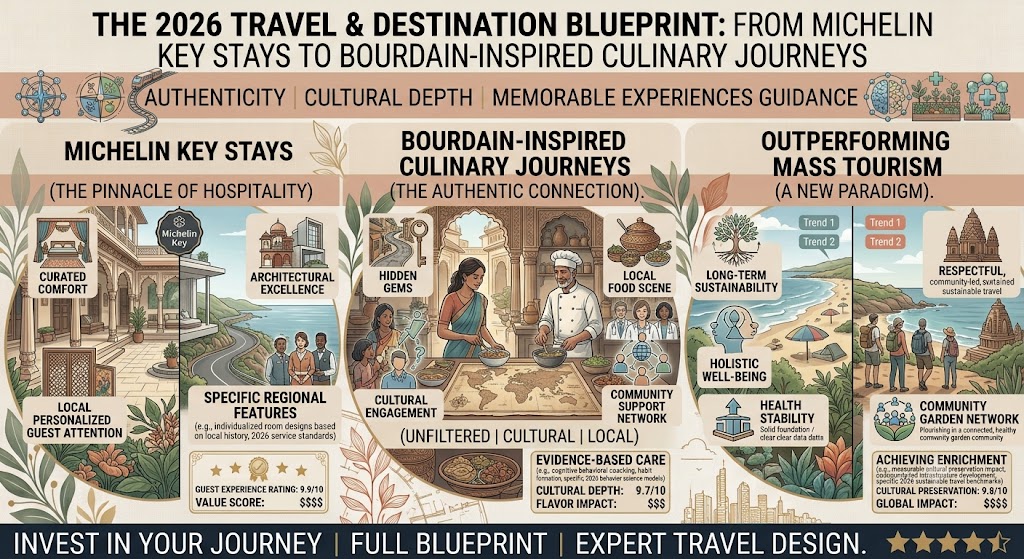
This traveler refuses to choose between comfort and grit. They demand the uncompromising hospitality benchmarked by the MICHELIN Key system, crave the unvarnished, smoke-filled street stalls celebrated by the late Anthony Bourdain, and prioritize psychological well-being through neuroinclusive and sensory-conscious spaces. Bringing these three seemingly disparate travel movements together is the blueprint for modern exploration: pairing design-led architectural sanctuaries with street-level culinary authenticity and itineraries designed to soothe rather than overwhelm the central nervous system.
Whether you are mapping an ambitious transcontinental expedition or an intentional regional retreat, this guide dissects the premier destinations, tactical strategies, and foundational philosophies defining the 2026 travel landscape.
Key Takeaways for 2026 Travelers
- The MICHELIN Key Standard: Accommodations are no longer evaluated solely on thread counts or infinity pools, but on architectural character, contextual personality, and seamless guest service.
- Unfiltered Culinary Exploration: The best dining experiences in 2026 bypass manicured celebrity kitchens in favor of multi-generational hawker stalls, market alleys, and rural taverns anchored in local heritage.
- Neuroinclusion Goes Mainstream: Forward-thinking destinations and properties now provide sensory guides, low-stimulation quiet zones, predictable logistics, and acoustic architecture for neurodivergent and sensory-sensitive travelers.
- The Hybrid Travel Method: Balancing high-sensory street exploration with low-sensory restorative stays creates sustainable travel rhythms that eliminate burnout.
Part 1: The MICHELIN Key Era—Hotels with Architectural Soul
When the MICHELIN Guide formally expanded its independent evaluation system to accommodations through the “MICHELIN Key” distinction (One, Two, and Three Keys), it fundamentally disrupted luxury hospitality. For decades, hotel stars were awarded largely on prescriptive amenities: Did the room have a dedicated turndown service? Was there a physical business center? Did the gym operate 24 hours a day?
The Key system evaluates properties through a far more holistic and aesthetic lens: architectural integrity, interior character, quality of maintenance, consistency of service, distinct individuality, and how deeply the property reflects its immediate geography. In 2026, these are the standout destinations where Key-recognized properties are reshaping regional travel.
1. The Oaxacan Coast & Central Valleys, Mexico
Oaxaca has long been a cultural touchstone, but its lodging ecosystem has matured into an architectural masterclass. South of the Sierra Madre del Sur, the coast between Puerto Escondido and Mazunte has embraced raw concrete brutalism softened by local parota wood and woven palm thatch.
- The Benchmark Stay: Look toward low-impact, design-forward coastal compounds such as Hotel Terrestre or Casa Silencio in the mezcal heartland of Santiago Matatlán. These properties reject air-conditioned hermetic sealing in favor of solar passive cooling, open-air stone baths, and deep integration with native flora.
- Why It Matters for 2026: These spaces act as cultural conservators. They don’t isolate you from Oaxaca; their materiality is made from the very earth you walk across.
2. The Alentejo Interior, Portugal
While the Algarve continues to struggle with overdevelopment and Lisbon navigates heavy tourism volumes, the Alentejo plains remain Portugal’s most poetic frontier. Characterized by cork oaks, ancient olive groves, and whitewashed villages, this region has become a sanctuary for adaptive-reuse design.
- The Benchmark Stay: Restored agricultural estates like São Lourenço do Barrocal demonstrate how a 200-year-old farming village can transform into a world-class, multi-Key retreat without losing its agrarian heartbeat. Guests sleep beneath vaulted brick ceilings, drink wine pressed from on-site vineyards, and navigate gravel paths scented with wild lavender.
- Tactical Tip: Visit between mid-April and late May, or late September through October. Summer temperatures in the Alentejo interior frequently surpass 40°C (104°F), pushing outdoor exploration to the extreme fringes of the day.
3. Kansai’s Mountain Sanctuaries, Japan
Japan’s high-speed rail lines make urban hopping effortless, but the country’s most exceptional Key-rated properties require winding mountain transfers into the interior prefectures of Nara, Mie, and Wakayama.
- The Benchmark Stay: From restorative forest ryokans in Yoshino to converted merchant warehouses in Asuka, properties here rely on woodcraft, tatami acoustics, and thermal onsen waters. The service ethos—omotenashi—is executed without theatrical performance, focusing entirely on quiet anticipation of guest needs.
| Distinction | Core Philosophy | Ideal Traveler Profile | Typical 2026 Setting |
|---|---|---|---|
| One Key | A truly remarkable stay with a distinct personality and clear local context. | Curious explorers wanting design and character over sterile chain standards. | Boutique urban conversions, design-forward coastal retreats. |
| Two Keys | An exceptional stay marked by memorable character, historic significance, or sublime architecture. | Design connoisseurs seeking memorable, landscape-integrated escapes. | Restored agricultural estates, secluded mountain ryokans, heritage castles. |
| Three Keys | The pinnacle of hospitality; an astonishing destination property worth a dedicated journey. | Travelers seeking flawless execution, transcendent privacy, and holistic care. | Remote private sanctuaries, world-defining architectural landmarks. |
Part 2: Bourdain-Style Eats—Raw, Visceral, and Grounded in Place
The late Anthony Bourdain taught a generation of travelers that food is never just fuel, nor is it a sterile aesthetic pursuit. It is an act of communion, a mirror of political history, and the most immediate entry point into the daily life of another human being. To eat “Bourdain-style” in 2026 does not mean recklessly seeking out shock-value ingredients; it means rejecting sanitized tourist zones, leaning into discomfort, and looking for the plastic stools, communal tables, and smoke-stained walls where working locals eat.
1. George Town and Ipoh, Malaysia
While Southeast Asia boasts exceptional culinary capitals, the urban corridor between Penang’s George Town and the limestone-ringed city of Ipoh remains an unrivaled epicenter of multi-generational street cooking. Here, Malay, Peranakan, Hokkien, Teochew, and Tamil culinary genealogies intersect across narrow shophouse corridors.
- The Plate to Hunt: In Ipoh, skip the polished cafes and seek out small morning coffee shops (kopitiams) serving hand-pulled white coffee paired with kai si hor fun—flat rice noodles swimming in an intense, clear broth rendered from chicken bones and prawn shells, topped with shredded poached poultry and chives.
- The Bourdain Ethos: You eat alongside retirees reading morning papers and logistics workers starting their shifts. The service is fast, loud, and devoid of performative charm. You pay in small cash, sit on low plastic furniture, and smell kerosene, charcoal, and broth simmering simultaneously.
2. Palermo’s Back-Alley Markets, Sicily
Palermo is chaotic, layered, and unapologetically stubborn. Its food culture is directly tethered to its Arab-Norman roots, best experienced within the narrow, labyrinthine alleys of the Ballarò, Capo, and Vucciria markets.
- The Plate to Hunt: Pane con la milza (or pani câ meusa in Sicilian dialect). At stalls like those run by generational vendors near the Piazza Caracciolo, beef spleen and lungs are boiled in cauldrons, sliced thin, fried in vast pans of rendered lard (strutto), and packed into a soft sesame roll with a squeeze of fresh lemon or a dusting of caciocavallo cheese.
- The Setting: Motorinos buzz inches from your elbows, vendors chant in guttural Sicilian cadences (l’abbanniata), and the pavement is slick with crushed ice and sea salt. It is immediate, sensory, and deeply honest.
3. Tainan, Taiwan
While Taipei commands global attention for its night markets, the southern city of Tainan is recognized by Taiwanese locals as the undisputed spiritual capital of food. Tainan’s food scene revolves around micro-specialization: stalls that have prepared a single dish for four generations and close the moment the daily prep runs out.
- The Plate to Hunt: Tainan Beef Soup (牛肉湯). Unlike slow-simmered western stews, local beef soup here depends on fresh, warm-carcass beef delivered directly from regional processing facilities in the early morning hours. Thinly sliced raw beef is dropped into a bowl, immediately scalded with a boiling broth infused with beef bones, ginger, and fruit, and served alongside a bowl of minced pork rice (lu rou fan).
- When to Go: 4:30 AM to 6:00 AM. If you arrive past sunrise, the prime cuts are gone, and the proprietors are scrubbing the stainless steel counters down.
Practical Rules for Finding Real Food in 2026
The ubiquity of crowdsourced review platforms has created a landscape where mediocrity is often rated five stars by undemanding tourists. Finding visceral, high-integrity food requires filtering out the digital noise with sharp, practical rules:
- The Single-Item Rule: If a kitchen makes noodles, roasted meats, dumplings, and sushi under one roof, walk away. Excellence at street level requires obsessive specialization. Look for vendors doing one thing: the grandmother roasting whole mackerel over binchotan, or the stall boiling beef tendons and nothing else.
- The Commuter Ratio: Look at the vehicles parked outside. If a stall is ringed by delivery vans, scooters, and municipal trucks at 11:45 AM, that kitchen sustains the community that keeps the city running.
- The Open-Fire Marker: Cooking with gas tanks or induction plates alters caramelization and smoke profiles. Wood embers, lump charcoal, and roaring wok burners powered by intense pressure valves produce depth, complexity, and honest wok hei (the breath of the wok) that cannot be faked.