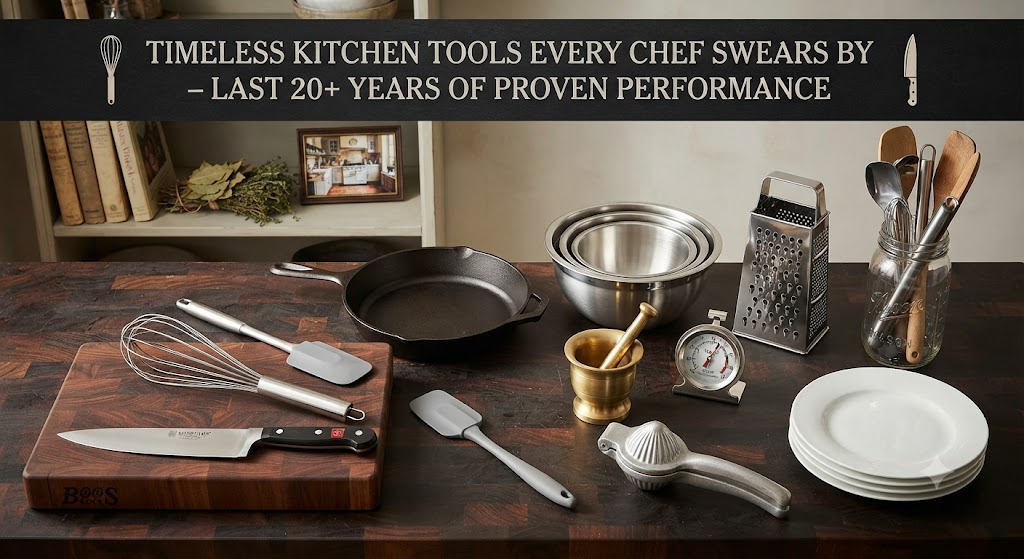
When you walk into a high-volume commercial kitchen, you won’t find battery-powered garlic peelers, flimsy plastic spiralizers, or unitaskers made of ultra-thin, stamped aluminum. Professional line cooks and seasoned chefs rely on an understated arsenal of timeless kitchen tools built on fundamental principles of material science, physical leverage, and extreme structural durability. These foundational items survive thousands of service hours, brutal heat cycles, and endless cycles through commercial dishwashers without warping, snapping, or losing their edge.
For the home cook, shifting your mindset from buying trendy, disposable gadgets to investing in durable kitchen tools is the single most transformative decision you can make for your culinary workflow. High-quality culinary equipment improves safety through control, yields better cooking results through thermal consistency and sharpness, and ultimately saves thousands of dollars over a lifetime of meal preparation. In this comprehensive guide, we examine the physics, material properties, and practical maintenance required to build a kitchen setup that lasts for decades—and perhaps outlives you.
Why Durability Beats Trendy Gadgets
The modern consumer market is flooded with single-purpose culinary gadgets designed primarily for impulse buys and social media virality. While a motorized avocado slicer or a cheap non-stick frying pan may seem convenient initially, they almost universally suffer from structural flaws: low-grade plastics, thin-gauge metals, glued joints, and non-replaceable mechanical wear points. Deciding to prioritize long-lasting culinary gear offers substantial financial, environmental, and practical advantages.
The True Cost-Per-Use Analysis
To understand why premium pricing for durable tools is actually the economical choice, you must calculate the true cost-per-use over time. Consider a standard non-stick skillet coated with PTFE (Teflon). Under normal home use, even high-end non-stick coatings degrade within 18 to 36 months as microscopic scratches, thermal shock, and fat polymerization ruin the non-stick surface. A typical consumer spends $40 on a mid-tier non-stick pan every two years, accumulating a cost of $500 over a 25-year period.
In contrast, a pre-seasoned cast-iron skillet or heavy-gauge carbon steel pan costs between $35 and $120 up front. Because cast iron and carbon steel do not rely on synthetic coatings and can be endlessly re-seasoned, their operational lifespan is virtually infinite. Over 25 years of daily use, a $50 cast-iron pan costs roughly $0.005 per cook, while delivering vastly superior heat retention and searing performance. The same principle applies to cutlery: a $150 forged high-carbon steel chef’s knife that is regularly sharpened will easily perform for 30 years ($0.01 per day), whereas a $30 box-set knife set made of soft stamped steel becomes dull, dangerously unstable, and landfill-bound within two years.
The Environmental Toll of Short-Life Kitchenware
The environmental footprint of disposable kitchen gear is substantial. Millions of discarded non-stick pans, melted nylon spatulas, and broken plastic garlic presses end up in municipal landfills every year. Synthetically coated cookware cannot be easily recycled due to the bonding of PTFE, ceramic nanoparticles, or silicone to base metals. Moreover, cheap synthetic spatulas and utensils often leach microplastics into high-heat preparations when subjected to temperatures exceeding their melting point.
By selecting solid materials like 18/10 stainless steel, sustainably harvested hardwoods, dense cast iron, and high-tensile food-grade silicone, you eliminate synthetic waste from your kitchen ecosystem. These tools either decompose naturally (in the case of wood) or are 100% recyclable metal alloys that retain intrinsic scrap value even after decades of service.
Real-World Reliability: Lessons from the Commercial Line
Professional chefs do not tolerate tools that fail during dinner service. A knife handle that snaps, a tongs spring that loses tension, or a pan handle that becomes loose during a busy Friday night line service presents a serious safety hazard and slows down food preparation. The tools that survive in commercial kitchens are stripped of extraneous mechanical parts, electronic screens, and non-essential moving joints. They rely on single-piece drop-forging, heavy-gauge wire, full-tang steel construction, and heavy-duty rivets. Bringing these exact commercial standards into your home kitchen ensures your equipment will handle daily family cooking with absolute ease.
Key Criteria for Identifying Timeless Tools
Before purchasing any piece of kitchen equipment, evaluating its construction against specific engineering standards allows you to filter out marketing fluff and spot true heirloom potential. If you are evaluating which best kitchen tools worth the investment belong on your counter, focus on these four physical criteria.
1. Material Science & Metallurgy
The foundation of any long-lasting tool is its atomic makeup. Understanding basic material grades prevents costly purchasing mistakes:
- Stainless Steel: Look for 18/10 (Type 304) stainless steel for pots, bowls, and measuring tools. The 18% chromium provides exceptional corrosion resistance, while the 10% nickel adds a deep luster and mechanical strength. For cutting tools, 18/10 is too soft; instead, look for high-carbon stainless steels such as X50CrMoV15 (German standard) or VG-10/SG2 (Japanese standard), which blend hardness (58–62 Rockwell C rating) with corrosion resistance.
- Cast Iron & Carbon Steel: High-carbon iron alloys containing 2% to 4% carbon retain immense thermal energy. Carbon steel contains around 1% carbon and is pressed or spun into lighter, smoother shapes than cast iron, making it the preferred material for high-heat woks and skillet pans.
- Silicone: Choose 100% platinum-cured silicone with no chemical fillers. Pure silicone withstands continuous heat up to 450°F–500°F (232°C–260°C) without leaching, degrading, or retaining food odors.
- Wood: Opt for closed-grain hardwoods such as Hard Rock Maple, American Walnut, or Cherry. Closed-grain woods prevent moisture from penetrating deep into the cellular structure, inhibiting bacterial growth and resisting splitting.
2. Construction Method: Forged vs. Stamped & Joint Strength
How a tool is formed dictates its resistance to physical stress. In cutlery and heavy tools, drop-forging—a process where a single billet of heated metal is pounded into shape under high pressure—aligns the grain structure of the metal, creating superior structural integrity, weight distribution, and edge retention compared to stamped sheet metal.
For handled tools, look for full-tang construction (where the metal blade extends continuously through the entire length of the handle) secured with solid triple rivets. Avoid tools where handles are attached with glue, light-duty spot welds, or shallow plastic press-fits, as structural fatigue and thermal expansion will inevitably break these joints.
3. Ergonomics and Universal Mechanical Design
A tool that is uncomfortably heavy or poorly balanced will sit unused in a drawer regardless of how long it lasts. True classic design features neutral ergonomics: handles shaped to accommodate various hand sizes and grip styles (such as the pinch grip used by professional chefs). Avoid overly sculpted finger grooves, which only fit a single hand size and restrict hand placement when shifting between different cutting tasks.
4. Repairability and Maintenance Access
The ultimate sign of a timeless tool is that its wear components can be restored rather than discarded. Knives can be re-sharpened and re-profiled on whetstones; cast-iron pans can be stripped of rust with steel wool and re-seasoned; wooden handles can be sanded smooth and re-oiled; stainless steel can be polished to remove heat stains. Avoid tools with non-removable electronic components, sealed battery compartments, or proprietary mechanical assemblies that render the entire tool useless if a single small component breaks.
Top 10 Timeless Kitchen Tools Every Chef Trusts
These ten core items form the backbone of both commercial line kitchens and serious home setups. Each of these chef approved kitchen tools offers proven longevity, high versatility, and outstanding performance across decades of continuous use.
1. 8-Inch Chef’s Knife (Forged High-Carbon Stainless Steel)
The 8-inch chef’s knife is the single most important tool in any kitchen, handling roughly 90% of all preparation work. A forged high-carbon knife features a thick bolster for hand protection, perfect balance at the heel, and a full-tang handle. High-carbon steel allows the edge to be ground to a razor-sharp angle while resisting chips during high-speed vegetable prep or protein trimming. When sharpened regularly on a waterstone, a quality 8-inch chef’s knife will last 30 years or more, outlasting dozens of cheap stamped knives.
2. Pre-Seasoned Cast-Iron Skillet
Virtually indestructible, a heavy-duty cast-iron skillet is unmatched for heat retention and non-stick performance when properly cared for. Capable of transitioning directly from high-heat stove burners to a 500°F oven, it is ideal for searing steaks, frying chicken, baking cornbread, and roasting vegetables. As you cook with fat over time, the pan builds a durable, non-stick layer of polymerized oil that improves with age. If you leave it out in the rain or allow it to rust, a simple scrub with steel wool and a fresh coat of oil baked at high heat brings a professional-grade cast iron skillet back to factory condition.
3. Heavy-Gauge Stainless-Steel Mixing Bowls
Thin aluminum or cheap plastic mixing bowls dent, warp, react with acidic foods, and absorb raw food odors. High-grade 18/10 stainless steel mixing bowls with wide flat bases and rolled rims are impervious to rust, thermal shock, and physical impact. Used for everything from whisking emulsions over double boilers to marinating meats and kneading dough, these bowls are completely non-reactive. Models equipped with tight-fitting silicone or BPA-free airtight lids double as permanent food storage containers, eliminating the need for disposable plastic wrap.
4. Heavy-Duty Silicone Spatula (Single-Piece Molded)
Traditional two-piece spatulas with wooden handles and removable rubber heads harbor food debris and water in the connection socket, leading to mold growth and handle separation. A single-piece molded spatula made of high-tensile, platinum-cured silicone wrapped around a rigid steel core eliminates these sanitary and structural flaws. Rated to resist heat up to 500°F, it will not melt when resting against a hot pan rim, will not scratch delicate cookware surfaces, and easily scrapes every bit of batter or sauce from bowl walls.
5. Professional-Grade Locking Tongs (Heavy Stainless Steel)
Often referred to as an extension of a chef’s own hand, commercial-grade spring-loaded stainless steel tongs are vital for flipping meats, turning roasted vegetables, tossing pasta, and pulling hot items from deep fryers. Look for models made from extra-thick 1mm or 1.2mm stainless steel featuring a heavy-duty pull-ring locking mechanism and scalloped metal edges. Unlike silicone-tipped tongs which can split over time, pure stainless steel tongs handle open flame grill cooking and high-heat pan searing without degrading.
6. Manual Swing-A-Way Can Opener
Electric can openers feature small plastic gears and electric motors that routinely fail within a few years of light home use. A classic, commercial manual can opener constructed from heavy-gauge nickel-plated or stainless steel uses hardened carbon steel gear teeth and a high-leverage crank handle. This design effortlessly pierces thick metal lids, operates without electricity, and requires nothing more than an occasional rinse and a drop of mineral oil on the gear pivot to function flawlessly for decades.
7. Precision Digital Thermometer (Calibrated Thermocouple Probe)
Overcooking protein is usually the result of guessing internal temperatures rather than measuring them precisely. An instant-read digital thermocouple thermometer delivers accurate temperature readings in under two seconds. Investing in an industrial-grade instant-read digital thermocouple thermometer featuring a sealed, water-resistant housing (IP67 rated) and field-calibration capability ensures you won’t throw away the unit if its sensors drift over time. Accurate readings prevent foodborne illness and guarantee perfect culinary execution on everything from medium-rare roasts to delicate caramel sugar work.
8. Multi-Tier Stainless Steel Steamer Basket
Steaming is one of the healthiest, fastest, and most delicate cooking methods for vegetables, seafood, and dumplings. Lightweight fold-out petal steamers often pop out their small hinge pins and fall apart after minimal use. A heavy-duty, multi-tier solid stainless steel steamer pot insert sits directly inside standard saucepans and stockpots. Constructed with thick perforated metal bases and sturdy riveted handles, it resists denting, allows rapid steam circulation, and washes completely clean in seconds without catching food in fragile wire meshes.
9. Stainless Steel Measuring Cups and Spoons with Etched Markings
Plastic measuring cups split when exposed to high heat, react with fat-soluble spice oils, and feature printed measurement numbers that rub off after a few runs through the dishwasher. A set of professional stainless steel measuring cups forged from single pieces of deep-drawn stainless steel avoids welded handle joints that pop off under pressure. Look for sets with permanently stamped or laser-etched markings rather than printed ink, guaranteeing you’ll always read precise ingredient volumes clearly even after thirty years of intense baking.
10. Classic Closed-Grain Hardwood Wooden Spoon
The humble wooden spoon remains one of the most useful stirrers in modern cooking. Wood is non-conductive (meaning the handle won’t heat up when left in a hot sauce pot), non-abrasive on all pan surfaces, and chemically inert. Spoons carved from dense, sustainably harvested hardwoods like American Hard Maple, Walnut, or European Beech resist cracking and splintering under heavy batch cooking. When periodically seasoned with food-grade mineral oil, a quality hardwood spoon acquires a rich patina and remains a reliable kitchen companion for life.
Comprehensive Tool Comparison
The chart below breaks down these ten essential, long-lasting kitchen tools by material composition, key durability features, and expected functional lifespan when properly maintained:
| Kitchen Tool | Ideal Material | Key Structural Feature | Expected Lifespan |
|---|---|---|---|
| Chef’s Knife | Forged High-Carbon Steel | Full-tang blade, riveted handle | 30+ Years |
| Cast-Iron Skillet | Heavy Cast Iron Alloy | Single-mold design, polymerized seasoning | 100+ Years (Heirloom) |
| Mixing Bowls | 18/10 Stainless Steel | Rolled rim, heavy-gauge base | 50+ Years |
| Silicone Spatula | Platinum Silicone + Steel Core | Single-piece construction, 500°F heat rating | 15–20 Years |
| Kitchen Tongs | 1.2mm Stainless Steel | Heavy-duty spring, pull-locking joint | 20+ Years |
| Manual Can Opener | Nickel-Plated Carbon Steel | Hardened gear teeth, high-leverage crank | 20+ Years |
| Digital Thermometer | IP67 Waterproof Polycarbonate | Calibratable thermocouple sensor | 10–15 Years |
| Steamer Insert | Solid Stainless Steel Insert | Perforated base, riveted handles | 30+ Years |
| Measuring Set | Single-Piece Stainless Steel | Stamped/laser-etched volumetric markings | 50+ Years |
| Wooden Spoon | Hard Maple or Walnut | Closed-grain, carved solid hardwood | 15–25 Years |
Maintenance Hacks to Extend Tool Lifespan
Even the highest-quality durable kitchen tools will degrade prematurely if subjected to improper cleaning, mechanical abuse, or destructive storage conditions. Extending tool lifespan requires matching specific maintenance procedures to each material type.
Knives: Sharpening vs. Honing and Proper Edge Care
The most common mistake home cooks make is using a dull knife or attempting to sharpen it with cheap pull-through carbide sharpeners. Pull-through sharpeners strip excessive steel from the blade face, leaving micro-serrations that ruin the geometry of the edge over time.
- Honing (Routine Alignment): Use a steel or ceramic honing rod before every cooking session. Honing does not remove metal; instead, it re-aligns the microscopic teeth along the edge that bend over during cutting contact with the board.
- Sharpening (Material Removal): Sharpen your knife 1–2 times a year using a dual-grit synthetic waterstone (such as 1000/6000 grit). Waterstones preserve the blade’s precise edge profile, bevel geometry, and overall life expectancy.
- Washing and Storage: Never place knives in a dishwasher. Dishwasher detergents contain aggressive abrasive salts and high heat that erode the blade steel edge and split wood/composite handles. Hand-wash immediately after use, dry completely with a cloth, and store on a magnetic wood strip rather than loose inside a cluttered utensil drawer.
Cast Iron and Carbon Steel Polymerization
Maintaining non-stick cast iron requires building and protecting a layer of polymerized fat:
- Cleaning: Wash the pan after use with warm water and a soft brush. Gentle dish soap is perfectly safe to use and will not strip true chemical seasoning (which is bound to the metal on a molecular level). Avoid abrasive steel scrubbers unless you intend to completely refinish the pan.
- Drying: Immediately dry the skillet thoroughly with a towel, then set it over medium burner heat on your stove for two minutes to evaporate any microscopic water trapped in the porous metal.
- Oiling: Apply 3 to 5 drops of a high-smoke-point oil (such as neutral oil or grapeseed oil) to the interior surface. Wipe it off vigorously with a clean paper towel until the pan appears dry before storing it in a low-moisture cabinet.
Conditioning Hardwood Tools
Hardwood spoons, rolling pins, and cutting boards lose their natural oils every time they encounter soapy water. When hardwood dries out completely, it absorbs ambient moisture quickly during the next wash, causing the grain to expand, warp, and split. Every month, apply a coat of food-grade mineral oil or a 50/50 mix of mineral oil and melted beeswax to dry wooden tools. Allow the oil to soak deep into the wood fibers overnight, then buff off the excess with a microfiber cloth. This creates a natural barrier that repels liquid water and prevents staining.
Stainless Steel Restoration
Over time, stainless steel pans and bowls can develop rainbow-colored thermal heat tints or stubborn white calcium scale buildup from hard tap water. Rather than scrubbing vigorously with coarse metal scouring pads that scratch mirror finishes, apply an oxalic-acid-based cleaner (such as Bar Keepers Friend). Oxalic acid safely dissolves mineral deposits, breaks down polymerized grease, and restores the brilliant luster of 18/10 stainless steel within seconds.
Buying Guide: Balancing Price, Brand, and Longevity
When shopping for long-lasting kitchen equipment, premium price tags don’t always translate to durability. Many consumer brands inflate prices through expensive lifestyle marketing, fancy packaging, or flashy aesthetics that add zero functional value to the tool.
Recognizing the Sweet Spot of Quality and Pricing
In almost every culinary tool category, there is a clear point of diminishing returns:
- Chef’s Knives: The durability sweet spot sits between $45 and $160. Within this bracket, you receive fully forged high-carbon German or Japanese steel with excellent heat treatments. Above $300, you are paying primarily for custom artisan Damascus patterns, exotic handle woods, and collector appeal rather than raw durability or cutting performance.
- Cookware: A professional 10-inch pre-seasoned cast-iron skillet costs $25 to $40 and will easily last 100 years. Pay extra for smooth finished cast iron or heavy-gauge 3-ply stainless steel pans ($90–$180), but avoid buying non-stick options priced above $60, as their non-stick coatings degrade at the exact same rate regardless of brand pedigree.
Evaluating Brand Warranties and History
Look for manufacturers that back their claims with limited or lifetime warranties. Brands like Lodge, All-Clad, Tramontina, Victorinox, Wüsthof, and Le Creuset maintain decades-long track records of replacing items damaged by structural manufacturing defects. A manufacturer offering a simple 90-day warranty on a $100 tool is sending a clear signal that they do not expect the item to handle sustained kitchen use.
Budget-Friendly Yet Durable Alternatives
Building a high-performance kitchen setup does not require maxing out your credit card. For home cooks looking for high durability without breaking the bank, selecting chef-approved kitchen tools under $50 provides high-performance utility that often outperforms high-end department store products.
1. Stamped High-Carbon Knives with Thermoplastic Handles
While forged knives are the gold standard for balance and weight, high-grade stamped knives made from high-carbon Swiss or German stainless steel offer identical edge retention at a fraction of the cost. Commercial line cooks frequently choose stamped utility and chef knives with slip-resistant, NSF-certified thermoplastic handles. They resist high heat, won’t harbor bacteria, and cost under $40, making them arguably the absolute best value performance choice in cutlery.
2. Carbon Steel Skillets Under $50
If you find heavy cast iron pans uncomfortable to maneuver with one hand, unenameled carbon steel skillets are an outstanding, lightweight alternative. Carbon steel heats up faster than cast iron, responds instantly to flame adjustments, and develops a natural non-stick patina through seasoning. Commercial carbon steel pans priced under $50 handle line duty seamlessly and deliver decades of searing performance.
3. Restaurant Supply Store Commercial Tools
One of the best secrets of professional chefs is buying basic kitchen utility items from local or online restaurant supply stores instead of high-end home goods retailers. Items like stainless steel sheet pans, wire cooling racks, mixing bowls, bench scrapers, and heavy wire whisks sold through commercial supply catalogs are built to strict industrial specs, lack unnecessary retail markups, and cost 50% to 70% less than equivalent department store products.
Frequently Asked Questions
Can I replace individual parts on commercial kitchen tools?
Yes. High-end, commercial-grade tools are often designed specifically with modular, replaceable parts. Commercial manual can openers feature inexpensive replaceable cutting gears and drive wheels. Industrial digital thermometers allow you to swap out damaged wire temperature probes without discarding the main housing unit. Professional spring-loaded tongs and mandoline slicers also offer replacement springs, blades, and guard assemblies through food service catalog suppliers.
How often should I re-season a cast-iron skillet?
Under normal cooking conditions, you rarely need to perform a full oven re-seasoning process on cast iron. As long as you cook regularly with fats and oils, clean the pan gently with warm water, dry it thoroughly, and wipe down the interior with a light layer of oil after each use, the non-stick seasoning layer builds continuously on its own. You only need to fully re-season a pan (by baking oiled iron at high heat upside down in an oven) if the existing coating is completely stripped away by acidic foods, scrubbed off with harsh steel wool, or rusted after long exposure to moisture.
Is there a universal warranty that covers all types of kitchen tools?
No universal warranty exists across different brands and retail categories. However, individual high-grade tool categories carry distinct warranty standards. Premium cookware brands frequently provide limited lifetime warranties against material defects, warping, and handle separation. Conversely, cutting edge degradation, natural wood surface wear, and normal non-stick finish abrasion are classified as standard operational wear and tear, meaning they are excluded from lifetime replacement guarantees across all manufacturers.
Final Verdict: Investing in Tools That Outlive You
Building a high-performance kitchen is not about filling every shelf with specialized appliances or following transient kitchenware trends. It is about thoughtfully selecting a lean core of timeless kitchen tools designed around structural integrity, high thermal tolerance, and physical durability. When you prioritize heavy-gauge 18/10 stainless steel, drop-forged high-carbon cutlery, dense closed-grain hardwoods, and versatile cast iron, cooking becomes safer, faster, and far more rewarding.
Instead of replacing cheap, broken kitchen accessories every few seasons, invest in heirloom-quality essentials that perform flawlessly year after year. Focus on basic materials, master a few straightforward maintenance habits, and build a lasting kitchen arsenal that serves you reliably for decades to come.